
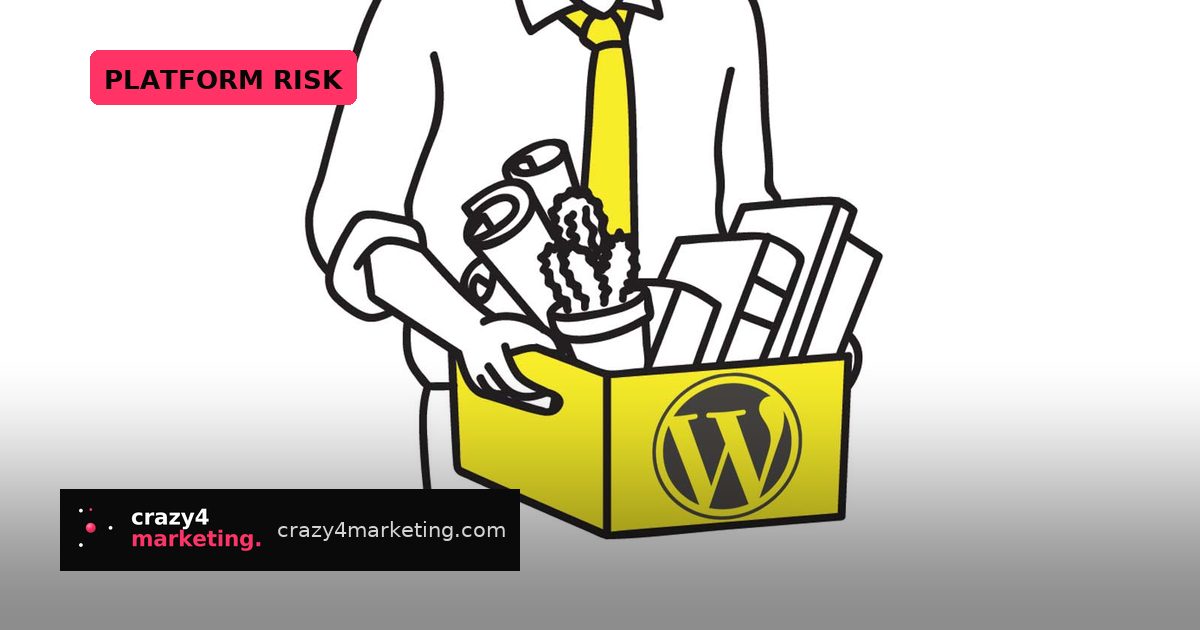
WordPress co-founder Matt Mullenweg has been removed as CEO of Automattic and placed on paid leave, according to Search Engine Journal. The board replaced him with Chief Financial Officer Mark Davies.
The manner of the removal is as notable as the removal itself. Mullenweg says he got the resolution only 50 minutes before the meeting started, and that his repeated requests for time to have it reviewed by independent legal counsel were refused.
In an internal Slack message quoted by the report, he wrote that he wouldn’t be able to make the next ELT meeting, adding that he had asked “even a few hours” for legal review, “which was denied.” He accused the CFO of working with the board behind his back.
Why a CEO change at Automattic matters to marketers
If you run content, SEO or e-commerce, there is a strong chance a meaningful slice of your revenue sits on WordPress. Agencies build client sites on it. D2C brands run blogs and landing pages on it. Publishers live on it.
That means governance drama at the top of the ecosystem’s most influential company is not gossip. It’s supply-chain risk for your marketing stack.
The WP Engine fallout is still unfolding
The leadership change lands while Automattic is dealing with the consequences of Mullenweg’s fight with WP Engine, a dispute he himself described as “nuclear.”
Per the report, Automattic faces a lawsuit from WP Engine that stems directly from Mullenweg’s actions, plus a motion for sanctions alleging destruction or failure to preserve evidence. Automattic’s e-discovery vendor, Jonathan Robins, reportedly said Mullenweg’s laptop and a phone were unaccounted for.
The ecosystem cost: share, community, plugins
The knock-on effects go well past the courtroom. Search Engine Journal points to three pressure points:
- Declining CMS market share for WordPress against rival platforms.
- Falling WordCamp attendance, the clearest signal of community energy draining away.
- A slow decline in the plugin economy, with many plugin developers reporting shrinking paid user bases and more discovered vulnerabilities, both attributed to AI.
That last point deserves a beat. AI is squeezing plugin businesses from both ends: it makes it cheaper for anyone to build a lightweight alternative in-house, and it makes it faster for researchers, and attackers, to surface vulnerabilities in existing code. Fewer paying customers plus more security work is a brutal combination for small dev shops.
What growth and web teams should actually do
You do not need to panic-migrate. You do need to stop treating your CMS as a permanent fixture. A simple audit:
- Map your dependency risk. List every paid plugin your site relies on for revenue: forms, checkout, schema, caching, CRO tools. Note which are maintained by one-person teams.
- Check update velocity. If a critical plugin hasn’t shipped in six months, treat it as a liability, not an asset.
- Harden security now. Rising vulnerability discovery means faster patch cycles. Automate updates on staging, not production, and monitor.
- Own your content layer. Keep clean, portable exports of posts, media and redirects so a future platform move is a project, not a crisis.
- Protect SEO equity. Document your URL structure, internal linking and schema implementation independently of any plugin that generates it.
The bigger lesson
Open-source infrastructure feels free and permanent. It is neither. It is governed by people, funded by companies, and vulnerable to leadership fights you have zero influence over.
The marketers who sail through platform turbulence are the ones who built for portability before they needed it. Whether Mark Davies steadies Automattic or the WP Engine litigation drags on, your job is the same: make sure a boardroom vote in someone else’s company can never take your traffic offline.
Watch for what the new leadership signals on the WP Engine case and on developer relations. That, more than the CEO title itself, will tell you where WordPress is heading.
Source: Search Engine Journal