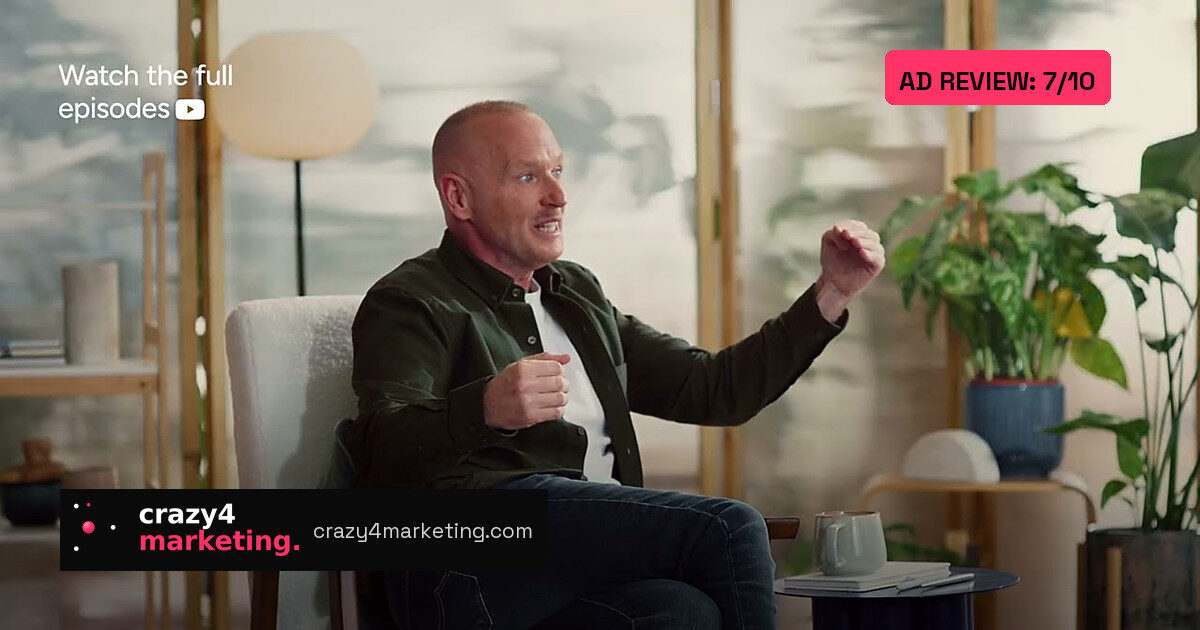
Our score: 7/10 · Bupa, “Mindplace Sessions”
Verdict: Bupa makes therapy feel approachable with familiar faces and unscripted honesty; the full series asks more than a social scroll.
What works
- A single stat, 80%, gives the emotional hook proof and urgency
- Unscripted conversations let viewers hear what a therapy session feels like
- Casting spans cricket, food, internet and television audiences
What misses
- A 60-second cut must sell four stories; depth only arrives in full episodes
- Social-first claim sits awkwardly beside YouTube-only episodes and a separate real-people OOH push
The lesson: Show the service being used: a live demonstration lowers the barrier better than another awareness claim.
The ad
Bupa’s Mindplace Sessions is a social-first original film series launched in Australia, created with London independent agency Story Studio. The 60-second trailer promotes four unscripted conversations between psychotherapist Owen O’Kane and a deliberately broad cast: former England cricket captain Freddie Flintoff, Aussie internet personality Olly Bowman, food journalist and chef Dame Mary Berry, and British television presenter Miquita Oliver. The series runs alongside a global OOH, OLV and social campaign across the UK, Spain and Australia, with all four episodes on Bupa’s YouTube channel. No director is named in the source.
What works
The first five seconds have a clear hook: familiar faces in an unfamiliar chair. It is not a talking-head awareness ad; it uses the format as the message. Bupa’s research makes that decision sharp: 28 per cent of people who have never engaged in therapy would be more likely to consider it if they had a clearer idea of what happens.
Four separate conversations give the structure range. Flintoff explores trauma and pain, Berry reflects on grief and loss, and Oliver talks about anxiety, shame and pride. The series avoids one-note emotion.
The share trigger is built into the casting. Flintoff, Berry, Bowman and Oliver bring their own audiences, and the unscripted format creates the candid moments that social platforms reward. The data makes the timing feel urgent: more than 80 per cent of Australians hide how they really feel, 85 per cent believe talking-based therapy could be useful, but only 11 per cent are currently in it.
What misses
The platform fit is the weakest part. The trailer has to compress four separate stories into 60 seconds, so the emotional depth only arrives if someone leaves the feed and watches full episodes on YouTube. For a social-first series, that is a real drop-off risk.
The separate global campaign uses real people and real questions rather than the celebrity conversations that make the series distinctive. That may dilute the most shareable asset for viewers who only see the OOH or social cut.
The verdict
7/10. Bupa’s Mindplace Sessions is smart, warm and unusually useful for a healthcare brand. It demonstrates the service instead of claiming it, but the full series asks for more attention than a social scroll usually gives.
The lesson
Show the service being used. A demonstration of therapy is more persuasive than another awareness message, especially when the data shows uncertainty is a bigger barrier than stigma alone.
Watch the original: Bupa on YouTube. Shown for review; the rights stay with the brand.