

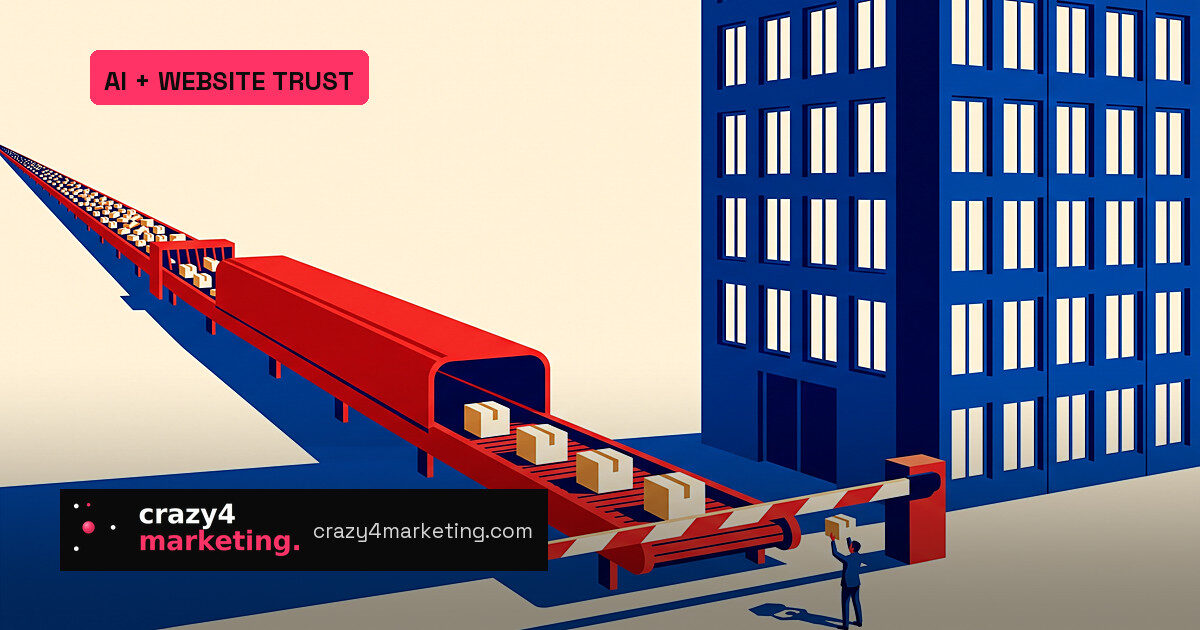
AI is increasingly drafting the shortlist, but the brand website is still where the final call gets made. That is the central finding from a Propeller Insights survey of 1,008 US consumers commissioned by Kinsta and published on September 22, 2026.
The buying journey has split in two
Among respondents, 59.2% use AI tools often or occasionally for product research, and 61.2% expect AI to eventually replace websites as the main way people discover products. Yet only 18.8% always trust an AI product recommendation without doing additional research. The result is a two-step journey: chatbots generate the candidate list, and the company website gets used as the verification checkpoint.
That verification visit carries real weight: 61.1% of consumers associate the standard of a company’s website with the standard of its products or services. As Kinsta CMO Matt Reid put it, “People are using AI to narrow their options, then coming to websites to make sure the recommendation checks out.”
What the numbers say
Kinsta’s data shows 53.8% of consumers sometimes or often skip company websites while researching with AI. The report’s base is unclear—the press release presents it as a share of all consumers, while the report page ties it to AI users—so treat it as directional. Why do some people stay inside the chatbot? AI feels faster than searching multiple sites (52.2%), follow-up questions are easier (45.2%), websites have too many ads or pop-ups (42%), and traditional search results feel cluttered or SEO-driven (37.6%). Respondents could choose more than one reason.
The trust gap is bigger than adoption
Adoption has not produced confidence. In the survey, 58% trust content less once they suspect it was AI-generated, 90.7% are concerned about AI-generated misinformation, and 52.1% say they trust traditional search results more than AI-generated answers—though that last figure sits within the margin of error of an even split. Only 18.8% take AI answers at face value. The destination still matters: 44.7% always or most of the time visit a company website after an AI recommendation, plus 25% who do so occasionally. That is nearly 70% checking at least some of the time.
Your site is now the truth layer
When a skeptical shopper lands on your page after an AI mention, a slow or thin experience can undo the recommendation. Contentsquare’s September 2026 survey found only 3% of AI-referred shoppers would complete a purchase if the site disappointed them, while 23% would switch brands and 16% would abandon the purchase.
Here is the practical checklist:
- Treat landing pages as trust pages, not just traffic pages: add proof, reviews, and clear product detail.
- Watch branded search and direct visits for AI-influenced demand. Similarweb found 55.9% of AI-influenced traffic arrives via search rather than as an AI referral.
- Check speed. Shopify’s data ties every extra 100 milliseconds of load time to roughly 3.5% lower conversion.
Review authenticity has become a default doubt: 70.9% have suspected a review was fake or AI-generated, and 43.3% say bots make them trust websites less. Generic testimonials may now read as risk rather than reassurance.
Kinsta sells website hosting, so its conclusion that site performance confirms credibility is self-serving. The survey also lacks fieldwork dates, question wording, and subgroup bases. But the direction matches a wider pattern: AI compresses discovery, not trust.
Source: PPC Land


