
What paid amplification actually is
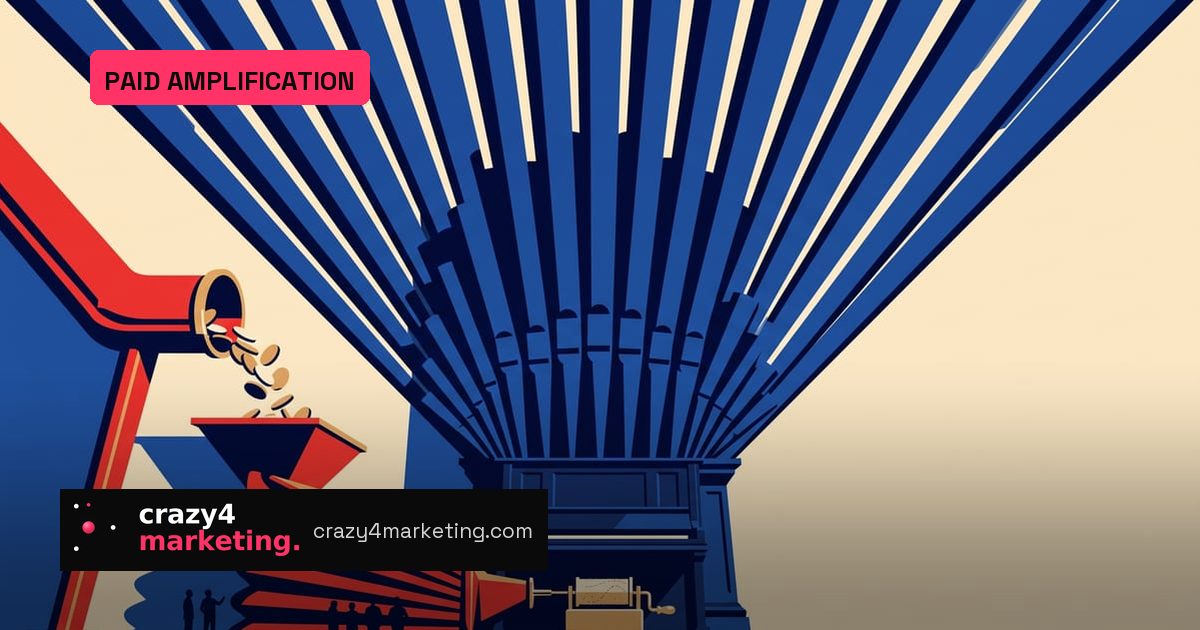
Paid amplification is paying a platform to distribute content that already exists—a brand post, a creator video, an employee update or a customer mention—to far more people than it would reach organically. The money buys distribution, not production. That distinction separates it from conventional ads built for paid placement and from a creator fee, which pays for the content itself.
The practice became routine as organic reach collapsed. Feeds are now ranked by algorithms, and platforms sell back the reach they no longer give away. In 2014, a Social@Ogilvy analysis put average organic reach for brand pages at 6.15%, down from 12.05% in October 2013—and just 2.11% for pages above 500,000 fans. That same year, Gini Dietrich’s Spin Sucks introduced the PESO model, treating paid as support for earned, shared and owned media rather than a replacement.
How the buy works
The sequence is consistent across platforms. First, an asset is published without paid support. Early signals—views, watch time, engagement, comments—are watched. Posts that clear an internal threshold get a campaign in an ad manager, with a budget, objective, targeting and schedule. The post then enters the same auction as any ad. It keeps the organic engagement it already collected, but carries a sponsored label.
Two variables decide the transaction. Identity: boosting your own post needs no permission, while boosting someone else’s post requires authorisation recorded by the platform. Rights: how long and where the advertiser may run the asset, usually defined in the creator contract. That’s why amplification is often priced separately from deliverables, usage rights and exclusivity.
Platform mechanics at a glance
- Meta: Brands boost their own posts or run partnership ads with creators. Meta says partnership ads average 19% lower cost per acquisition and 13% higher click-through rates than standard formats.
- TikTok: Spark Ads use a creator-generated video code, and engagement earned during promotion accrues to the original post.
- YouTube: Creator Partnerships Boost links a creator’s video into Google Ads or DV360 campaigns.
- LinkedIn: Sponsored Content amplifies company posts; Thought Leader Ads extend the same model to individual members.
Tooling is consolidating fast. Meta announced a Creator Marketing Hub at Cannes Lions on June 23, 2026, merging Creator Marketplace and the Partnership Ads Hub. X widened the category on July 15, 2026 with Mentions Boost, letting Premium Business accounts pay to extend unpaid posts that mention them.
Why this matters for performance marketers
Budget is shifting. Brands are moving influencer spend from creator fees toward boosting posts that have already performed organically. ANA research found only 15% of marketers rated paid amplification difficult—the lowest of any influencer programme step—while 67% named measurement the hardest. Ryan Detert, chief executive of Influential, said paid distribution of creator content “has enabled marketers to apply more rigorous measurement approaches.” His company’s guidance: a 30% paid share for awareness objectives, rising to 70% for conversion.
Platform data makes the case. TikTok reported that Spark Ads-boosted creator content drew 159% higher engagement than non-creator content at identical CPMs in North America between February 2024 and January 2025, and a TikTok marketing mix modelling study of beauty brands in Romania credited Spark Ads with 37% higher ROI.
The caveats to watch
Selection bias is the first trap. Boosting only winners means paid results inherit organic momentum, and vendor comparisons against standard ads rarely isolate that effect. Audience quality is another concern: one YouTube creator gained roughly 80,000 subscribers in 30 days from a $2,000 promotion budget, but later videos performed closer to the old 20,000-subscriber baseline. Trust is the third issue—IAB Australia research published today found 44% of Australian online shoppers said knowing a post was paid made them less likely to act, while IAB Ireland put the share of adults who see paid creator posts as authentic at just 17%.
For growth teams, the practical play is simple: track amplification separately, test incrementality, and treat paid distribution as a media decision—not an organic afterthought.
Source: PPC Land