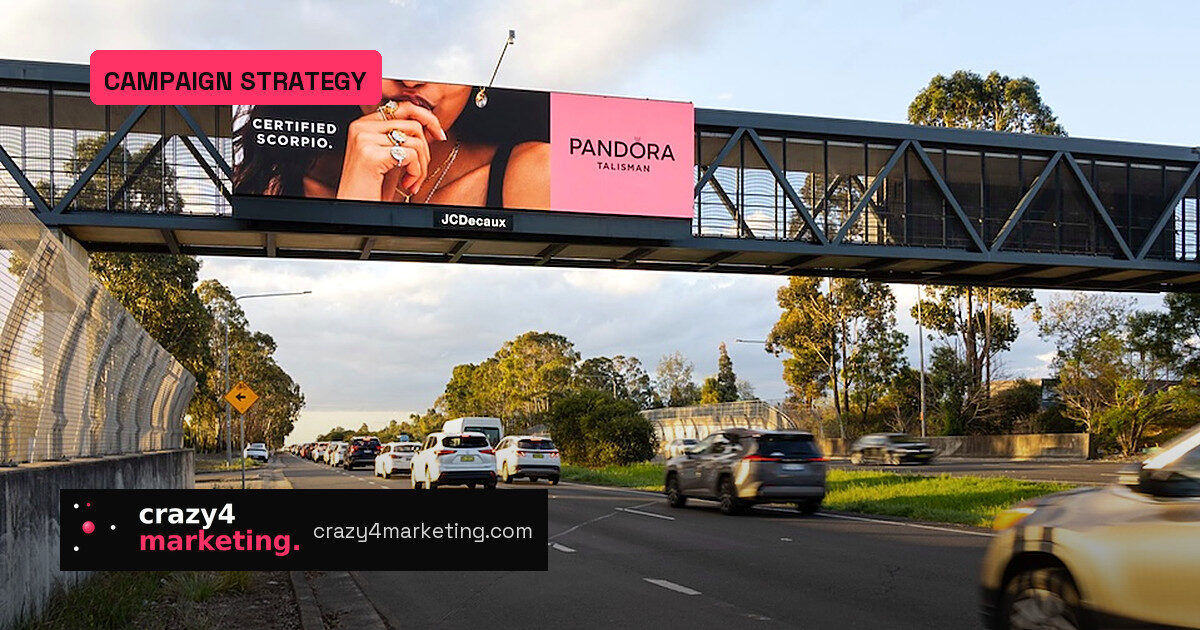
Pandora is bringing its zodiac-inspired Talisman collection to Australia and New Zealand, but the real story for marketers isn’t the jewellery. It’s a global campaign rebuilt around one idea: out-of-home creative should be photographed, not just noticed.
Jack Nimble, the social-first agency behind the local adaptation, reworked Pandora’s international creative suite into a national push across out-of-home and digital out-of-home. Rather than running the global work as-is, the team leaned into how Australians already talk about astrology — as social identity.
Star signs, reimagined as personality types
The campaign gives each zodiac sign a familiar internet-native archetype. Capricorn is “boss energy”, Libra is “it girl energy” and Leo is “main character energy”. That’s not vague horoscope-app marketing. It’s identity marketing with a built-in distribution trigger.
Pandora’s Talisman collection, inspired by ancient coins, spans zodiac charms, reversible rings, necklaces and bracelets with motifs drawn from nature. But the creative sells identification as much as product.
The shareable-billboard play
James McInnes, Managing Partner at Jack Nimble, spelled out the strategy. Horoscopes aren’t just something people read — they are “people we know and love.” The campaign was designed to give passers-by an extra reason to snap a photo of the billboard and send it to a friend.
That reframes out-of-home entirely. Outdoor advertising is no longer just a broadcast channel. It’s a social distribution engine.
Here’s why the play works:
- One creative suite speaks to twelve audiences at once, because zodiac identity is cheap personalisation
- “Boss energy” and “main character energy” are phrases people already use in posts and comments
- A photographable billboard turns every passer-by into an unpaid distributor
- Localising global creative keeps brand consistency while adding cultural relevance
What growth teams should steal
The tactic isn’t to add zodiacs to your next campaign. It’s to treat shareability as a design brief, not a happy accident. Before you sign off on a billboard, ask: would someone photograph this and send it to a friend? If the answer is no, you’re leaving the most valuable impression on the table.
There’s also a localisation lesson here. Jack Nimble didn’t redo Pandora’s global concept from scratch. It found a local emotional truth — Australia’s cultural obsession with horoscopes as identity — and layered it onto existing assets, keeping Pandora’s signature pink for brand recognition.
The playbook is simple: identity, archetype, photographic moment. Pick an identity people already talk about, describe it in social-native language, and give the creative a scene worth sharing. It’s the same logic that powers meme marketing: give people a mirror and a share button, and they’ll do the distribution for you.
The Pandora Talisman campaign is now live across Australia and New Zealand, with Dentsu handling media.
Source: Campaign Brief