
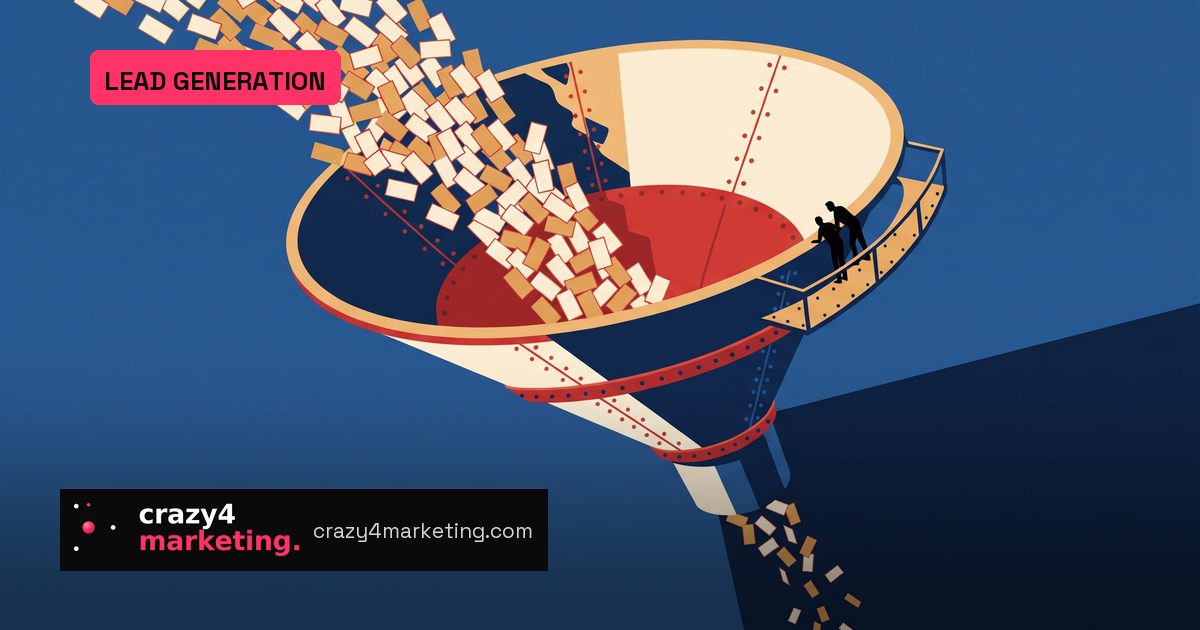
Lead ads put the form inside the ad unit. A tap opens a pre-filled form, a second tap submits it. No landing page, no typing, no browser load. That friction removal built a massive acquisition channel—but it also created a system that collects accidental taps and cheap low-intent records as easily as real buyers.
In 2026, the format is being rebuilt around qualification rather than pure capture. Here is what performance marketers need to know.
The big three work differently
Meta structures instant forms around an introduction, questions, privacy link and ending screen. It offers three paths: more volume submits on a single tap, higher intent adds a review step, and rich creative layers in branding and product detail. Up to 15 custom questions can be added, but each one costs completions.
LinkedIn allows up to 12 profile fields plus three custom questions. The platform recommends three to four fields. Work email validation blocks free domains, but LinkedIn documents the trade-off: submission rates fall when members won’t give a corporate address.
Google defines the format as a LeadFormAsset. Required inputs include business name, CTA, headline, description and privacy policy URL. A background image must be exactly 1200 by 628 pixels. Custom questions cap at five, and a desired_intent setting mirrors Meta’s volume-versus-quality dial.
One rule is consistent: a privacy policy URL is mandatory across all three platforms, and it is the only compliance element enforced at build time.
Delivery is where leads go to die
A submitted lead sits inside the platform until something collects it. That operational step is where many campaigns fail. Meta offers manual export, a native CRM integration or a custom Graph API webhook. On submission the webhook carries identifiers such as leadgen_id, page_id, form_id and ad_id, which must be exchanged for the record.
The critical constraint is retention: Meta keeps lead data for 90 days and no longer. A webhook that fails silently—through an expired token or dropped subscription—does not delay leads. It destroys them. Treat the platform as a queue, not an archive.
Google routes submissions into LeadFormSubmissionData with the Google Click Identifier so a lead can later be imported back as an offline conversion. That feedback loop now matters more than the initial capture.
Why lead quality is under pressure
The format’s low friction is also its weakness. A two-tap form attached to broad targeting collects people who barely engaged. Jon Loomer has documented Meta optimising for cheap, low-quality leads; without age restrictions, a large share of budget can go to older audiences simply because cheap conversions are available there.
Automated and invalid traffic compounds the problem. In Lunio research, only 5.3% of senior marketers ran a dedicated invalid traffic platform, while 75.6% estimated losing more than 5% of monthly budget to bots. More than half pointed to bidding systems optimising toward non-human converters, and 21.4% named sales teams working through agent-generated form fills as a leading risk.
Cost data is equally messy. LocaliQ benchmarks show Facebook costs rising 21% overall, but category-level dispersion is extreme: cost per lead in arts and entertainment jumped 242%, while restaurants saw a 341% conversion rate improvement. Broad benchmarks hide very different category realities.
What to do about it
Smart teams are moving from capture volume to measurable qualification. The playbook:
- Keep forms short, but add the review step or higher-intent format when lead quality matters more than volume.
- Set up webhook failure alerts so no lead expires inside Meta’s 90-day window.
- Feed closed deals back through Meta’s Conversion Leads or Google’s generate, qualify and close conversion events so algorithms learn which leads actually convert.
- Filter submissions for bots and invalid records before reporting cost per lead wins.
- Watch consent rules carefully: US TCPA interpretation has shifted, and Do Not Call Registry access rises to $85 per area code from 1 October 2026.
The current wave is conversational pre-qualification. Google named Business Agent for Leads at Marketing Live on 20 May 2026, letting prospects ask questions inside the ad before a form appears. Meta’s Business Agent launched globally on 3 June 2026 in messaging. The shift is clear: capture is no longer the hard part. Filtering, routing and proving quality is.
Source: PPC Land