Senior marketers are walking into the year with more confidence, and AI is a big reason. But a new report from Bench Media suggests the guardrails have not kept up.
The report is based on a survey of more than seventy senior client-side marketing leaders in Australia. It found 90% say decision-making has become easier over the past year. That is despite 59% naming the sheer volume of AI and martech tools as the biggest factor still making decisions more complex.
The tension shows up in the data. 48% say AI has made them more confident, and 41% name AI as the input they rely on most when taking a calculated risk. Yet 38% accept AI-generated strategic recommendations without human review, and that number rises to 45% for budget recommendations and creative concepts.
The bigger the budget, the bigger the bet on AI
AI reliance climbs with spend. Leaders managing budgets above $20 million are roughly twice as likely to lean on AI for a calculated risk as those below that mark (51% versus 24%). More budget means more decisions, but it also raises the price of an unchecked recommendation.
Jess Torstensson, General Manager, Growth at Bench Media, said the finding ran against her expectation: “Confidence isn’t about trusting AI more, it’s about knowing when to trust it, when to challenge it, and when to trust yourself.”
The report gives that skill a name: veto literacy. It means knowing when to override AI and defend the call to a board that assumes the machine is right. Torstensson predicts it will soon show up in job descriptions.
Instinct still gets the final vote
For all the automation talk, humans have not surrendered. 59% of leaders still back their own judgement when an AI recommendation conflicts with it.
That is not anti-AI; it is a governance position. As nudie Foods Head of Marketing and Category Emma Fogarty puts it: “There still needs to be a human in the loop.”
No clear winner among confidence inputs
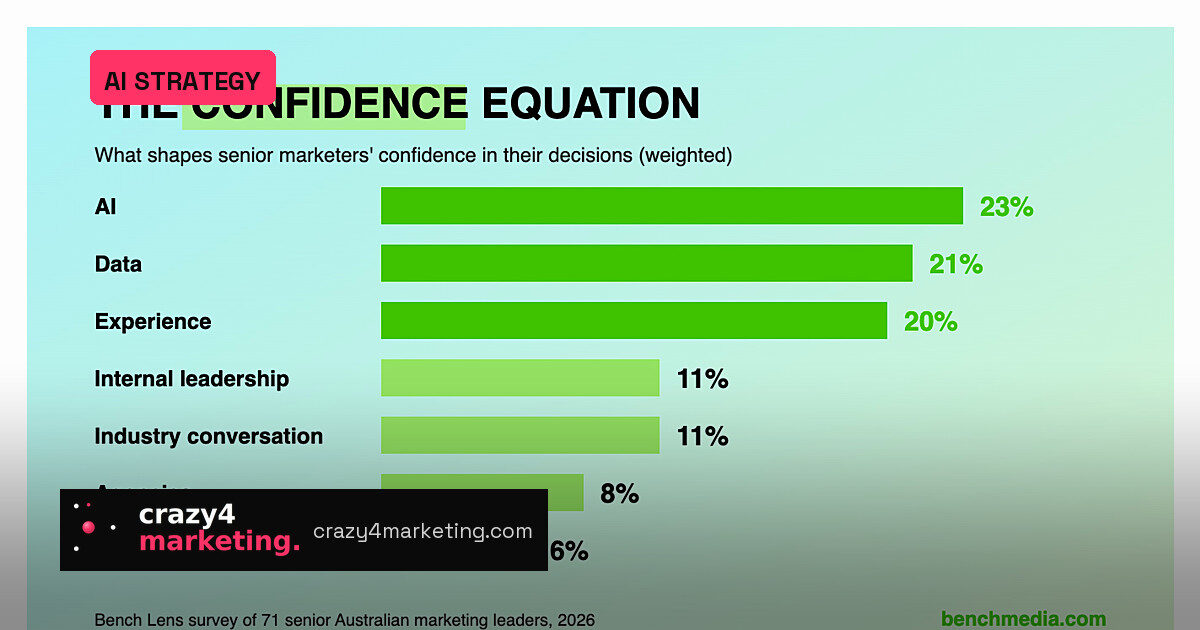
When leaders weighted seven influences on confidence, no single input dominated. AI topped the list at 23%, followed by data at 21% and experience at 20%. Internal leadership and industry conversation each accounted for 11%, agencies 8%, and peers 6%.
That spread, Bench argues, gives the advantage to organisations that build a clear framework for which input leads on which decision.
What leaders should do now
Torstensson’s practical recommendation is to pair AI output for strategy and budget decisions with fast, targeted primary research. Confidence is only useful when you can explain what informed a decision. That means giving leaders a process for testing AI’s advice, challenging it and standing behind the final call.
Here is a simple framework the research implies:
- Classify the decision. Let AI lead on pattern-heavy work, data on benchmarking, experience on brand judgement.
- Add a human review gate. Budget and creative AI outputs should not go straight to sign-off.
- Test the risky calls. Run a fast primary research pulse before locking in high-stakes strategy.
- Log the override. Record when a human disagrees with AI and why the final call was made.
The marketers who thrive will treat AI as an advisor with no signing authority.
Source: Campaign Brief