
Hot pies, cold drinks, sauce sachets, phone, tickets. The walk from the food counter to your seat on grand final day is a balancing act most Australian footy fans know too well. Four’N Twenty decided to fix it with a product rather than another ad: the Pie Scarf.
The timing matters. Grand Final weekend concentrates football attention across AFL and NRL, and stadium food is part of the ritual. By launching a physical object around that exact moment, Four’N Twenty attached itself to one of the biggest fan conversations of the season without needing a big media buy.
What the Pie Scarf is
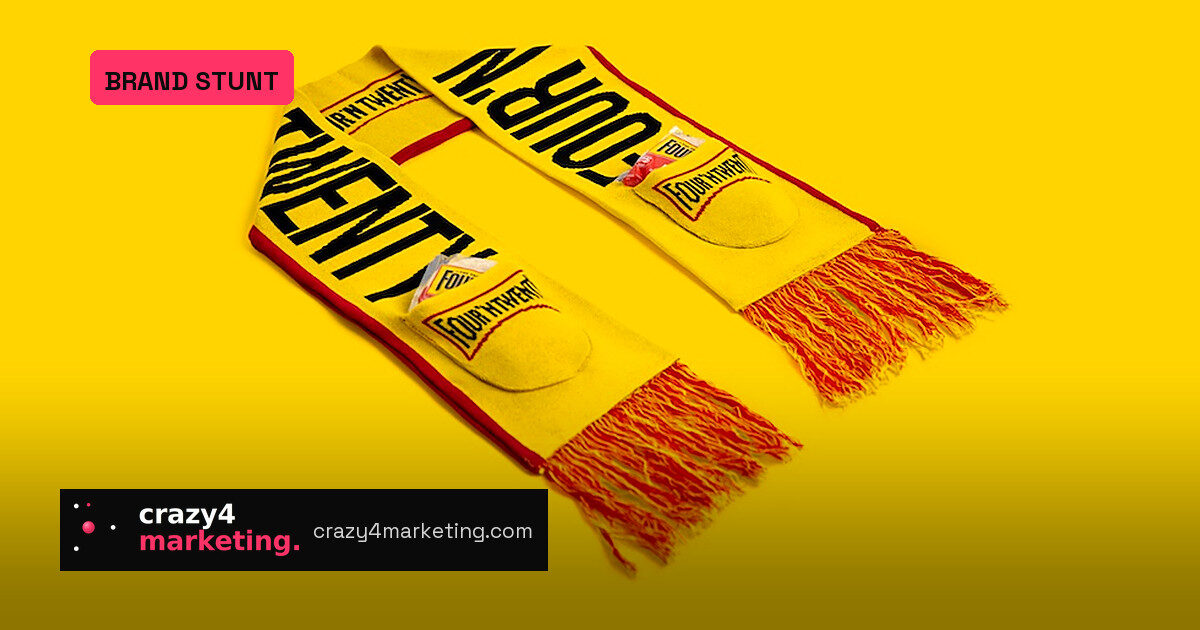
Unveiled ahead of this year’s AFL and NRL Grand Finals, the Pie Scarf is a custom-made, limited-edition accessory from Four’N Twenty, created with TBWA\Australia and Eleven. Brought to life by Coburg-based supplier Geccu, it has two built-in pie pockets designed to hold Four’N Twenty pies and keep fans’ hands free.
Comedian Brett Blake revealed the invention in a social campaign. A limited run was produced and seeded to media, creators and footy fans, and the brand opened registration for future drops through its merchandise store.
Why the idea works
The campaign does not start with the product feature; it starts with fan behaviour. Anand Surujpal, Patties Food Group Chief Marketing and Growth Officer, described the thinking as taking a universal game-day experience and turning it into something he called “equal parts practical and ridiculous.” That tension is the engine: useful enough to justify its existence, absurd enough to share.
Matt Stoddart, Executive Creative Director at TBWA\Australia, noted the idea came from observing footy culture rather than the pie itself. The insight is that Australians apply serious ingenuity to very specific problems. Here the problem was carrying pies through a packed concourse, and the solution became a talking point in its own right.
What marketers can take from it
- Find the ritual your brand already appears in, then solve its most awkward moment.
- Make the solution tangible rather than a message, so it can be seeded and photographed.
- Keep the tone self-aware: practical plus ridiculous travels further than polished.
- Add a waitlist or registration before scaling production to generate demand data.
This is product-led earned media. Instead of spending the budget to interrupt the game, the brand created an object that fans and creators can hold, film and argue about. The limited run and future-drop registration turn attention into a measurable pipeline.
Watch the demand signal
For D2C and challenger brands, the play is transferable. Identify the unglamorous ritual your audience tolerates, build a small physical fix, seed it to creators in your niche, and use registrations to judge whether the stunt deserves more production. If the waitlist fills, you have proof. If it doesn’t, you learned before over-investing.
Source: Campaign Brief