

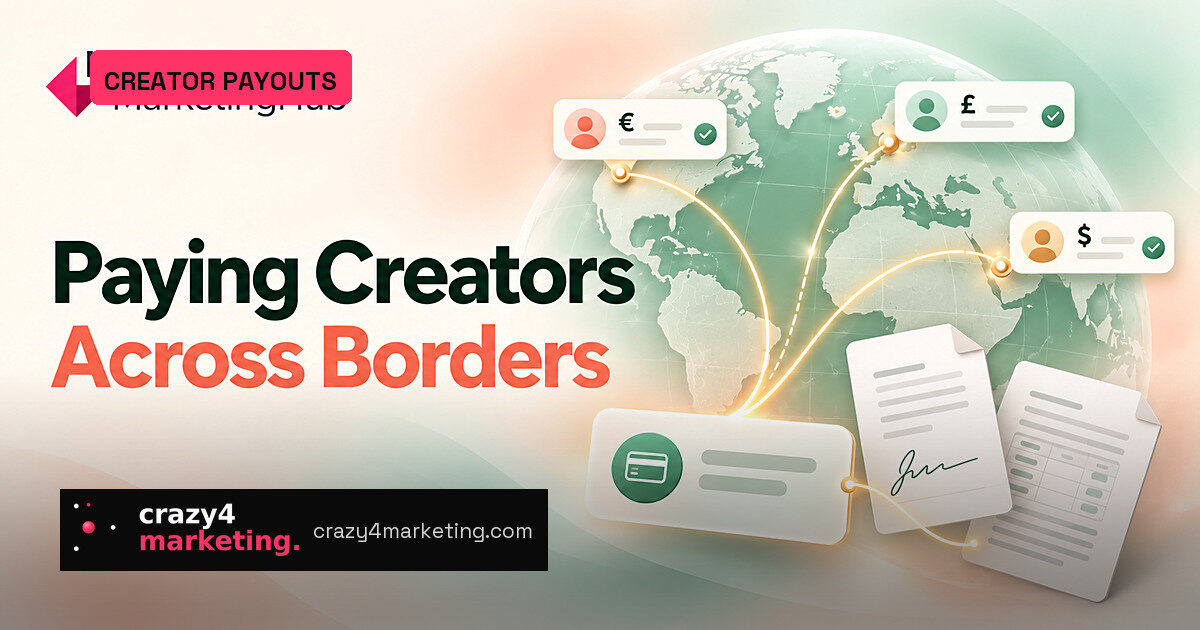
A skincare brand closes a campaign with 22 creators across six countries and then hits the question nobody answered: who gets paid this week, in what currency, against what paperwork, and whose tax form is missing. Three creators never sent a form. Two are owed a partial reshoot payment. One changed payout accounts. None of it is unusual once a creator program crosses borders.
The lesson is simple: influencer payouts are not a finance afterthought. They sit at the intersection of contract law, tax reporting and hidden FX costs. Get one piece wrong and the brand either loses the right to reuse content, triggers backup withholding, or overpays for the transfer without seeing it.
Start with the contractor frame
Paid influencers are independent contractors in almost every case. The brand does not withhold income tax, pay benefits or set fixed hours. Local classification tests differ, but they look at control, equipment, integration, exclusivity, economic dependence and length. If a brand dictates posting schedules, provides equipment or treats creators like staff, it builds facts that point to employment no matter what the contract says.
Practically, the agreement should tie payment to completed deliverables, not hours, and avoid fixed-hour language.
Four clauses that prevent later fights
- Deliverables: platform, format, date and revision rounds.
- Usage rights: paid invoices do not automatically transfer copyright in the US; the brand needs a signed assignment clause to reuse content in ads or keep it live.
- Exclusivity: keep the category window narrow; broad, long exclusivity increases economic dependence and employment risk.
- Payment terms: state exactly when payment triggers on delivery, approval or go-live.
Tax form follows the creator, not the brand
US creators sign a W-9. The 2026 information-reporting threshold is $2,000 per payee per year, with the first forms filed in early 2027. Non-US creators sign a W-8BEN, which stays on file and expires after the third calendar year. Without valid documentation, brands face backup withholding of 24% or 30% for foreign payees. The decisive test is where the services are performed, not the creator’s nationality, and US citizens abroad are still W-9/1099 creators.
The 1.6% leak most brands never see
The visible transfer fee is a poor guide to cost. The average total cost of a business cross-border payment is about 1.6% of the amount sent, and roughly 1.4 percentage points of that is the exchange-rate margin, not a line-item fee. While visible fees shrink as payment size grows, the margin holds roughly between 0.7% and 1.1%. Region matters too: costs can run near 1% in Europe and up to 3.5% in parts of sub-Saharan Africa.
Creators care about speed and a predictable local-currency amount. A transfer marketed as free can still cost the creator through a worse exchange rate.
Fifty creators is a different problem
At scale, a spreadsheet cannot reliably catch missing forms, agreement versions, manual payout timing or auditor-ready records. That is when brands move document collection, tax-form checks and payouts onto a contractor-payment platform while still owning creative decisions and terms. The operational parts live in one place.
Before the money moves
Check five mistakes: treating the brief as the contract, collecting tax forms after payment, writing exclusivity broader than the campaign needs, assuming the cheapest-looking transfer is cheapest, and running a large roster through one inbox.
Your payday sequence should be: signed agreement first, tax form second, payout route with disclosed exchange rates third. In that order, the brand keeps the rights, the tax exposure and the margin under control.
Source: Influencer Marketing Hub


