

Most brand stories chase the launch. This one lives in the ordinary day.
It is the UPI ping at the chai stall before office. It is a study group holding a video call across three cities. It is a family road trip where live maps settle the next turn. None of these moments feels like a campaign, but each one is a signal for marketers.
The shift marketers felt
In 2016, Jio launched with the Welcome Offer: unlimited 4G data, voice, video and apps (Reliance Industries). The company reached 100 million subscribers within 170 days of launch (company-reported; Reliance Industries Integrated Annual Report 2016-17).
For consumers, that changed the unit of daily life. Data stopped being something you rationed before a video call or a train ride. The question India asked moved from ‘How much does data cost?’ to ‘What can we do with data?’ (series framing line, not a statistic).
For agencies, the takeaway was immediate. Creative could assume that a consumer had enough data to watch, re-watch and share. For D2C founders, it meant a buyer could compare products from a scooter, a classroom or a kitchen. The scarcity that used to shape digital plans quietly disappeared.
A normal day is now a marketing map
Marketers can read an Indian day as a series of connected micro-moments:
- Chai stall UPI: a payment becomes a habit loop, not a purchase decision.
- Study group video call: learning and peer influence happen live, on small screens.
- Family road trip maps: utility content wins when it resolves context in real time.
Each moment is brief. Each one is also measurable, shareable and open to a useful brand role.
That changes what a “touchpoint” looks like. A family stops for chai; the payment sound completes before the cups arrive. A student shares notes on a video call without waiting for a download. A route changes, and an app reroutes before the driver asks. These are not high-attention moments, but they are high-relevance ones.
What growth teams should take from it
Jio’s ecosystem today spans connectivity, entertainment, commerce, payments, devices, cloud and AI (Reliance Industries 48th AGM, August 2025). Its stated priorities include connecting every Indian, bringing digital services home, digitising businesses and ‘AI Everywhere for Everyone’ (Reliance Industries 48th AGM, August 2025).
For performance marketers, the more interesting shift is cultural. The consumer no longer waits for a Wi-Fi zone to watch, pay or learn. The data-rich moment is the default. That means campaigns can be designed for the spaces between tasks: a 20-second utility, a map overlay, a payment-smooth offer, a study prompt.
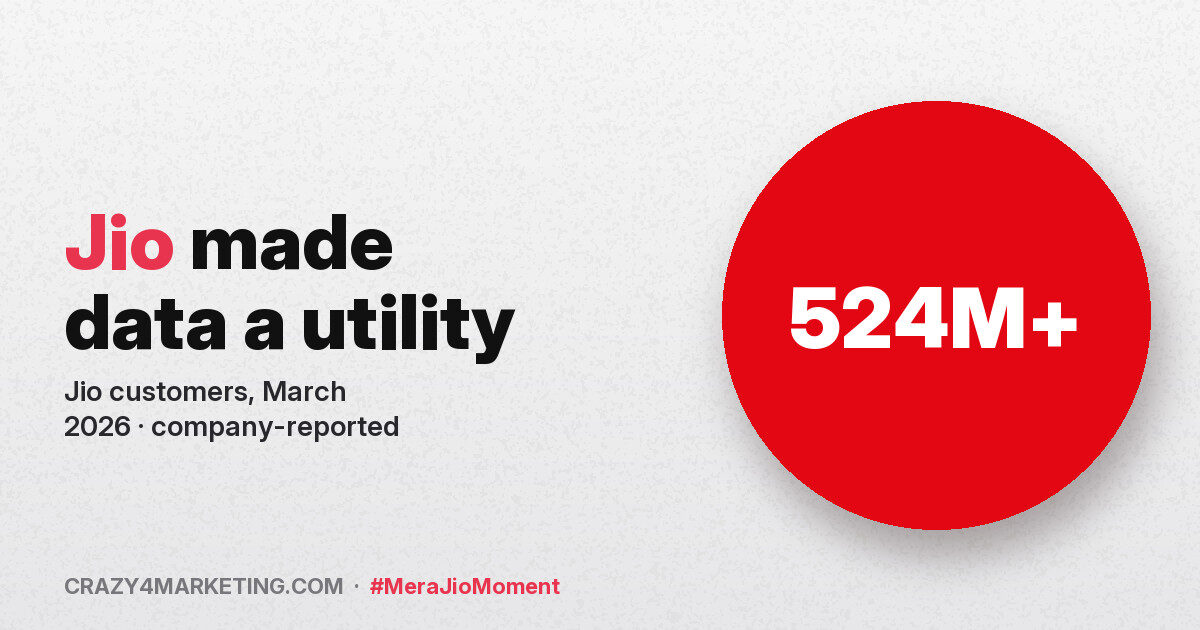
The scaling proof is in the subscriber base: Jio serves 524 million+ customers (Reliance Jio Infocomm, March 2026; company-reported). But for a marketer, the more useful number is one: the one ordinary day that repeats across that base.
The brief that works now
Growth teams often ask how to grab attention. The everyday utility story suggests a different question: how can a brand be useful inside a moment that is already happening?
That does not mean every campaign should become a UPI flow or a navigation app. It means the work should respect the context: clear value, light friction, mobile-first, and an understanding that today’s Indian consumer is already connected.
Data is no longer the offer. It is the environment.


