

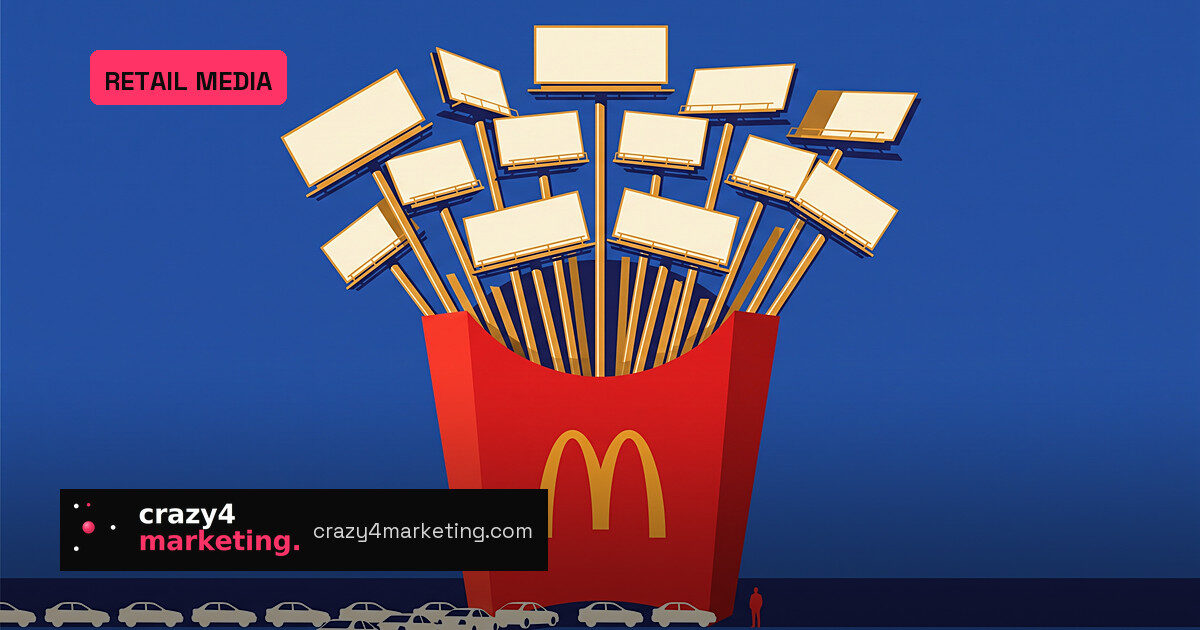
McDonald’s is turning its own drive-thru order boards into ad inventory. The pilot launched in August across 450 company-operated US restaurants, CMO Morgan Flatley told investors in Chicago on September 23, 2026. The ambition: build the McDonald’s Media Network into a billion-dollar business across the system over time.
That puts a quick-service giant alongside Amazon, Walmart and Uber, which already sell advertising against their own customers and screens. For brands, it creates a new placement at a very specific moment: a customer waiting for food, with the order already done. Flatley framed the move against a US commerce media market expected to surpass $100 billion by 2028.
What McDonald’s actually confirmed
The disclosure was thin. Flatley described the network as a ‘billion-dollar business across the McDonald’s system over time’ and said it could generate revenue with little added cost and ‘no disruption to our customer experience.’ Beyond that, much is still unknown:
- Confirmed: a pilot in 450 company-owned US restaurants; ads appear on drive-thru order boards after orders are placed.
- Ambition: a $1 billion media business, but no target year was given.
- Not disclosed: named advertisers, pricing, technology partner, measurement provider, franchise rollout or any use of loyalty data for targeting.
The franchise gap
Scale is the real question. CNBC puts the US estate at roughly 14,000 locations, so the pilot covers about 3.2% of it. More importantly, around 95% of McDonald’s restaurants worldwide are franchise-run, and the pilot has not been extended to US franchisees. With the company targeting roughly 98% franchised globally by the end of 2028, the pool of screens McDonald’s directly controls is set to shrink.
That means any path to a billion dollars runs through franchisee participation and a revenue split McDonald’s has not described. The chain framed the network as a way to create ‘new high-margin sources of value for McDonald’s and our franchisees,’ but operators will likely want proof it doesn’t slow service or cheapen the experience.
The measurement gap
There’s a deeper tension. Retail media grew on a closed loop: buy exposure on a retailer’s property, then measure whether it produced a sale in that retailer’s records. An insurer or automotive brand advertising at a burger counter is non-endemic. McDonald’s does not sell those products, so there is no purchase record on its side to close the loop.
Gizmodo reported that an example shown to investors included a Geico ad occupying half of a drive-thru screen, but neither the pilot nor the reporting confirms Geico is buying inventory. That example exposes the challenge: without a sale to track, buyers are left measuring reach, frequency and brand lift rather than direct return on ad spend.
What buyers should do now
For media buyers and D2C teams, this is a watch-and-ask moment, not a rush-in moment. The audience is interesting—McDonald’s says it has nearly 220 million active loyalty members and roughly 70 million daily customers globally. But the information needed to price a test is still missing.
If a drive-thru screen proposal lands on your desk, push for specifics. Ask how impressions will be counted per screen or per vehicle, how frequency is capped for repeat visitors, whether creative can vary by daypart or location, and what measurement you’ll receive for a non-endemic product. If the answer is ‘awareness only,’ treat it like digital out-of-home and benchmark accordingly—not like a retail media placement with closed-loop sales proof.
Source: PPC Land


