
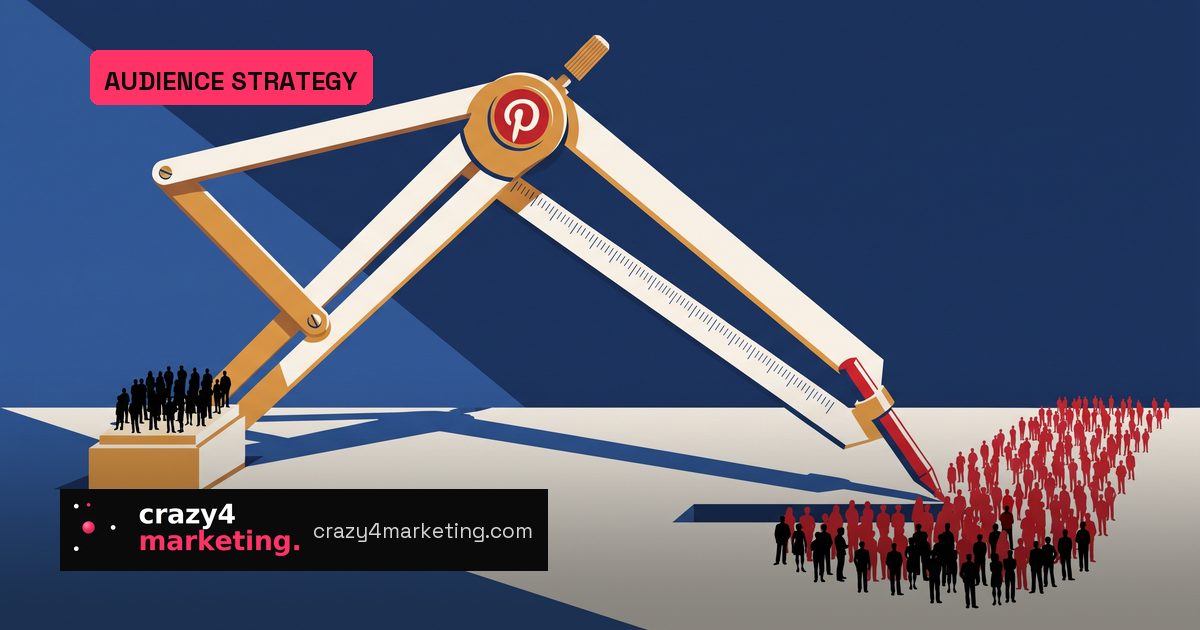
Pinterest’s version of a lookalike audience is called actalike, and it lives under the Find new customers targeting strategy in Ads Manager. The platform uses behavior on Pinterest—saves, searches, click-throughs—to expand a known list into a larger prospecting pool. For performance marketers, that distinction matters because it changes how you should build and test seeds.
What actalike actually does
Think of actalike as a prospecting multiplier. You bring a source audience of at least 100 matched members. Pinterest models behavioral similarity and returns a segment sized as a percentage of one country’s Pinterest population—not a percentage of your seed. The source audience is automatically excluded, so you are not re-serving known users.
Two controls define the result:
- Country: one market per actalike. Running in five countries means five separate audiences from the same seed.
- Range: 1 to 10, where 1 is the tightest resemblance and 10 gives roughly ten times the reach at looser similarity.
Seeds can come from a customer list CSV of emails or mobile advertising IDs, a site visitor audience built from Pinterest tag events, or an engagement audience from Pins on a claimed domain. Audiences then move through INITIALIZING, PROCESSING and READY, usually within 48 hours and up to 72.
Why it matters now
Pinterest’s scale has outgrown first-party data. The platform reported 640 million monthly active users and $1.18 billion in Q2 2026 revenue. Your customer file is a rounding error against that base. Retargeting pools saturate; actalike converts known data into a media plan.
It also sits inside a more automated stack. Performance+, launched globally in October 2024, was driving roughly 30 percent of lower-funnel revenue by early 2026. The Taste Graph supplies the behavioral signals behind actalike, and with more than 72 percent of impressions on search surfaces, Pinterest’s search behavior heavily shapes who looks like your customers.
Clean rooms are becoming a bigger seed source, too. The Epsilon integration, announced in November 2025, can push segments into Ads Manager within 24 to 48 hours—and those segments can seed an actalike.
How to use it without burning budget
Start with your highest-intent seed, not your largest list. A model trained on newsletter signups finds more newsletter signups. For a D2C account, past purchasers or high-value engaged visitors are usually stronger than generic email subscribers.
Then use a simple test framework:
- Tight first: launch range 1–2 in one country to validate creative and offer against a close match.
- Scale second: add a 5 percent segment and compare ROAS, not just CTR.
- Separate markets: do not let one blended actalike hide weak regions; Pinterest scopes by country for a reason.
- Watch seed quality: Meta suggests 1,000 to 5,000 source users despite a 100 minimum. Pinterest does not publish an equivalent, so test larger seeds if results look noisy.
The compliance guardrails
Actalike is not available everywhere. Pinterest bars credit, employment and housing campaigns from using it in certain markets. Eight sensitive categories—health conditions, race, trade union membership, political affiliation and others—are closed to targeting, along with proxies and anyone under 18.
That is not just a policy footnote. Meta’s lookalike tool became the Special Ad Audience and was withdrawn from housing, employment and credit ads after a 2022 Department of Justice settlement. The revised Pinterest Advertising Guidelines take effect on November 12, 2026, keeping the actalike restriction for those categories but making the demographic list illustrative rather than exhaustive. If you work in regulated verticals, review the new text before launch.
Bottom line
Actalike is Pinterest’s most scalable prospecting tool for advertisers with real first-party data. Treat it like a behavioral lookalike, not a demographic clone: feed it high-quality seeds, scope it by country, start tight and let results—not Pinterest’s promoted case studies—set your range.
Source: PPC Land