
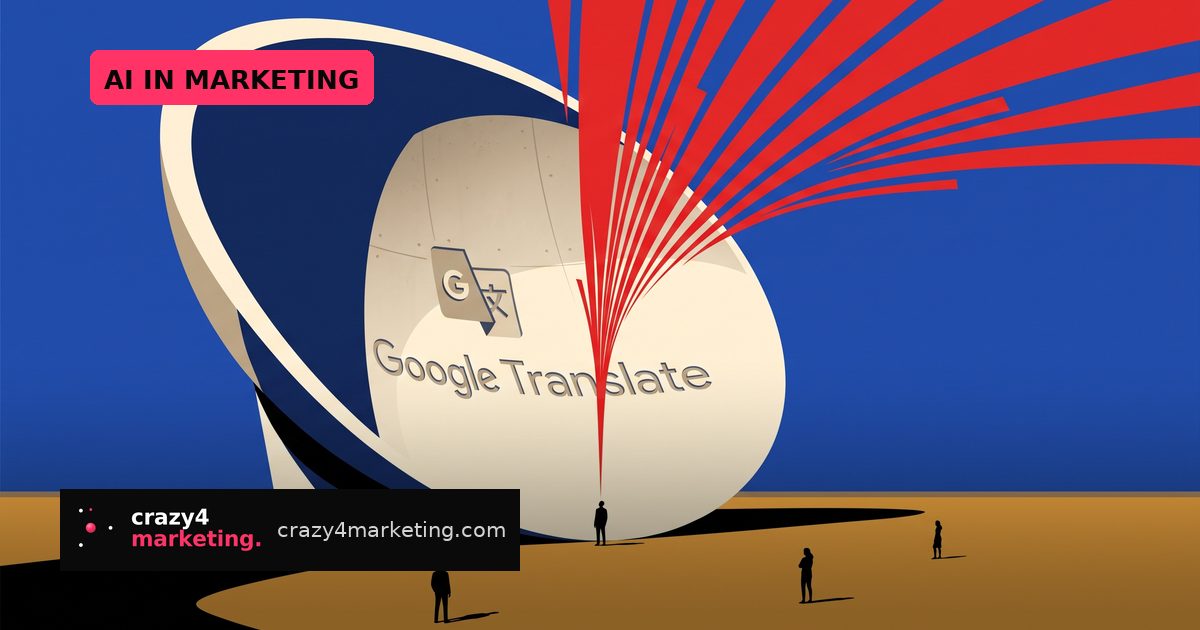
Google shipped two small updates to Translate on September 4, 2026. Neither one touches an ad product. Both are worth ten minutes of your attention.
What actually changed
According to a post on Google’s blog The Keyword by Sasha Kapur, Product Manager for Google Translate, Android users can now keep a live translation session running in the background or with the screen locked. iOS support is described only as “coming soon”, with no date.
The second change goes the other way. iPhone users worldwide can now hear translated audio through the earpiece at the top of the handset – the speaker used for calls – instead of needing headphones. Google says the same capability already existed on Android.
Both sit on top of live translate, the app’s near-real-time audio mode covering more than 70 languages. Google’s own examples are travel-shaped: catching announcements in noisy airports, following crowded tours.
The one number Google published
The only statistic in the announcement: more than a third of live translation sessions now run longer than five minutes.
That single figure explains the engineering. Short exchanges survive fine inside an app that stays on screen. Five-minute sessions do not – mobile operating systems suspend apps that lose focus, and continuous mic capture plus continuous playback is about the most expensive thing an app can ask to keep doing.
It also explains why Android went first. Sustained background audio capture is a well-trodden pattern on Android; Apple’s platform is stricter about apps that keep listening once the screen locks.
Note what is missing: no absolute session volume, no battery figures, no confirmation on whether background sessions run on device or in the cloud, and no language parity statement between foreground and background modes.
Why the earpiece detail is bigger than it looks
Engineering-wise, earpiece routing is trivial. Behaviourally, it is the bigger of the two changes.
A loudspeaker translation in a shop or a museum queue is a public performance. An earpiece translation is invisible. Removing the headphone requirement and the social cost widens where and how often people use it – and it does so with no accessory dependency at all.
Contrast that with Apple, whose Live Translation with AirPods depends on Apple Intelligence and specific device pairings, and which Apple said in September 2025 would be delayed for European Union users on Digital Markets Act interoperability grounds. Google’s version uses hardware in every phone and shipped worldwide.
Three reasons this lands on your desk
No targeting option changed. The relevance is second order, and it runs through three channels.
- Language mismatch in delivery. Google confirmed in August 2026 that campaign-level language targeting is being removed from Search and Performance Max from September 2026, replaced by automatic detection based on creative, landing page, search terms and user settings. As ambient translation grows, more users have a device language, a query language and a comprehension language that all differ – inside a system that just removed the manual lever for reasoning about that.
- Measurement blind spots. Translated audio through an earpiece produces no page view, no analytics session, no indexable artefact. Multilingual engagement moves further outside advertiser-visible systems, the same way spoken search answers already have.
- Context signals and inventory. Google’s examples are travel scenarios, and Demand Gen added Google Maps as a placement on May 20, 2026. A locked phone running background translation in an airport is, functionally, a travel-context signal.
The pattern behind the pattern
These changes extend the Gemini 3.5 Live Translate model Google released on June 9, 2026, a speech-to-speech system covering more than 70 languages that processes speech as it streams rather than waiting for a speaker to finish. Continuous streaming is what makes long sessions natural – and long sessions are what forced background execution.
The same lengthening shows up elsewhere. AI Mode passed one billion monthly active users on May 19, 2026, with Google reporting queries roughly three times longer than traditional searches. Meanwhile Translate’s web destination shrank to a 24-month low of 314.7 million monthly visits in February 2026 per OneLittleWeb data, recovering to 349.6 million in April. The app grows, the browser page fades.
What to do this quarter
Audit landing page and creative language signals now that automatic detection is doing the work manual targeting used to. Check whether your travel, retail and hospitality campaigns assume a single comprehension language. And accept that a growing slice of multilingual demand will never appear in your dashboards – build qualitative signals, not just session counts, into how you read international markets.
Source: PPC Land