
Everyone wants the viral post. Almost nobody wants the strategy document that makes the viral post worth anything.
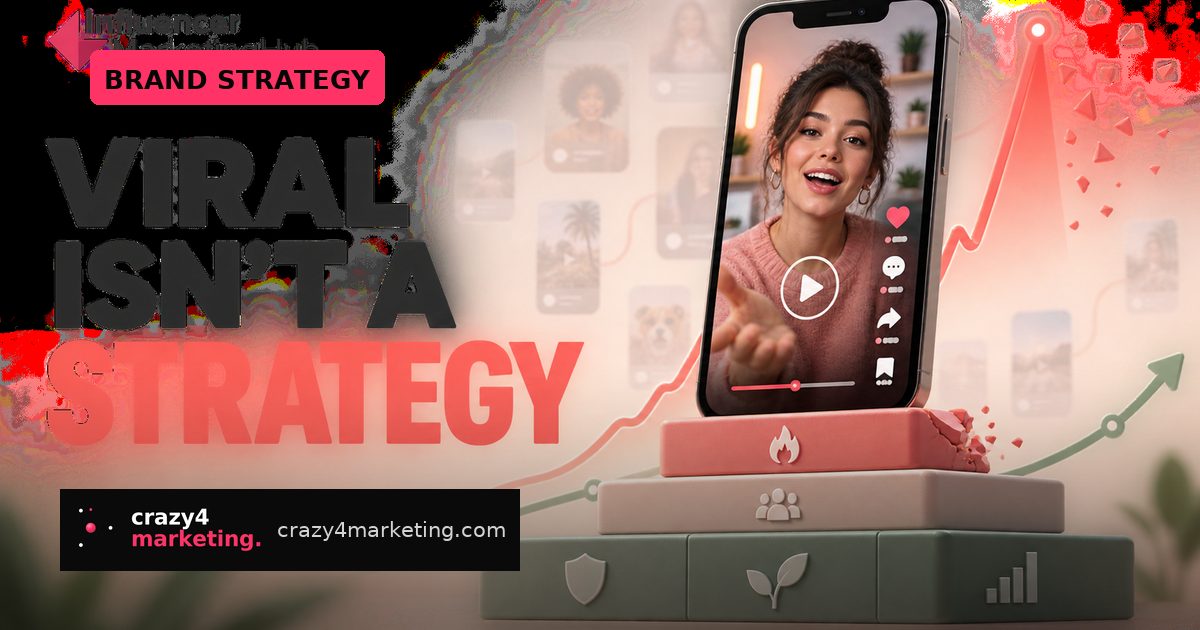
A new piece from Influencer Marketing Hub makes an argument that performance teams need tattooed on the inside of their eyelids: posting on TikTok is not a strategy. A tidy Instagram grid is not a strategy. A trending sound is definitely not a strategy. Those are tactics — and tactics collapse the moment something goes wrong.
The money makes this urgent
This isn’t a philosophy debate. It’s a budget one.
The global influencer industry hit roughly $32.55 billion in 2025, per Influencer Marketing Hub’s own figures. Even with tighter budgets elsewhere, 80% of brands maintained or increased creator spend. In the US alone, influencer marketing reached $10.52 billion in 2025, with creator marketing overall projected at $21.10 billion in 2026, according to eMarketer and SQ Magazine.
That’s an enormous amount of capital chasing attention. And attention without direction just burns the media budget faster.
The report’s sharpest line: a creator partnership with no brand strategy behind it is just well-produced noise. Spike in engagement today, nothing left in 30 days.
Marketing is the megaphone. Strategy is the message.
Here’s the split worth internalising:
- Social media marketing is distribution. It’s how you show up in the feed, the comment thread, the sponsored Reel. It moves fast, chases trends, and is judged on engagement.
- Brand strategy is direction. Why the brand exists, what it stands for, how people should remember it in five years — not this week.
- Strategy sets the boundaries for marketing. Not the reverse. If your content calendar is defining your brand, you’ve inverted the stack.
Cracker Barrel: when no caption can save you
August 2025 gave us the case study. Cracker Barrel rolled out a new logo as part of a rebrand reportedly costing around $700 million — dropping “Uncle Herschel” and the barrel for a plain, text-only mark.
The backlash was immediate. The stock fell 12%. Within days, the company reversed and reinstated the old logo.
The critique from observers was that the redesign stripped out exactly the heritage customers were attached to. And logos no longer just sit on a storefront — they land in memes, TikToks and late-night monologues within hours.
The part performance marketers should sit with: no social team on earth could have rescued that launch. It wasn’t a copy problem or a posting-cadence problem. The strategy underneath the identity didn’t match what the identity actually meant to real customers.
Duolingo: the same lesson, running the other way
For years, Duolingo’s public face was Duo the Owl going completely feral — staged deaths, unhinged TikToks, stunts that turned a study app into an entertainment property. It worked spectacularly.
Then, moving into 2025 and 2026, the brand eased off the chaos. According to reporting cited in the piece, leadership acknowledged that pulling back on the unhinged content actually slowed user growth, a point echoed in shareholder letters.
Crucially, Duolingo didn’t just tweak its posting style in response. It went back to the brand strategy to rebalance. The chaos had always been a tactic serving a larger purpose — not the purpose itself. That’s the difference between a brand that knows why it’s loud and one that’s just loud.
What to actually do with this
Practical translation for growth and agency teams:
- Audit your creator briefs. If a brief only specifies format, deliverables and hashtags, it’s a media buy, not a brand play. Add positioning, voice and the one thing the audience should believe afterwards.
- Write a “what we’d never do” list. Brand strategy is as much about boundaries as ambition. Cracker Barrel needed one.
- Pressure-test identity changes against your most loyal segment, not your newest one. Heritage is an asset on the balance sheet even when it’s not on the P&L.
- Measure past 30 days. If your only KPI is engagement, you’ll optimise straight into forgettable.
Virality is a distribution outcome. Brand is the reason anyone remembers it happened.
Source: Influencer Marketing Hub