
Amazon just published the materials science behind its quiet switch from plastic film to paper mailers, and the numbers are bigger than most sellers realised.
According to the company, single-use plastic delivery packaging appeared in 37% of North American shipments in 2025, down from 65% a year earlier. Automated fulfillment machines avoided 288 million plastic bags over the same period. Globally, 11% of 2025 orders shipped in the manufacturer’s own packaging with nothing added. Since 2015, Amazon puts cumulative packaging avoided across North America and Europe at 5.4 million metric tons.
The material that made it possible
The unlock is extensible paper: a creped substrate that stretches 5% to 7% before tearing, roughly two to three times the give of standard Kraft. It has been used for concrete and sugar bags for years. Amazon has run it in Europe since 2021 and started the North American rollout in 2025.
Why it matters mechanically: plastic melts and heat-seals, which forgives sloppy tolerances at speed. Paper tears at fold points. The extra stretch gives packing machines room to fold and seal without splitting, and Amazon’s team developed water-soluble coatings so the paper can heat-seal and still be recycled. Existing machines were retrofitted rather than replaced.
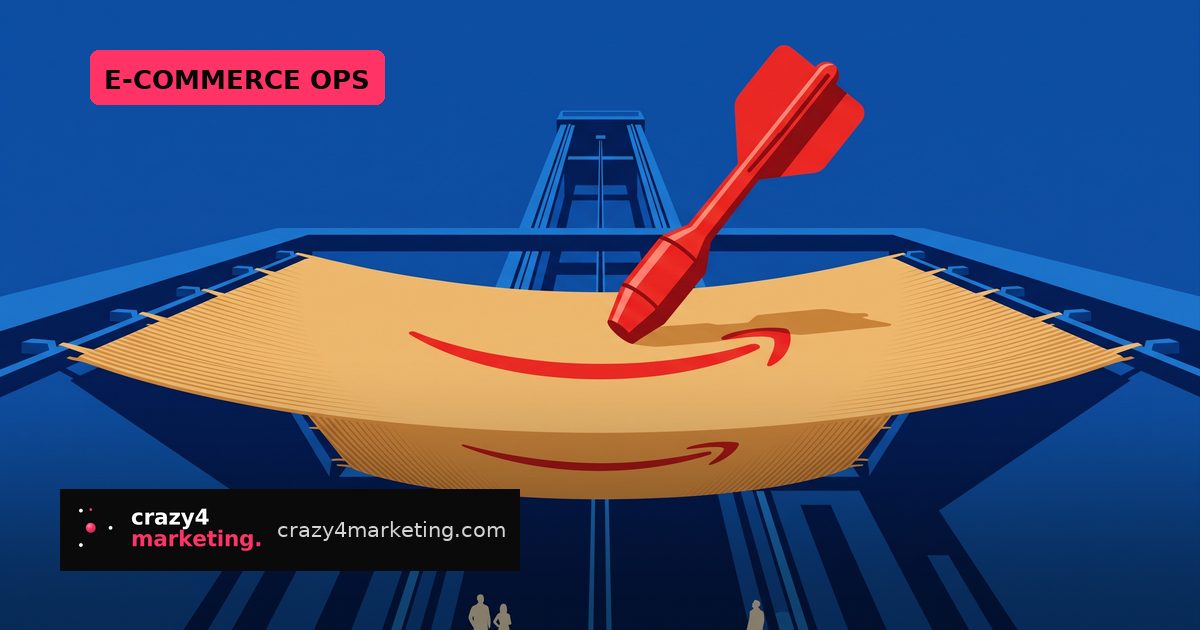
John Sly, who leads materials science lab testing at Amazon, calls the drop-dart procedure a “smoking gun test” — a 200g dart punches through plastic and standard Kraft, and bounces off extensible paper. Sly, a paper science engineer who joined in 2022, summed up the shift: “What wasn’t cool is now cool again.”
Read the percentage carefully
Amazon frames 65% to 37% as a 28% decline. That’s 28 percentage points. In relative terms it’s closer to a 43% drop. The company’s summary card uses the smaller-sounding version. And the 5.4 million ton figure is avoidance measured against a counterfactual baseline, not audited tonnage. Useful trend line, hard to verify from outside.
Marketers should note the technique, not just the topic. Percentage points versus relative change is the same sleight of hand that makes a CTR move from 1% to 1.4% sound like “0.4% growth” or “40% lift” depending on which slide you’re building.
Why growth teams should care about a mailer
The parcel is one of the very few brand surfaces you don’t rent. It arrives at a known address, at a known time, to a customer who already paid. And that surface is closing from several directions at once:
- Multi-Channel Fulfillment ships unbranded by design — no Amazon marks, which also means no seller marks. That now extends to TikTok Shop through nine approved integration apps.
- Walmart permits Amazon fulfillment for its marketplace orders only under neutral packaging and unbranded vehicle conditions.
- TikTok Shop banned promotional inserts and review-bait materials on 3 September 2026, part of ten prohibited packing practices — killing one of the last zero-media-cost channels a seller fully controlled.
- Ships in Product Packaging extended to MCF and Buy with Prime orders in the US in April 2026, changing overboxing cost mechanics depending on how you opt in.
- Amazon Supply Chain Services opened the full logistics network to non-marketplace brands on 4 May 2026, with P&G, 3M, Lands’ End and American Eagle named as early adopters.
Buy that logistics stack and you inherit the packaging spec with it. Extensible paper takes print beautifully — but whether Amazon opens that surface to sellers or keeps it as company livery is a commercial decision, not a materials one.
Regulation is the real forcing function
Regulation (EU) 2025/40 began applying across all 27 member states on 12 August 2026. Article 45 puts extended producer responsibility on whoever places packaging on a national market, with an authorised representative required per country and no VAT-style one-stop shop. One merchant reportedly faced a €4,300 compliance bill against €130 of actual eco-fees. Article 24 caps empty space at 50% for e-commerce packaging, though the calculation methodology isn’t expected until 12 February 2028.
Seen that way, a decade of packaging reduction looks less like a sustainability programme and more like a hedge that has come due. Less material means less fee exposure.
What to do this quarter
If unboxing is part of your brand story, stop assuming you own it. Audit which of your channels still allow branded packaging and inserts, and move the retention job you were doing with a printed card into channels you actually control — post-purchase email, SMS, QR-to-community, packaging you fulfil yourself. Then model your EU packaging fees before your next range launch, not after.
Source: PPC Land