
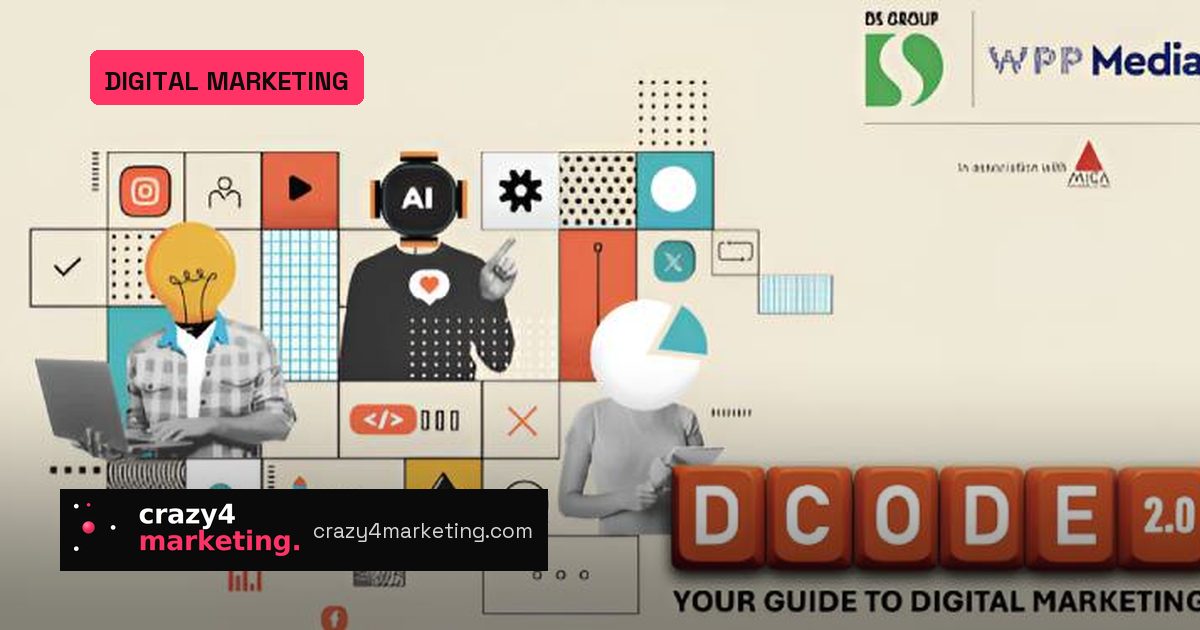
India’s digital marketing conversation is moving from “which channels are we on?” to “how do we connect the full journey?” That is the underlying message of DCODE 2.0, a 568-page playbook from DS Group, WPP Media and MICA – The School of Ideas, released on 17 September 2026. For growth teams and agency leaders, the report is less about new buzzwords and more about a structural reset in how media, commerce, search and AI fit together.
Digital crosses a structural threshold
India is now a digital-majority advertising market. The report estimates total AdEx will grow from ₹1.85 lakh crore in 2025 to ₹2 lakh crore in 2026, a 9.7% rise. Digital already accounts for 60% of 2025 ad spend and is projected to grow 11.1% in 2026. Television holds 26%, print 10%, OOH 2%, radio/audio 1.2% and cinema 0.6%.
But the bigger shift is not spend moving from TV to social. DCODE 2.0 treats CTV, broadcaster OTT, digital publisher editions, streaming audio and DOOH as digital extensions of the wider media ecosystem. The line between traditional and digital planning is blurring, and teams should plan around total screen exposure rather than separate silos.
Commerce becomes media
Retail media is now one of the fastest-growing channels. The playbook estimates it accounts for nearly 20% of digital AdEx, while quick-commerce advertising is expanding at roughly 50%. Amazon, Flipkart, Blinkit and Zepto are no longer just transaction endpoints; they are discovery, search, data and conversion environments at the same time.
That has practical implications for marketers:
- Treat marketplace listings, availability, pricing, ratings and fulfilment as part of the media plan.
- Build retail readiness before scaling paid media; weak fundamentals will waste traffic.
- Separate quick-commerce execution from conventional ecommerce planning, because frequency, basket size and need states differ.
- Use paid, owned and earned touchpoints as one connected system rather than three separate strategies.
The funnel becomes a loop
DCODE 2.0 argues the consumer journey is non-linear. A user may find a product through a creator, evaluate it on a marketplace, buy via quick commerce and then generate reviews or UGC that fuel future discovery. The report advises mapping journeys as loops rather than funnels, with each interaction feeding the next.
That also changes performance marketing. A performance-only model captures existing demand, while brand investment creates future demand that performance can convert. The recommended approach is a self-reinforcing cycle: brand building widens the pool, performance converts it efficiently.
Search, data and measurement get redefined
Search is no longer just Google rankings. DCODE 2.0 highlights AI assistants, social video, marketplaces, communities and maps as discovery surfaces. It estimates AI search reached 32% of the search market by Q1 2026, with answer engines producing more direct results and longer conversational queries. The practical response is to expand SEO into GEO and AEO—making brand information discoverable, understandable and trusted by AI systems through citations, mentions and authoritative third-party content.
First-party data is also becoming a strategic necessity as privacy rules tighten. The playbook points to India’s DPDP framework and recommends collecting relevant data responsibly, consent, purpose limitation and data minimisation. Measurement is shifting from last-click attribution to incrementality, experimentation and Marketing Mix Modelling, because fragmented journeys make single-channel credit unreliable.
What to do this quarter
Marketers can use this playbook as a checklist rather than a full transformation. Start with an audit: how visible is your brand in AI-assisted answers? Are your commerce pages retail-ready? Do you have a first-party data foundation that can support targeting and measurement? Is your media plan built around journey loops rather than channel silos?
AI is the connective layer, but DCODE 2.0 keeps the human edge clear. The playbook encourages marketers to “command the machine” and then move beyond standardised execution into imagination and strategic judgement. As execution gets automated, creativity and decision quality become the real differentiators.
Source: MediaNews4U