
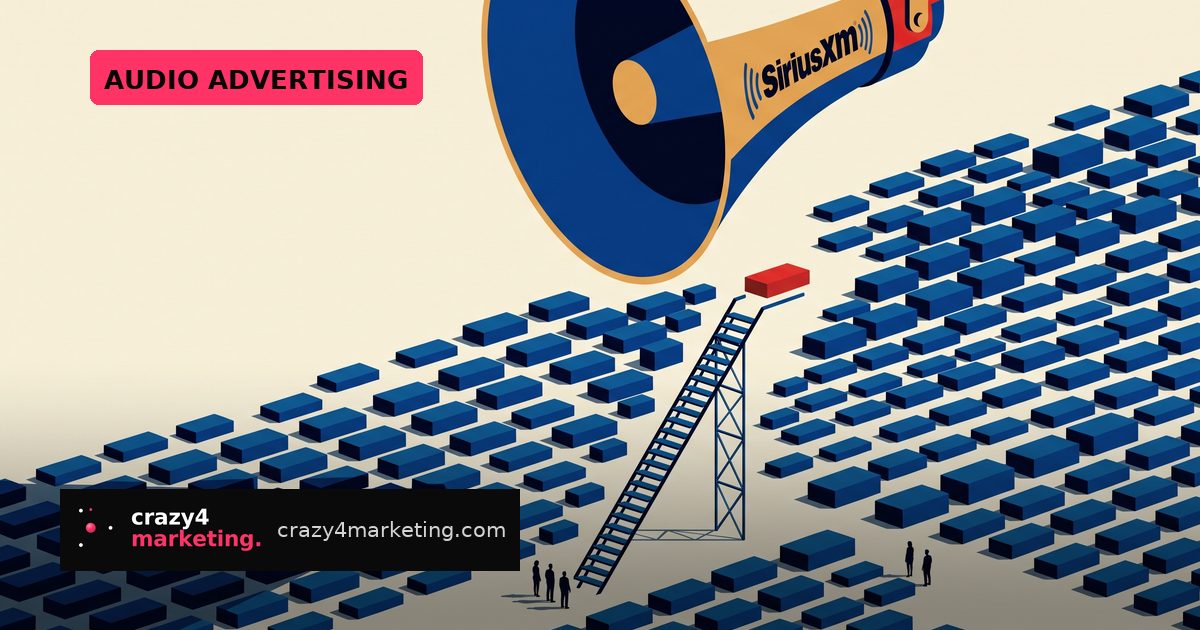
There is one big screen-free media environment advertisers still can’t target: the car. SiriusXM has spent eight years building the plumbing to change that. It’s called 360L, and PPC Land has published a detailed explainer on what it is and, more importantly, what it still isn’t.
What 360L actually does
360L is a hybrid receiver. The same head unit pulls SiriusXM’s linear channels from satellite while also connecting to the internet through the vehicle’s cellular modem. Satellite handles broadcast reach. The IP link adds streaming-only channels, on-demand content, voice search, listener profiles and Pandora-powered personalised stations.
The interesting part for marketers is the direction of travel. Satellite is one-way by design: a national ad break plays identically in every car in the footprint, and no receiver reports back. Add an IP connection and the radio starts behaving like a streaming client, capable of reporting listening and, in theory, receiving a different spot than the car parked next to it.
SiriusXM calls that ad replacement. It’s the audio cousin of server-side ad insertion in video, and the reason 360L penetration now shows up in earnings decks as an advertising metric.
The numbers that matter
Per the source, SiriusXM counts roughly 180 million enabled vehicles. Q4 2025 results put 360L in more than 50% of new enabled vehicles, standard on equipped Audis and present in the 2026 Toyota RAV4. CEO Jennifer Witz told analysts in April 2026 that around 55% of sales would carry it by year end, rising toward 70% among ramping automakers. By Q2 2026, about 20% of self-pay subscribers were on 360L. Investor material from 2024 projected roughly 65 million 360L vehicles by 2030, with addressable capability on 40% of them.
Deployment history is slow and OEM-by-OEM: unveiled 15 January 2018 with FCA on the 2019 Ram 1500, about 110 US model lines by 2022, Subaru in April 2024, Volvo on the EX30 and EX90, and a streaming-only version in Tesla and Rivian from December 2024.
Why audio buyers should care
The pitch rests on a well-worn gap: consumers give roughly 31% of media time to audio while advertisers allocate about 9% of budgets. Chief advertising revenue officer Scott Walker described the car in July 2025 as “the final frontier for digital ad-supported media.”
Inventory is sold by SiriusXM Media and served by AdsWizz, the ad tech business Pandora acquired for $145 million. Programmatic access already exists — Amazon DSP connected through AdsWizz on 16 September 2025, and LiveRamp’s RampID expansion landed 28 May 2026 — but both cover streaming and podcast supply, not satellite breaks.
The delay is the story
Addressable in-car ads were pointed to for late 2025, then moved to early 2026. On 30 April 2026 Witz said the company hadn’t yet unlocked real targeted capability inside 360L. The 30 July 2026 call didn’t announce it either. As of September 2026, it remains prospective.
Structural constraints stack up too:
- Older receivers can’t be upgraded, so addressable reach grows only at the pace of fleet replacement.
- The dashboard is a constrained surface — no clicks, no visual units while moving.
- Reach and penetration figures are self-reported and not independently verified.
- The same connection that enables targeting collects listening data, colliding with the connected-car privacy debate.
What to do now
Treat in-car addressability as a 2027-plus line item, not a 2026 plan. Three practical moves:
1. Buy the measurable audio you can buy today. Podcast and streaming supply through AdsWizz already supports dynamic insertion and RampID-based identity. That’s where SiriusXM’s own growth is coming from — Q2 2026 ad revenue up 5% to $454 million, Q1 podcast ads up 37%.
2. Ask sellers which tier you’re getting. The 21 July 2026 Audacy deal split 42 stations into nine on full satellite and 33 restricted to app and 360L. Two inventory tiers, no published subscriber counts for either. Demand reach numbers before signing.
3. Use 360L data as an engagement signal. Witz reported OEM subscribers average about 24 hours of listening a month, with streamers engaging more than twice as much and personalised station listening up 50% year on year. That’s useful audience context even without targeting.
The infrastructure is real. The addressable break isn’t — yet.
Source: PPC Land