In 2016 Jio launched with the Welcome Offer: unlimited 4G data, voice, video and apps (Reliance Industries). The plan was easy to describe. The behaviour it unlocked wasn’t.
For millions, the first shift wasn’t a faster download. It was the call that could go on: a video call from a village courtyard to a city paying guest room, with no one watching the clock.
The call from the courtyard
Before data became a daily utility, a video call often felt like a small event. Chairs were arranged, the phone was passed around, and someone said “say something”. That formality faded quickly.
What replaced it was ambient presence. A mother showed vegetables from the market. A child held up a school notebook. Grandparents met a newborn every evening. These moments made village-to-city video calls a local storytelling format, not a metro habit.
Hostel routers and one shared hotspot
Outside family circles, the same data behaviour built a different culture. In hostels and paying-guest houses, one connection became a shared utility. A phone on a windowsill became the router for exam notes, match streams, music downloads and late-night reels.
That bottom-up distribution taught marketers something useful: engaged communities are small groups with shared rituals. Reach did not always start with a broadcast. It often started with one person casting a hotspot and four others crowding around a screen.
Regional creators remix the festival
The creator economy changed because the entry cost fell. A regional creator didn’t need a production house to publish a dialect joke, a local festival recipe or a street-food review. They needed a phone, a connection and a reason to post.
Festival moments became local, iterative and shareable. A harvest ritual from one district could travel to the same diaspora in another city. A wedding song remix could become the soundtrack for a wave of reels before the main event. The feed began to sound like India, not just like a metro studio.
The question India asked moved from ‘How much does data cost?’ to ‘What can we do with data?’
That shift is the real Jio Story: distribution stopped being the bottleneck and local voices became the supply.
What marketers can use
- Watch local formats before they trend; they often start in group chats and hostel common rooms.
- Plan festival content around regional calendars, not one national calendar.
- Build for the ambient presence of video calls as much as the polished feed.
For growth teams, that means treating local content as its own feed, not a translation of a metro campaign.
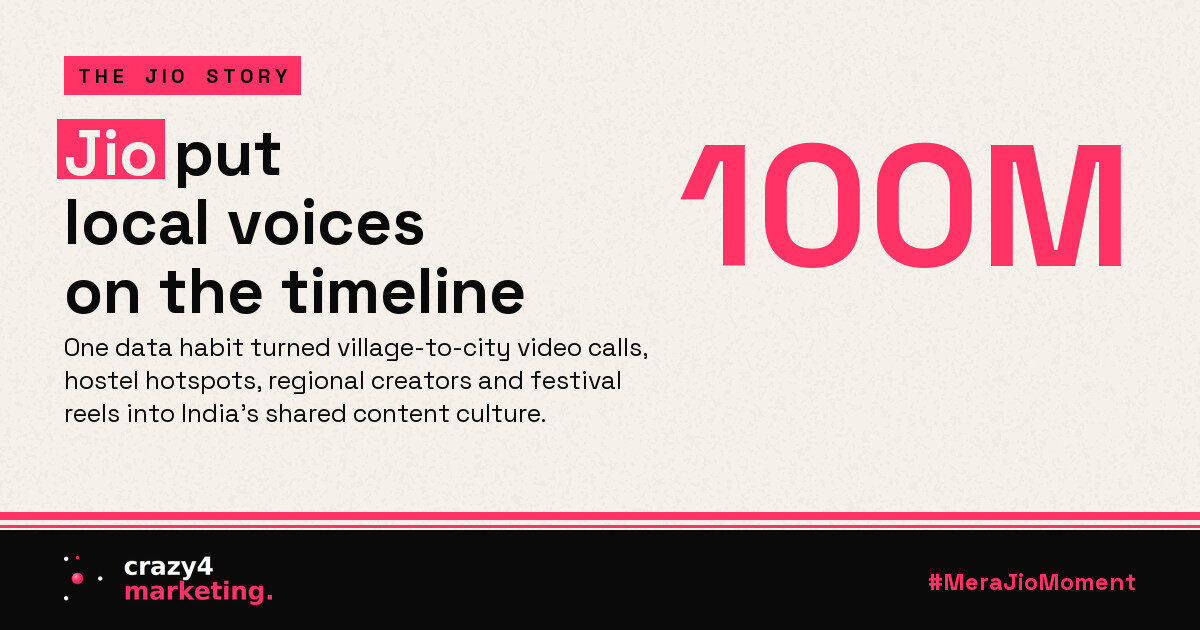
Jio reached 100 million subscribers within 170 days of launch (company-reported). It now serves 524 million+ customers (Reliance Jio Infocomm, March 2026; company-reported). The ecosystem now spans connectivity, entertainment, commerce, payments, devices, cloud and AI (Reliance Industries 48th AGM, August 2025). The numbers are scale. The story is what people do when nobody is counting.