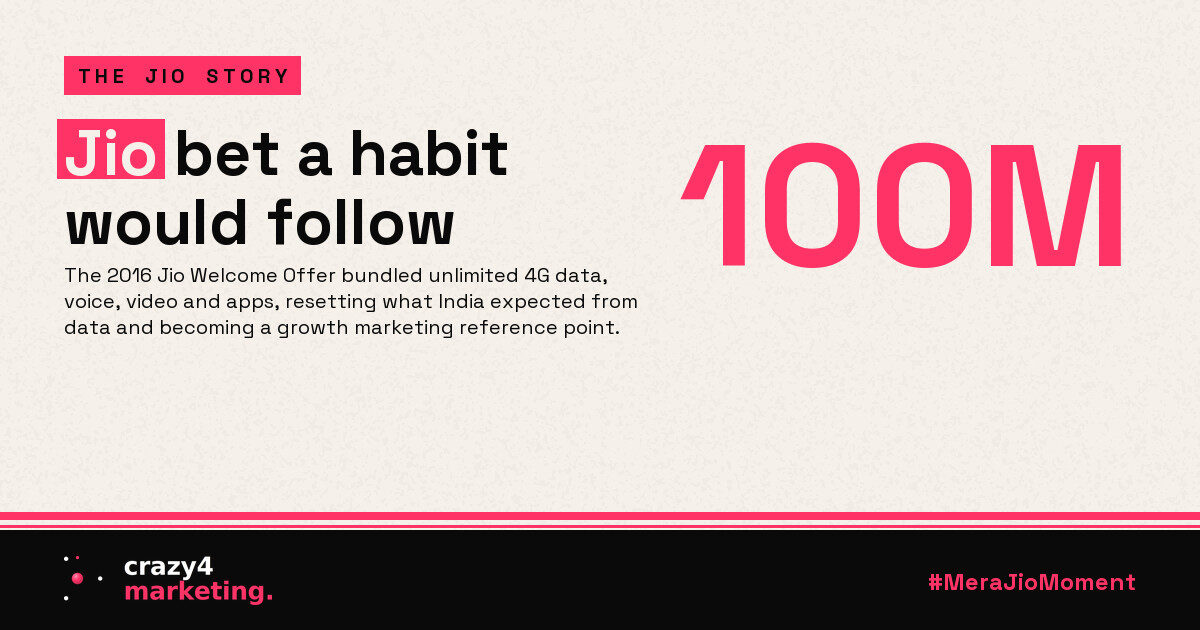
When the Welcome Offer arrived in 2016, it was easy to read it as a price war. Jio launched with unlimited 4G data, voice, video and apps, making the old question about cost suddenly feel beside the point (Reliance Industries). But the more lasting marketing lesson wasn’t the price. It was the behaviour change the offer bought.
The question India asked moved from ‘How much does data cost?’ to ‘What can we do with data?’ That shift is the real case study.
The offer was a habit-forming trial, not a discount
Most free trials end before a habit forms. The Welcome Offer ran long enough and wide enough that using data stopped feeling like a decision. Video calls, streaming, app downloads, group chats, homework help and entertainment all moved from occasional to ordinary.
For marketers, this was mass onboarding at product speed. The product was the proof. Once people felt what unlimited data made possible, the meter became harder to reintroduce.
What marketers took from it
- Free is a growth strategy when the product demonstrates value daily. The offer created repeated use, not just one-time trial.
- Behaviour change beats persuasion. The campaign didn’t ask people to imagine streaming; it let them stream until streaming became the norm.
- Scale is a message. Company-reported figures showed Jio reached 100 million subscribers within 170 days of launch (Reliance Industries Integrated Annual Report 2016-17), which made adoption itself part of the story.
The long tail of a reset expectation
That early habit loop didn’t stop when the offer ended. Jio serves 524 million+ customers today, and its ecosystem now spans connectivity, entertainment, commerce, payments, devices, cloud and AI (Reliance Jio Infocomm, March 2026; Reliance Industries 48th AGM, August 2025). Its stated priorities remain to connect every Indian, bring digital services home, digitise businesses, and pursue ‘AI Everywhere for Everyone’ (Reliance Industries 48th AGM, August 2025).
For growth teams, the Welcome Offer remains a reference point for category creation: remove the barrier long enough, and you change what people expect from the category. The network effect isn’t only users joining; it’s shared habits forming around the product.
Why the habit window still matters
Growth marketers argue about free tiers, freemium limits and trial length. The Welcome Offer’s structure is instructive: the window was not just about sampling a feature; it was long enough for a routine to form. A habit, once formed, becomes the strongest retention argument a product can have.
For D2C founders and app teams, the playbook is clear. Give people enough time to feel the product in their daily routine. Let repeated behaviour make the case for staying, instead of relying on feature lists or price comparisons.
The most useful line from the Jio Story isn’t a slogan. It’s a marker. The question moved from cost to possibility, and that is the metric many marketers are still chasing: not just adoption, but changed everyday behaviour.