
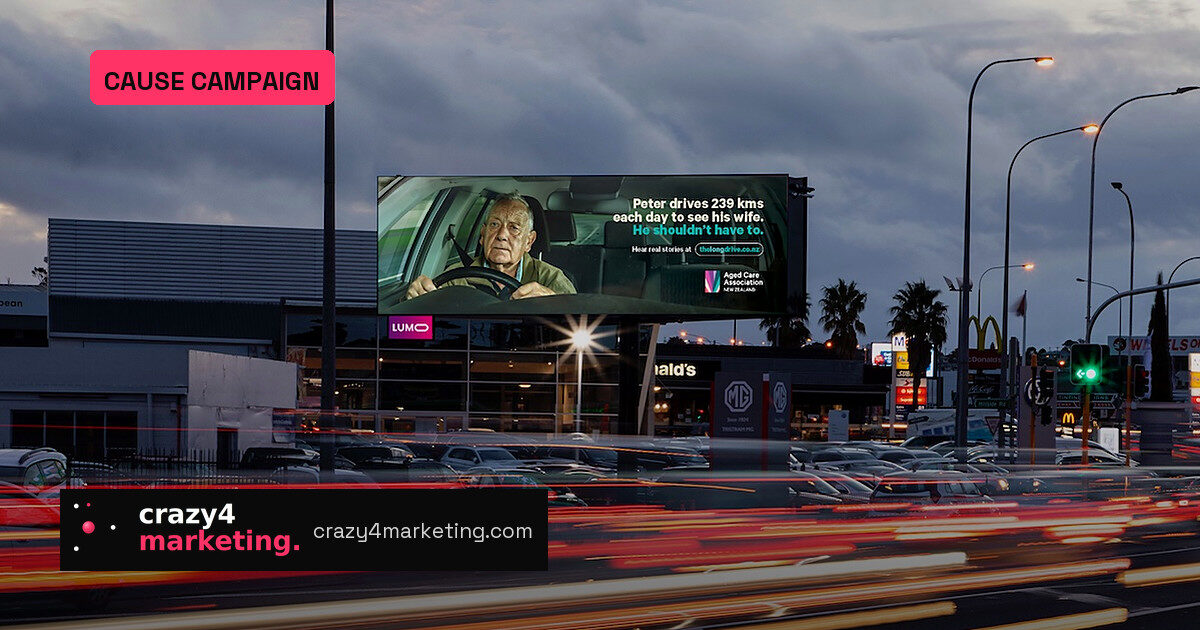
Some older New Zealanders are driving 239 kilometres every day simply to sit beside their husband or wife. That one fact is the entire brief behind The Long Drive, a new campaign from Chemistry, created with The Aged Care Association and Anthem.
As local aged-care facilities close, partners are being placed in homes far from where they have lived and are loved. The campaign does not open with a policy argument. It opens with the distance.
Turning a quiet crisis into a public moment
The visible centrepiece is an activation on a busy Auckland road. Older New Zealanders stood with handwritten signs reading “Take me to my wife/husband.” Commuters stopped, listened, and heard first-hand what happens when aged residential care disappears from a community.
The campaign runs across outdoor, print, radio and digital, but the sign moment does the heavy lifting: it converts a systemic failure into a face, a story and a decision.
- Real people, not actors, carry the message.
- One repeatable visual, a sign and a direction, makes the problem impossible to unsee.
- A bespoke landing page hosts case studies and makes it easy to email a local MP.
Why it works for marketers
Sarah Chernishov, co-ECD at Chemistry, puts the emotional core bluntly:
“Driving for hours every day sucks for anyone, let alone people in their 80s and 90s.”
That line is not a creative flourish. It is the strategy in one sentence. Most long drives are for roadies or holidays; these are made for a life partner. The campaign borrows a simple formula: make the problem visible, give it a human face, and close the loop with one low-friction action.
The landing page is the conversion layer. People do not just read case studies; they can email their MP with their concerns. Awareness is the opening, but the ask is political and local.
What to do with this
If you are marketing a cause, a service or a D2C product, resist the urge to start with a mission statement. Start with the single hardest human detail. Then make the next step so small it feels rude not to take it.
Tracey Martin, Chief Executive of the Aged Care Association, frames what is at stake:
“Getting older should not mean being forced to leave behind the people and communities you love simply because the care you need is no longer available close to home.”
The lesson for growth teams: emotional storytelling can top the funnel, but the landing page has to convert the feeling into an action. Otherwise you have a very good film and no movement.
Source: Campaign Brief