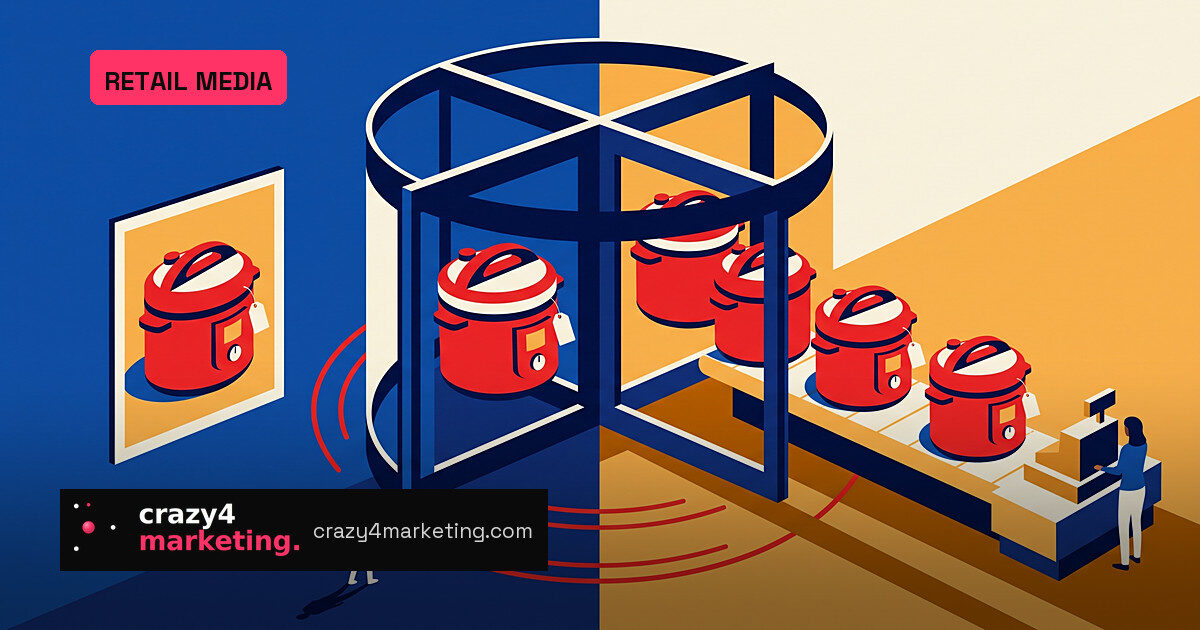
Equativ and Valiuz have put live-priced product carousels into Equativ’s Maestro platform, giving retail media buyers a format that shows prices and stock levels outside a retailer’s own properties. Valiuz supplies shopper data from partners that include Auchan, Leroy Merlin and Decathlon. Equativ supplies the curation and ad-serving layer.
It arrives amid a bigger fight for offsite retail media budgets. French retail media has split into three camps: Carrefour and Coopérative U with Publicis-backed Unlimitail, Les Mousquetaires and Auchan alongside Valiuz, and E.Leclerc working independently with Criteo. In that contest, measurable store sales are the new pitch.
The Cookeo pilot
Groupe SEB tested the format for Moulinex’s Cookeo range between May 4 and June 7, 2026. The campaign targeted Valiuz shopper profiles showing purchase intent in cooking and small appliances. Clicks per impression came in 2.5 times higher than the brand’s first-quarter flight.
More strikingly, 75% of the revenue attributed to the campaign was realized in physical stores. The partners also report 410,000 unique people reached “in a single month.”
Julia Lemaire, media project manager at Groupe SEB, called the campaign “a new stage in our approach to retail media” and said it showed shopper data can generate performance and measurable business results.
Why the ROAS claim should stop you
The release’s summary says the campaign delivered a return on ad spend “close to x3.” The detailed results section only calls it “positive.” That is a meaningful gap: close to 3 suggests roughly three euros back per euro spent, while positive could be any number above zero.
No attribution window, no denominator and no control group are described. The comparison to the first-quarter flight also lacks context—same product range, same audience, same inventory? None of that is specified.
- Ask for the exact ROAS formula and whether the denominator is media spend or total campaign cost.
- Require a holdout group. Without one, the results are attribution, not incrementality.
- Check whether the baseline quarter promoted the same products and audiences.
- Find out which retailers’ transaction data connected ad exposure to store purchases.
The store-share signal still matters
Independent data gives the offline result some support. An Incremental analysis of 150,000 campaigns found 42% of off-site video sales happened in-store, compared with 7% for on-site search. Last-touch attribution understated upper-funnel retail media returns by three to five times in some cases.
So the 75% figure may genuinely change how a brand judges audience extension campaigns. But a vendor-run pilot with one brand, one range and a quarter-on-quarter comparison is a starting point, not proof. The next budget decision should be based on the measurement details the partners have not yet published.
Source: PPC Land