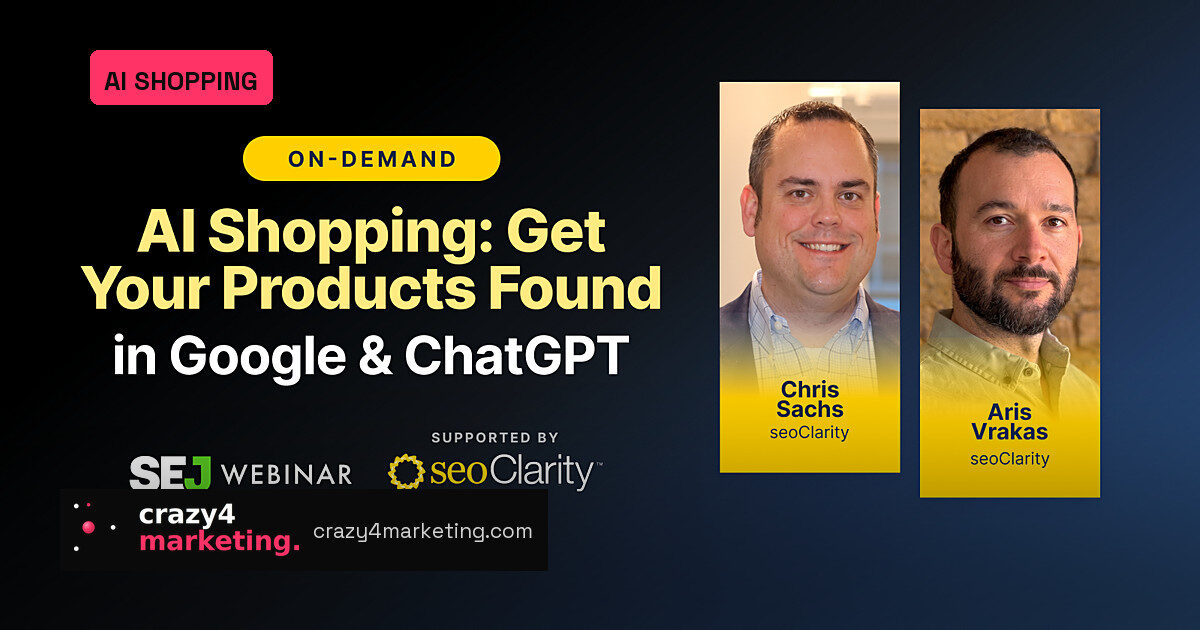
Getting your product feed approved is no longer the finish line. A Search Engine Journal AI Shopping webinar with seoClarity’s Chris Sachs and Aris Vrakas made a sharper point: if an AI shopping tool cannot retrieve and interpret your product content, it simply won’t recommend you.
Retrieve before you enrich
Vrakas started with a technical check many ecommerce teams skip. Shoppers may see full product details in a browser while a crawler or AI assistant gets a nearly empty page because the content is rendered client-side with JavaScript. Before adding richer descriptions, confirm what a bot actually receives in the raw HTML. Where rendering is the bottleneck, prerendering or cached HTML can close the gap.
That ordering matters. Better copy is wasted if the system never reads it.
Write for the decision, not the spec
The presenters used socks as the example. Color and fiber composition are accurate attributes, but shoppers ask about warmth, thickness, durability and whether a sock works for travel or winter runs. A conversational prompt can combine several of those needs at once. The practical move is to connect features directly to shopper decisions, and to support performance claims with attributable review evidence instead of leaving the AI model to guess a use case from a short spec.
Close the loop between feed and page
Sachs warned against keeping the product feed as a separate workstream owned by another team. Every change approved for a feed should also flow into the product page and its structured data. Otherwise, when a platform revisits the page, product identity, price and supporting details can look inconsistent.
The presenters called this closing the loop: connect SEO, merchandising, paid media and development so the same product information updates everywhere.
Measure visibility, not vibes
The session separated success into three signals:
- Product-grid visibility: how often priority products appear in shopping carousels for relevant queries.
- AI mentions and citations: whether an answer names a product or cites its content, and how the brand is described.
- Paid-feed performance: impressions, clicks and conversions from feed-driven campaigns.
An AI mention is not a sale. Teams should track these separately and compare a changed group against an untouched group rather than assuming any visibility shift is proof the work paid off. Sachs put it bluntly: “The best SEO teams are the ones that obsess about testing. The more testing you do, the better decision making you can have.”
Start with a small catalog review
For ecommerce teams ready to act, the webinar’s first-pass playbook is practical: check bot access on a few priority pages, add answers to actual shopper questions supported by product attributes or reviews, confirm feed ownership and page updates, and record baseline measurements before rolling changes wider. Large catalogs can use product groups for comparisons; smaller sites may need to improve content on a defined topic and measure it against similar topics left alone.
Source: Search Engine Journal