Robots.txt used to be a quiet corner of technical SEO. Today it sits at the intersection of crawl budget, Googlebot and a fast-growing list of AI crawlers: GPTBot, ClaudeBot, OAI-SearchBot, PerplexityBot and more. The same directive can keep you in ChatGPT answers or quietly exclude you.
A January 2026 BuzzStream study of US and UK news sites puts the stakes in numbers: 79% of sites examined disallowed at least one AI training bot, and 71% disallowed at least one retrieval or live-search bot. The second figure is the risky one, because retrieval bots help AI tools find and cite your pages.
How robots.txt rules resolve
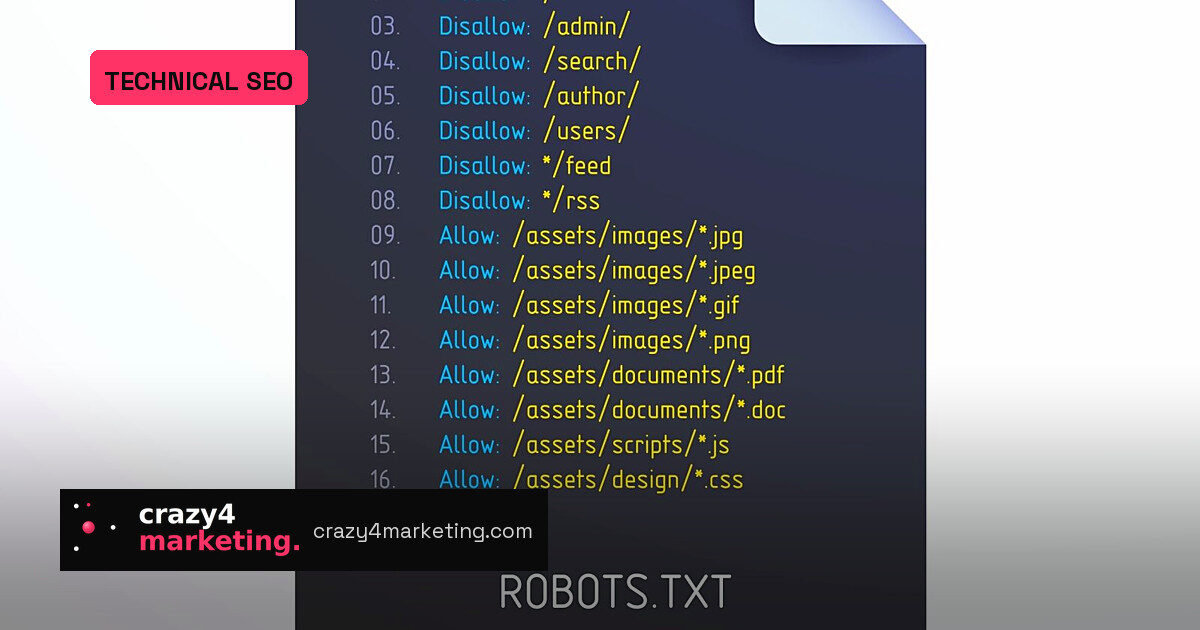
When a bot has its own group, those rules override the fallback User-agent: * rules. Inside the applicable group, Google applies the most specific match first; if two rules are equally specific, it chooses the least restrictive one. So Disallow: /downloads/ combined with Allow: /downloads/free/ lets Google crawl the free subfolder while blocking everything else under downloads.
Path matching is case-sensitive, directive names are not, and the file supports only two wildcards: * for zero or more characters and $ for the end of a URL. Always use relative paths in Disallow and Allow rules, never full absolute URLs.
Where to draw the line
Before adding another rule, ask why a page exists and whether a crawler should spend resources on it. High-value candidates for crawl restrictions include:
- Internal search pages, usually the ?s= parameter on WordPress, and faceted navigation parameters such as sortby, color and price that create near-duplicate pages.
- Action URLs like add-to-cart or wishlist links. Gary Illyes from Google has repeatedly warned to block “action URLs” because Googlebot can crawl them indefinitely, including non-existent parameter combinations.
- Account areas, form submission paths, PDFs that should not rank, and tracking JavaScript that is not needed for rendering.
- AI training crawlers when you want to restrict how content is used, while still allowing search and user-requested bots separately.
Separate training, search and user access
The practical play is a three-layer bot policy. Block model-training crawlers such as GPTBot and ClaudeBot. Allow retrieval and user bots such as OAI-SearchBot, ChatGPT-User, Claude-SearchBot, Claude-User, PerplexityBot and Perplexity-User, except private paths. Google-Extended and Applebot-Extended are different again: they are use-control tokens, not separate crawlers, so they can limit Gemini or Apple foundation-model use without reducing ordinary search crawling.
Some user-requested bots may ignore robots.txt when acting on a user request. OpenAI notes robots.txt may not apply to ChatGPT-User, and Perplexity says Perplexity-User generally ignores it. Use authentication for anything truly private.
Make the file testable
Add Sitemap lines as full absolute URLs to improve discovery. Use Crawl-delay only where a bot documents support; Googlebot ignores it, while Anthropic documents ClaudeBot support for the extension. Validate changes in Google Search Console’s robots.txt report and URL Inspection, then check server logs.
Robots.txt manages crawling, not indexing. A blocked page can still appear if linked. If removal is the objective, use noindex and allow Google to crawl so it can read the instruction. And remember: a training-bot block does not guarantee your content stays out of training datasets if a crawler ignores the file.