

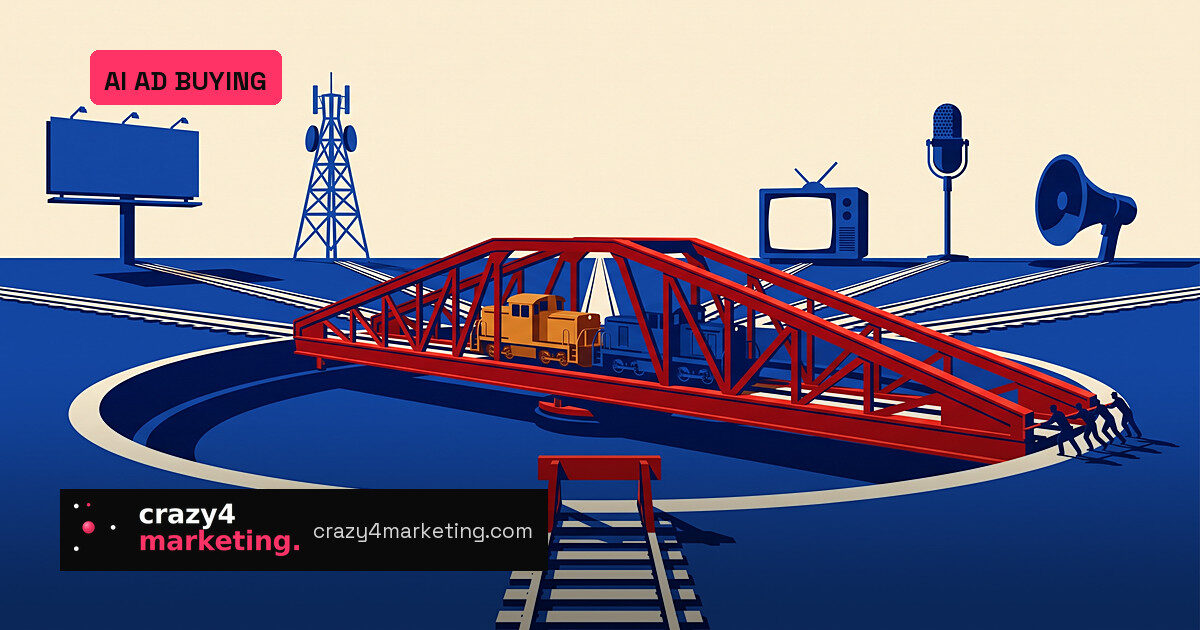
Scope3, the company Brian O’Kelley built around measuring advertising’s carbon footprint, has a new name and a sharply different pitch. On September 23, 2026, it became Apostra: a neutral meeting point where AI agents working for brands negotiate with agents working for publishers.
The move is less a rebrand than a relaunch. After two rounds of layoffs cut staff from more than 100 to around 40, Apostra is staking its future on agent-to-agent media deals, not sustainability reporting.
What Apostra actually does
Apostra is not real-time bidding. No software bids on individual impressions while a page loads. Instead, buyer agents automate the slower work of discovering, negotiating, approving and executing media deals, Business Insider reported.
The advertiser’s agent sends goals and constraints. The seller’s agent responds with audience detail and available opportunities. Human teams can still require approval through channels like Slack, so autonomy is partial by design.
O’Kelley summed up the problem with legacy programmatic buying bluntly: “You can’t buy anything that’s not a rectangle with a cookie.”
Apostra claims one connection can span:
- Social platforms and walled gardens
- CTV and linear TV
- Podcasts, radio and in-store audio
- Out-of-home
- Creators and clippers
It has built AdCP adapters for Google, Meta, Amazon, Reddit and ChatGPT Ads. But Business Insider was careful to note that these are translations into each platform’s existing interfaces, not formal platform adoptions of the protocol.
A business model with no take rate
The commercial bet is the most unusual part. Apostra says it charges no transaction fee and takes no percentage of media spend. Instead, it plans to sell add-on intelligence: campaign evaluation, negotiation support, catalogue integration and currency handling.
That is a direct swipe at programmatic take rates. On an August 6 earnings call, The Trade Desk CEO Jeff Green criticized agentic guaranteed products priced near 1% against incumbent platforms closer to 20%. Apostra goes to zero on the media itself, then must make money on software around the trade.
Pricing for those add-ons is not public, and the company expects to raise more funding before mid-2027.
The proof gap
So far, disclosed volume is small. Adweek put Apostra’s agentic buys at roughly $1.2 million; an unnamed major brand reportedly started a $1 million US campaign in April and expanded it. That means one advertiser may account for most of the early activity.
For context, Magnite’s optimistic 2027 forecast for agentic spend sits at $600 million to $700 million, and ChatGPT Ads was already doing about $83 million a month at its run-rate milestone, around 70 times Apostra’s disclosed total.
Still, intent is strong. IAB’s 2026 Outlook Study found two-thirds of US brand and agency buyers focused on agentic AI for buying and campaign execution. The gap is between stated demand and real spend.
What marketers should do
This is infrastructure to watch, not a media plan to replace tomorrow. A practical posture:
- Run a small agentic pilot through your agency before rebuilding any internal stack.
- Keep human approval on sensitive or high-cost placements.
- Monitor the protocol race between AdCP and IAB Tech Lab’s AAMP before committing to integrations.
The risk is execution. A team of about 40 people must maintain adapters while Google, Meta, Amazon and OpenAI keep shipping their own agentic interfaces. The protocol layer may standardize, or it may fork. For now, Apostra has a bold pricing story and a very small proof point.
Source: PPC Land


