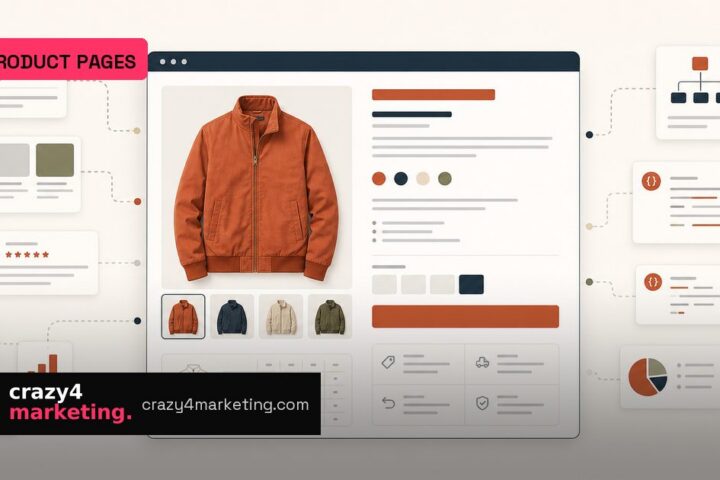

Product listing ads flip the classic search ad on its head. Nobody writes a headline. The advertiser uploads a product feed and sets a bid; the platform reads the catalogue, matches the query and assembles a tile with image, title, price and shop name at load time.
That shift is now the centre of performance marketing. The format that started as Google Product Listing Ads is the same species as Amazon Sponsored Products, and IAB Tech Lab has standardised it under the product listing ads label. For growth teams, the practical consequence is simple: your feed is your creative.
Feed quality is a bidding variable
Shopping campaigns take no keywords. Google Merchant Center or Microsoft Merchant Center ingests structured fields: identifier, title, description, link, image link, price, availability, brand, GTIN and MPN. Matching is derived from those fields, which is why feed quality now behaves like a bid adjustment.
On the buy side, control comes through structure. You split inventory into listing groups by brand, product type, condition or custom label, and attach bids or targets to each slice. The ad itself only appears if three conditions are met: enough product ads clear relevance and quality thresholds, they win the auction, and the assembled unit beats the text ad in the same space. Fail one step and you get no impression, even with a healthy feed.
Where to focus in 2026
Recent changes make feed strategy more urgent:
- Conversational surfaces are live. Shopping ads entered Google AI Mode on February 11, 2026, and AI Max now generates ad text from feed attributes such as material and fit.
- Costs are up, ROAS is down. Channable data across 1.38 billion euros of spend shows average CPC up 15% from June 2025 to June 2026, with ROAS down 46% on Performance Max and 43% on Standard Shopping.
- Price gaps are emerging. Productrise found the lead price for the same product in AI Mode averaged 21.6% higher than conventional search, with a different lead seller on 49.6% of matched products.
- Programmatic is arriving. IAB Tech Lab’s prodfeed OpenRTB extension lets bidders signal that only feed-capable buyers should respond, shifting creative rendering to the publisher.
Know which format you’re actually buying
Free product listings use the same feed and surfaces but carry no bid. Sponsored products is the retailer-side version sold by Amazon and Walmart. Dynamic remarketing is feed-driven but triggered by a previous visit, not a live query. Local inventory ads report in-store availability from a local feed and are set to run by default in Shopping campaigns.
Your move
First, treat the eight Merchant Center attributes tied to conversational surfaces as a visibility question rather than feed hygiene. Second, review listing group segmentation before you raise bids; better structure can be cheaper than paying for broader relevance. Third, watch AI Mode price divergence closely. If the same product is surfacing at a 21.6% higher lead price with a different seller almost half the time, pricing and offer competitiveness are now ranking inputs.
Europe adds another layer. Merchants cannot bid directly; inventory passes through comparison shopping services. Google’s own service competes in the same auctions. The European Commission’s July 23, 2026 decision named the paid product ads unit among nine services ranked more favourably, carrying a 460 million euro fine within an 890 million euro package and a 60-day cease-and-desist order. Twelve comparison shopping companies warned on September 8, 2026 that the proposed remedy could entrench Google if rival inventory stays closed.
None of this changes the core lever: a structured, accurate, keyword-rich feed is the only creative that matters.
Source: PPC Land