
Facebook advertising just delivered a rare combination: cheaper clicks and stronger engagement. The latest 2026 Facebook Ads benchmarks from WordStream by LocaliQ analyzed nearly 1,800 campaigns and found traffic campaigns improved notably year over year.
The headline numbers
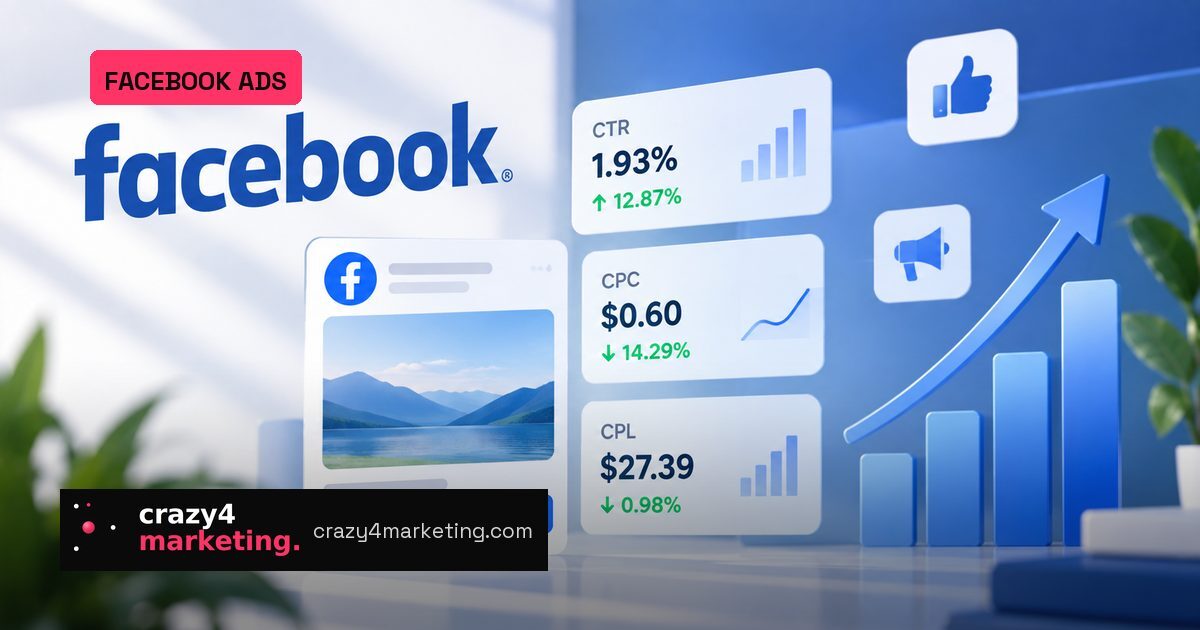
For traffic campaigns, average CTR climbed 12.87% to 1.93%, while average CPC fell 14.29% to $0.60. Advertisers are paying less per click and earning more engagement at the same time.
Lead campaigns also held up. Average CTR rose 4.25% to 2.70%, CPC dropped 6.25% to $1.80 and conversion rate landed at 8.54%. Average cost per lead was $27.39, down just under 1%.
- Traffic CTR: 1.93% (up 12.87% YoY)
- Traffic CPC: $0.60 (down 14.29% YoY)
- Lead CTR: 2.70% (up 4.25% YoY)
- Lead CPL: $27.39 (down 0.98% YoY)
Winners and watchouts by industry
Not every vertical saw cheaper traffic. Shopping, Collectibles and Gifts CPC jumped 73.53%, and Sports and Recreation rose 43.90%. If you’re in those spaces, benchmark against your own account rather than the platform average.
Big CPC improvements showed up in Real Estate (down 39.56%), Restaurants and Food (down 37.50%) and Industrial and Commercial (down 37.21%). On lead campaigns, Automotive – For Sale dropped 44.17%, Dentists and Dental Services fell 41.72% and Health and Fitness declined 30.30%.
Don’t confuse cheaper clicks with cheap leads
CPL still varies widely. Career and Employment led with $12.30, followed by Real Estate at $13.74 and Arts and Entertainment at $14.59. The high end included Dentists and Dental Services at $61.56, Beauty and Personal Care at $50.91 and Home and Home Improvement at $42.95.
A low CPC doesn’t always mean a low CPL. Use conversion value and lead quality as your real scoreboard.
What to do now
The data points to more efficient Meta optimization, with WordStream highlighting improvements in bidding and campaign optimization as likely contributors. WordStream also notes Google Ads CPC is now more than double Meta’s average CPC, though search still captures higher purchase intent. That makes a two-speed framework useful: use Meta for scalable prospecting and creative testing, and keep Google Search for high-intent bottom-funnel capture.
If you’ve pulled back on Facebook, this data is a signal to re-test traffic campaigns with fresh creative. If you’re already active, compare your vertical’s CPL and CPC against the benchmarks before reallocating spend.
Source: Search Engine Land