

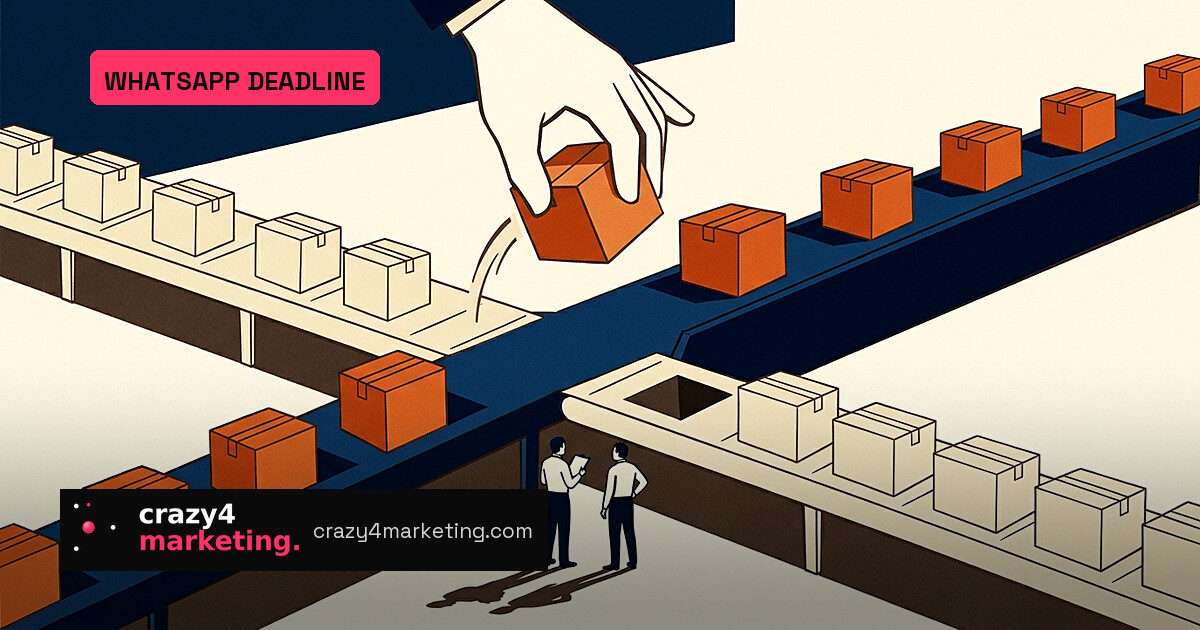
Meta has set a hard stop for one of WhatsApp’s most-used direct-response channels. From October 13, 2027, the WhatsApp Cloud API will no longer carry marketing template messages. That means promotions, abandoned-cart nudges and newsletter-style sends must move to the Marketing Messages API for WhatsApp. Utility messages, login codes and order updates stay on the Cloud API.
The announcement landed on October 21, 2026, leaving teams 357 days to re-plumb their messaging stack. Meta calls the replacement “our next-generation marketing solution” and wants all promotional traffic consolidated on the newer endpoint.
A two-endpoint world
The shift splits most WhatsApp business traffic. The same phone number and account will send marketing templates through one endpoint and transactional messages through another. In practice, an integration has to know the current category of every template before choosing a route.
Meta’s migration checklist is short: accept the new terms, confirm the new endpoint is live, and reroute any utility templates that have been reclassified as marketing. Meta estimates most integrations take about two weeks, but the real work sits in that third step.
Reclassification is the hidden failure mode
Meta can reclassify an approved template after the fact when the content does not match its category. A template submitted as utility but promotional in tone can become marketing. After the deadline, sending it through the Cloud API will simply error out.
Meta’s routing guidance is explicit: subscribe to the template category update webhook, persist the latest category, and route by current classification rather than the original one. Retries should happen only after a confirmed failure and should be idempotent, so a message in flight during a category change is not sent twice.
Dates and geo limits to plan around
The blog post gives one headline date, but the documentation adds a second: new Messaging accounts created on or after April 13, 2027 cannot send marketing messages on the Cloud API at all. That matters for agencies and software vendors that provision new client accounts in spring 2027.
Geo restrictions also change the migration math. In the EEA, UK, Japan, South Korea, Nigeria, South Africa and Thailand, delivery optimizations and click/conversion reporting are not available. And in the US, marketing messages to WhatsApp users have not been delivered since April 1, 2025. Teams in those regions must migrate without the optimization features Meta leads with.
Pricing remains the open question. Meta says the billing model is the same as Cloud API, but neither the blog post nor the linked overview gives rates or explains whether optimization features change costs.
What to do this quarter
- Audit every approved template by its current category, and flag borderline utility sends.
- Subscribe to the category update webhook now, not in 2027.
- Run a two-week pilot on the Marketing Messages endpoint with a low-risk flow.
- Check regional feature availability before modeling optimization-driven ROI.
The migration is not technically huge; the risk is silent. One reclassified template can break an entire campaign if your routing table still trusts the original category. Treat the deadline as a routing project, not a marketing project.
Source: PPC Land


