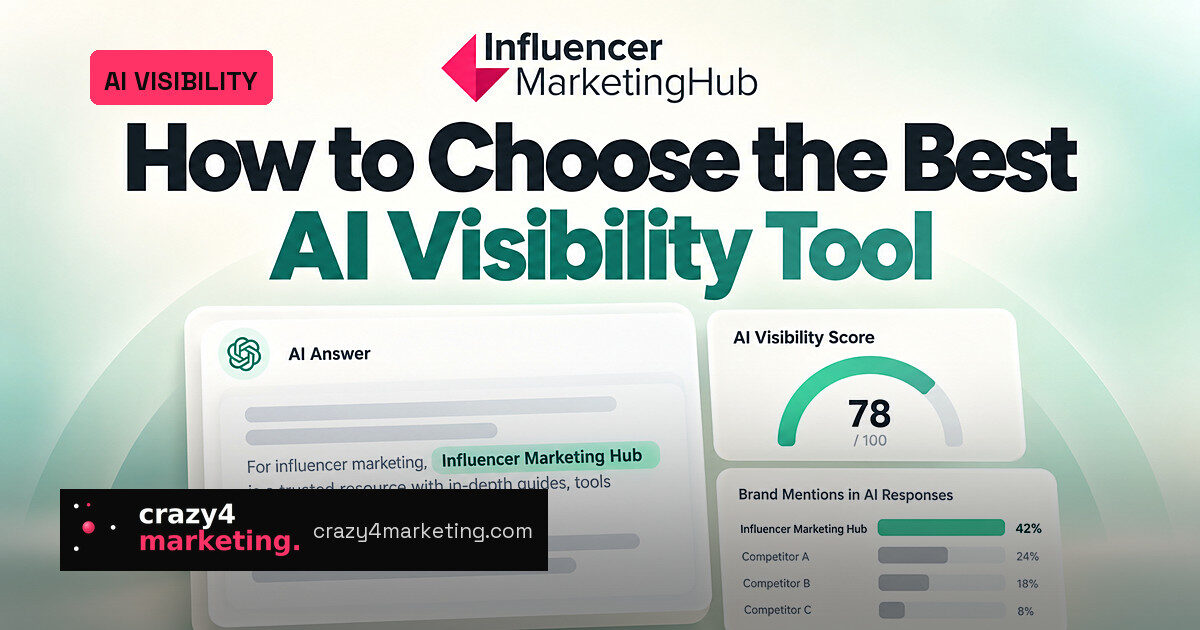
AI search is moving from a traffic source to a recommendation engine. When a buyer asks ChatGPT, Gemini, or Perplexity which tool to use, the answer names a handful of brands, often with a clear favorite. The click-through rates from those answers are routinely below 0.1%, so dashboards that count visits miss most of the value. A new guide from Influencer Marketing Hub lays out a nine-point scorecard for choosing an AI visibility tool.
What AI visibility actually measures
AI visibility is how often, and how favorably, an engine names, cites, and recommends your brand inside the answer itself. The work goes by AEO or GEO, and it is different from SEO: you are not competing for a blue link, you are competing for a place in a synthesized recommendation.
Three definitions make vendor demos easier:
- Mention: any response that includes your brand name; appearing three times still counts as one mention.
- Citation: an explicit reference to a page or source, usually with a link.
- Visibility score: a weighted measure of position, tone, and competitor presence in the answer.
Why spot checks fail
Manual tracking breaks for four reasons. Answers change constantly because engines generate fresh responses and re-crawl sources. They vary by country, language, and city, so a single global number hides the markets where you are losing. Most value happens inside the answer, not after the click. And content decays quietly: Promptwatch’s data shows a page’s citation relevance typically holds for 8 to 14 weeks before a refresh is needed.
The nine-point scorecard
The guide’s nine criteria compress into five checks that matter most. First, confirm the vendor collects data from the real ChatGPT, Gemini, Perplexity, and Google AI Overviews interfaces, not just APIs; API answers often differ from what users see. Second, check engine coverage in the plan you would actually buy. Third, demand a visibility score that weighs position, tone, and competitor presence, not raw mentions. Fourth, ask for a published methodology. Fifth, make sure the tool shows why you are visible: citations, Reddit and YouTube sources, third-party coverage, and whether AI crawlers can reach your pages.
The remaining checks are prompt volume and difficulty, a clear action queue, local tracking by country, language, state, and city, and a connection to AI-referred traffic and conversions kept separate from crawler activity.
Promptwatch, the reference tool in the guide, tracks 11 platforms and is used by 1,780+ brands and agencies. Brands plans track four platforms per project, agency plans track all 11.
From dashboard to workflow
A useful test is the first three months. Start with a baseline of unbranded, branded, and comparison prompts across your key markets. Then diagnose: find the Reddit threads and review sites shaping answers, and fix any crawler errors on pricing or product pages. Then act: update comparison pages, join relevant discussions, and publish answers to missing sub-queries. Finally, measure over weeks, not days, and schedule refreshes inside that 8-14 week window.
Mistakes that sink the purchase
Buying on engine count alone, treating mentions as the goal, ignoring crawler access, stopping at monitoring, and reporting a single blended number all waste budget. As Hans van Gent, Head of SEO at Seeders, put it: “If AI crawlers hit errors on your key pages, content work stalls.”
The takeaway for growth teams: choose a tool that closes the loop from tracking to diagnosis to content action, not a dashboard that leaves the hard work on your team.
Source: Influencer Marketing Hub