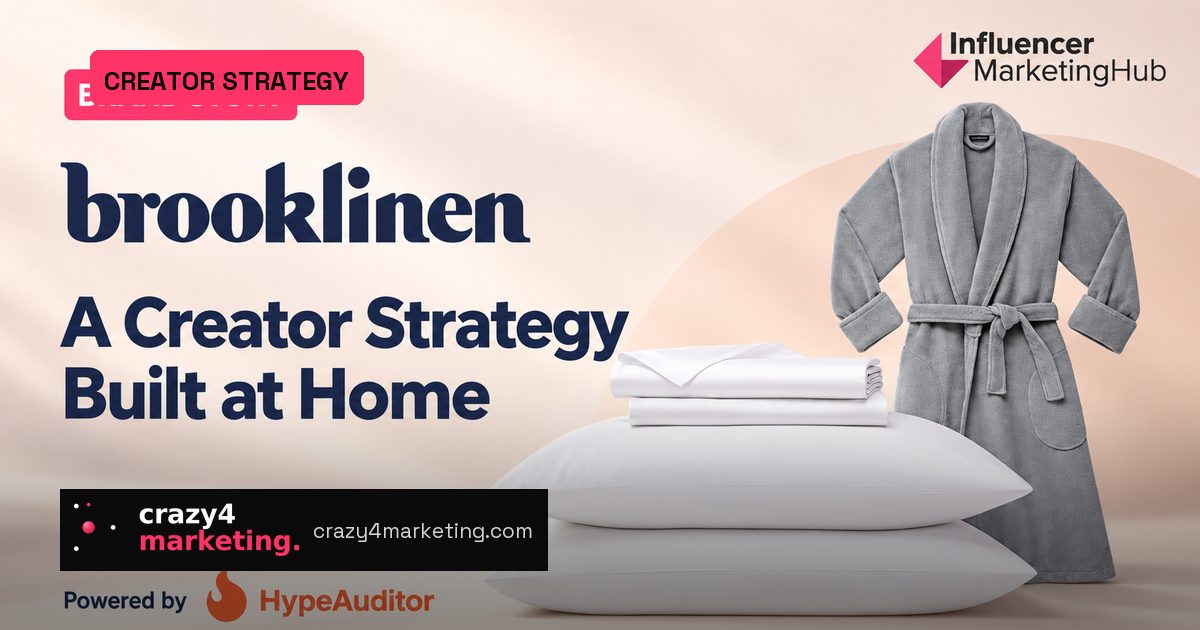
Brooklinen has a problem many D2C brands would recognize: how do you sell a comfort product to someone who cannot touch it? Its answer has evolved from Kickstarter backers to a wide creator network, but the core stays the same—show the product inside real life, then help the buyer choose.
From Kickstarter to a billion-dollar brand
Rich and Vicki Fulop launched Brooklinen after a hotel stay made them rethink everyday sheets. Their 2014 Kickstarter asked for $50,000 and brought in roughly $250,000, according to Influencer Marketing Hub. That early demand forced the founders to learn fulfillment and customer expectations at the same time.
The offer itself was built to reduce uncertainty: simplified bundles, clearer fabric and color choices, and labels for the long and short sides of the sheets. For online bedding, easier buying was part of the product.
As of 2026, Brooklinen reports more than six million customers and over $1 billion in cumulative sales. Robes have become the fastest-growing first-purchase category, which helps explain why the brand keeps placing them in routines and cultural moments.
Creators gave the sheets a setting
Early growth came from recommendations, editors and bloggers. The founders sometimes delivered bedding themselves—even using a Zipcar. Later, creator programs became more structured.
A 2018 campaign with ACTIVATE involved 12 lifestyle influencers and at least 24 pieces of content. Brooklinen’s goal was both awareness and purchase, and the creators supplied two things at once: access to new audiences and a content pipeline the brand could repurpose.
Instead of isolated product shots, the brand shows bedding in bedroom resets, hotel-style bed-making, summer changes and hot-sleeper conversations. The product benefit shifts with the scene. That gives each viewer a specific reason to picture the sheets at home.
What the data shows
HypeAuditor tracked 424 Instagram mentions from 255 accounts in six months. Reels made up about 82% of those posts. The report categorized 27 mentions as sponsored, 140 as likely sponsored and 257 as organic, but those labels do not prove payment or attribution.
The influencer mix is broad: 116 mid-tier, 63 micro and 51 nano creators—roughly nine in ten tracked accounts. Quenlin Blackwell led modeled reach at around 1.4 million. Estimated reach hit 8.3 million, but overlapping viewers and lack of sales data leave a key question open: which creators actually drove revenue?
Marketers should read those numbers as a distribution signal, not a revenue proof.
A playbook for the next campaign
Brooklinen’s latest work has become more product-led. By 2026, the company said it had relaunched about 80% of its product line, including a reworked Luxe Sateen sheet developed through 37 prototypes.
The “Best. Sheets. Ever.” campaign cast comedians, a basketball player and a musician in vignettes across TV, connected TV, YouTube and social. In-house teams led the work, with CMO Laura Jacobs crediting the internal group.
Paid social testing turned a specific pain point—night sweats—into an ad reading “So Long Night Sweats.” That is a useful template:
- Start with one sharp customer problem.
- Create a simple message around it.
- Test variants against hotter sleepers or similar segments.
- Scale what proves interest before chasing broader reach.
Why this matters for marketers
Brooklinen’s system works because each channel has a job. Creators put the product into everyday routines; partnerships with SNL, DedCool and designer Zoe Schlacter add adjacent audiences; stores and reviews help a browser become a buyer; and new products keep the conversation fresh.
The lesson is not “work with more influencers.” It is to make comfort specific, match creators to the setting, and treat paid testing as the bridge between a product problem and a proven message.
Source: Influencer Marketing Hub