
Most PPC competitor research stops at keywords, offers, and landing pages. But your competitors’ unhappy customers are quietly publishing a research brief you can use for free: negative reviews.
A one-star review tells you what someone expected, where the experience broke, and often what would have fixed it. Read enough of them and you start seeing demand signals, not just complaints.
The opportunity is especially strong for lead-gen and local service advertisers, where the same frustrations tend to repeat across an entire market.
Turn competitor complaints into themes
Start with 30 to 50 negative or mixed reviews from two or three direct competitors. Focus on one-, two-, and three-star reviews on Google, Yelp, Tripadvisor, Booking.com, or wherever your category lives.
Paste the raw reviews into an AI tool and ask it to group them into recurring complaint themes with a table showing the theme, number of mentions, percentage of reviews mentioning it, and a representative example.
You might see patterns like:
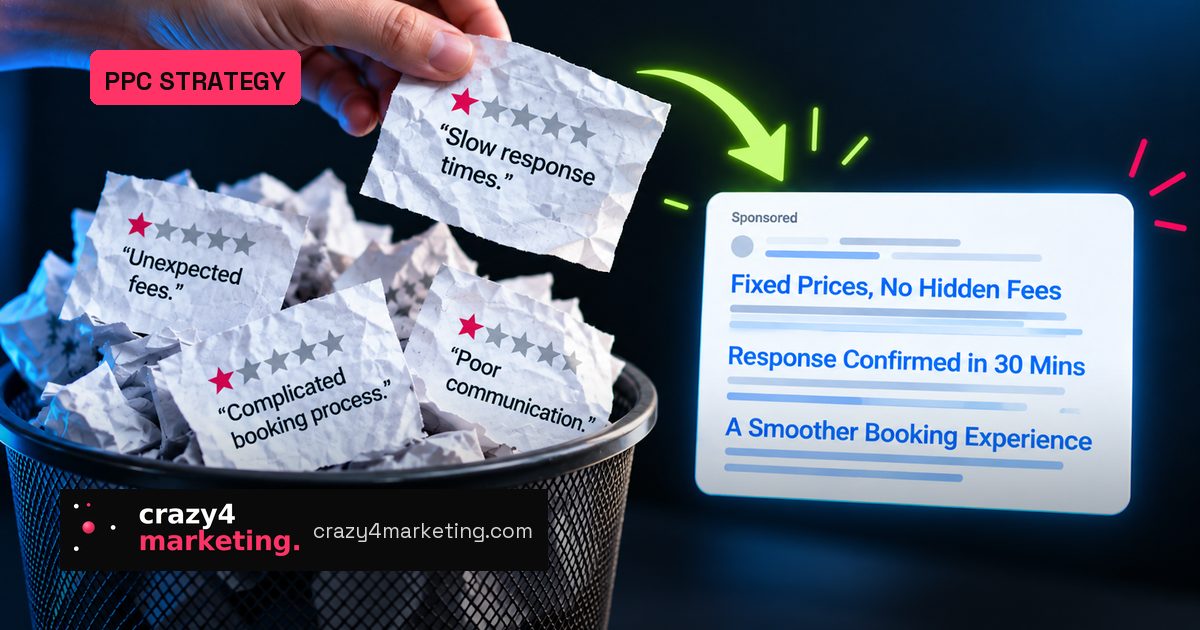
- 12 mentions of slow response times
- 9 mentions of unexpected costs
- 7 mentions of poor communication
- 6 mentions of a complicated booking process
- 4 mentions of limited availability
One complaint can be noise. The same frustration showing up across several competitors is usually a market expectation that nobody is meeting clearly.
Don’t advertise their weakness, advertise the value behind it
Slow replies may mean customers want certainty. Unexpected costs may point to demand for transparent pricing. Poor communication may show people want to know what happens next.
Compare those themes against your own operations. If customers complain that competitors take days to respond and your team replies within 30 minutes, that is an ad message—if it is true.
Before you put it in an RSA, validate the claim with your operations team. PPC should amplify a real advantage, not manufacture a promise you cannot consistently keep.
Turn the gap into ad and landing page tests
Once a differentiator is validated, test it in Responsive Search Ads. Instead of filling every headline with keyword variations, add one or two headlines that address the complaint-driven value. For example, a plumbing advertiser might test:
- Control: a trusted local plumber message with a free quote
- Variant: a fixed-price plumbing quote with no surprise charges
Then match the message on the landing page. If your ad promises pricing transparency, the page should explain the pricing process. If response time matters, show what happens after form submission: share the need, get a review within 30 minutes, receive a fixed-price quote before work begins.
Measure more than CTR. A higher click-through rate with weaker lead quality is not a win. Track CTR for attention, conversion rate for persuasion, and qualified lead rate for fit.
Use reviews as a hypothesis engine
Treat AI output as a source of test ideas, not final answers. The workflow is simple: complaint → underlying expectation → validated operational strength → ad copy variation → landing page proof.
Your next PPC advantage may already exist inside your business. Competitor reviews can help you realize it and make it visible before someone clicks.
Source: Search Engine Land