
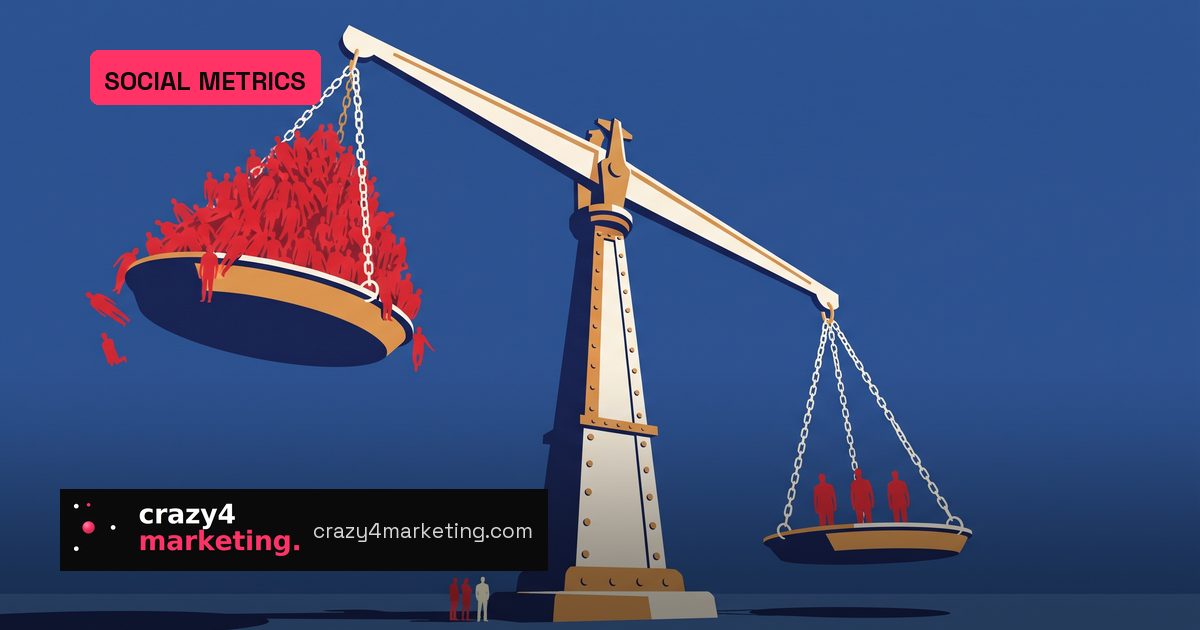
Follower count looks like a scoreboard, but it is actually a net total of one-way links. When someone follows an account, the number goes up by one; when that follow is deleted, the number drops. There is no reciprocal approval required—and that asymmetry is what allowed some profiles to accumulate massive audiences.
What the number does in 2026
Platforms use follower count for three jobs at once: deciding whose posts get prioritized, signaling social proof on a profile, and acting as a commercial unit in creator briefs and rate cards. The tension comes from conflating those roles. A high count can open doors even when it no longer predicts how many people will see the next post.
Where it still opens doors
Follower thresholds remain hard gates across platforms:
- YouTube’s Partner Program still requires 1,000 subscribers, even after the August 2026 viewing requirement doubled for entry from February 2027.
- YouTube verification still sits at 100,000 subscribers.
- Google lowered Search profile eligibility on August 13, 2026, to 35,000 followers on YouTube, Instagram or X, and 100,000 on TikTok alone.
- TikTok Shop Fan Groups require at least 5,000 followers plus Bronze tier and a Creator Health Rating of 200.
- TikTok’s Branded Buzz product draws on creators with 50,000 or more followers.
- Amazon, by contrast, weighs follower counts against engagement metrics but publishes no threshold.
Regulators are also using the metric. Spain’s Royal Decree 444/2024 defines a “user of special relevance” for creators with at least €300,000 in annual platform income, above one million followers on a single service or two million across services, and at least 24 videos published in a year.
Why buyers are de-prioritizing it
The traditional influencer brackets—celebrity above one million, macro between 100,000 and one million, micro between 10,000 and 100,000, nano below 10,000—no longer work as a selection shortcut. A September 2026 Association of National Advertisers report argues against using follower brackets as the primary filter. It quotes Kaya Yurieff, co-founder and co-CEO of Scalable, saying “the million-follower era is coming to an end.”
Buyers have already moved. In a joint TikTok and BSI study, follower count ranked last among selection priorities: only 8% of brands and 7% of agencies named it as a priority. The report also cites an anonymous agency executive describing accounts with 500,000 followers that pull about 1,000 views per post.
Platform ranking changes did much of the damage. Instagram said in April 2024 that recommended Reels had been ranked largely on how an account’s own followers engaged, and introduced an input to distribute smaller creators more widely—later clarified as accounts below 10,000 followers. When distribution no longer tracks audience size, the follower total describes past performance, not future reach.
What still holds up
Follower growth remains a useful directional signal. WARC analysis of TikTok and Emplifi data logged a 200% year-over-year rise in median brand follower count in Q4 2025. Meta counted 213.6 million net Instagram followers added by 2026 World Cup squads in one month, a 6.6% rise on a base of 3.26 billion.
Caveats remain. Engagement rate is often calculated against follower count, importing the same flaw it was meant to fix. Rounding hides movement: a YouTube channel with 10 million subscribers shows no public change until it gains or loses 100,000. And fraud persists—the FTC’s 2019 settlement with Devumi and CEO German Calas Jr. recorded more than 58,000 orders for fake Twitter followers, and a 2024 FTC rule now bans selling or buying fake social media influence indicators.
What to do about it
For performance marketers and growth teams, the practical shift is simple: treat follower count as an access requirement, not an audience forecast. When vetting creators or pages, ask for reach and view data per post, not just follower brackets. Use follower thresholds to know whether a creator qualifies for a platform feature, then measure the actual campaign against reach, engagement and conversion—not the profile’s vanity metric.
Source: PPC Land