
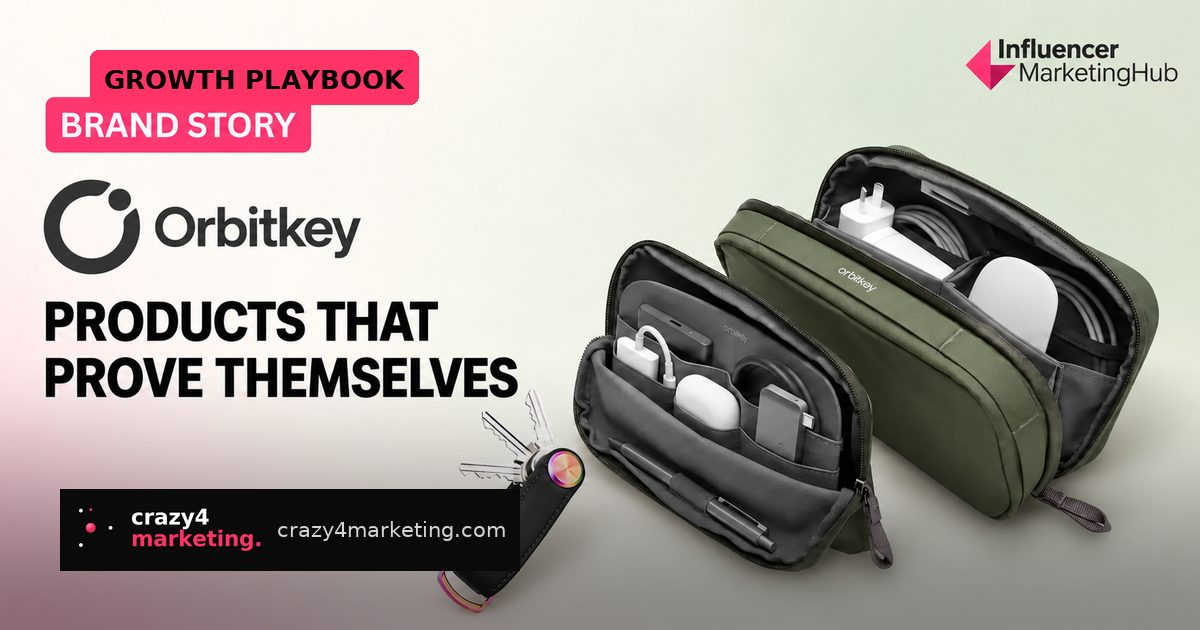
Some brands spend fortunes explaining what their product does. Orbitkey barely has to.
Loose keys fold into a silent stack. A pouch opens and every cable has a slot. A desk organizer rearranges around whatever you own. The problem and the fix are both visible in seconds — and that single trait has quietly powered one of Australia’s most creator-friendly D2C stories.
From a runner’s annoyance to a global brand
Co-founder Charles Ng, then an industrial designer training for a half-marathon, hated the jangle of keys in his pocket. He screwed them together using hardware-store parts. Crude, but quiet.
He showed it to school friend Rex Kuo, a pharmacist who avoided carrying keys next to his phone because of scratches. Roughly nine months of refinement later, a soft band replaced the screws and the Orbitkey Key Organiser had its signature silhouette.
The design principle stuck: find a small point of friction in a familiar routine, then make the improvement obvious enough that customers spot it in use.
Kickstarter as a repeatable system, not a one-off
Orbitkey launched on Kickstarter in 2013 — reportedly on the first day Australian creators could use the platform. The goal was AU$10,000 to cover tooling and a minimum production run.
It hit target in about 16 hours and closed 30 days later at roughly AU$210,000 from 4,961 backers. Rex had asked Charles what number it would take for him to quit his job; Charles said AU$200,000, a figure neither expected. He quit.
First orders shipped around March 2014, run out of Rex’s parents’ property — office, warehouse, assembly and fulfilment all in one.
Here’s the part most brands miss: Orbitkey never treated crowdfunding as a launch chapter it graduated from. In a 2026 interview, the founders said their first 12 campaigns had raised more than $7.5 million from over 65,000 backers, with a thirteenth referenced since.
Crowdfunding became infrastructure — product validation, pre-order revenue and proof of demand that makes retailers, reviewers and affiliates take a call. Orbitkey now builds pre-launch audiences via landing pages, email, PR, creators and paid social, because strong activity in the first 24–48 hours lifts visibility inside Kickstarter itself.
Why “demonstrable” beats “beautiful”
Look across the range — Nest, tech pouches, the Desk Mat, the new Grid Desk Organizer with movable dividers — and almost every product performs an action a camera can capture. It folds, clips, slides, stacks, separates or reconfigures.
That’s why TikToks and Reels keep following the same script: noisy keys, tangled cables, an overloaded travel bag, then the reorganisation. “What fits inside” videos make capacity tangible. Before-and-afters do the persuading for you.
Rex has said the company skipped categories like wallets when it couldn’t find a meaningful improvement, and rejected key attachments whose usefulness didn’t justify the bulk. That discipline is a content decision as much as a product one. A new colourway gives creators something pretty. A quick-release mechanism or modular divider gives them something to explain.
The creator strategy: from scattergun seeding to tracked links
In a Refersion webinar, Rex described early influencer seeding as scattered — products went to big followings, but the team couldn’t see the impact on site performance.
The shift was toward creators, reviewers and publishers whose content could carry trackable links. YouTube proved especially valuable: an unfamiliar product needs explanation, long-form reviews keep pulling search traffic for years, and an affiliate link gives the creator a reason to keep it live.
A relationship might start with a sponsored review, then the same product resurfaces in an everyday-carry roundup — affiliate link still intact.
What the current network looks like, per HypeAuditor data cited in the source:
- 157 accounts mentioned Orbitkey in 218 Instagram posts over six months
- Reels drove 70.2% of mentions; carousels 26.1%
- Nano creators were 42.2% of classified accounts, micro 39.6%, mid-tier 18.2% — no macro tier shown
- Travel led the category mix, alongside family, gadgets, gaming, photography and accessories
- 35 mentions were classified sponsored, 33 likely sponsored (modelled estimates)
- Average engagement rate: 1.65%, rated low — though about half of posts matched or beat the creators’ norms
The standout: Spanish-language tech creator @santienig compared several sub-100 Orbitkey products — Key Organiser, Quick Release Ring, Urban Loop Keychain — with pricing context and a profile link. HypeAuditor logged roughly 50,400 likes, 304 comments and a 23.5% engagement rate.
It worked because it was a buying guide, not an ad. Orbitkey supplied the proof; the creator supplied the decision.
Collabs that unlock new audiences
The Key Organiser’s early everyday-carry audience skewed male. Partnerships fixed that. Marie Kondo’s audience already framed organisation as calm — Rex says the tie-up helped reach a broader female audience. Disney added nostalgia and family identity, executed through character signatures, custom palettes, lining patterns and hidden Easter eggs rather than slapped-on logos. Monocle brought design credibility, National Geographic material storytelling, Nomad tech-carry familiarity.
The takeaway for growth teams
Creator selection is downstream of product design. If your product can’t be demonstrated, compared, configured or transformed on camera, no amount of seeding budget fixes it.
So audit your range: which SKU has a five-second visible before-and-after? Brief creators around that action, attach trackable links, and let long-form reviews compound in search while nano creators drop the product into real routines.
Orbitkey didn’t win by shouting louder. It won by making the fix easy to see.
Source: Influencer Marketing Hub