
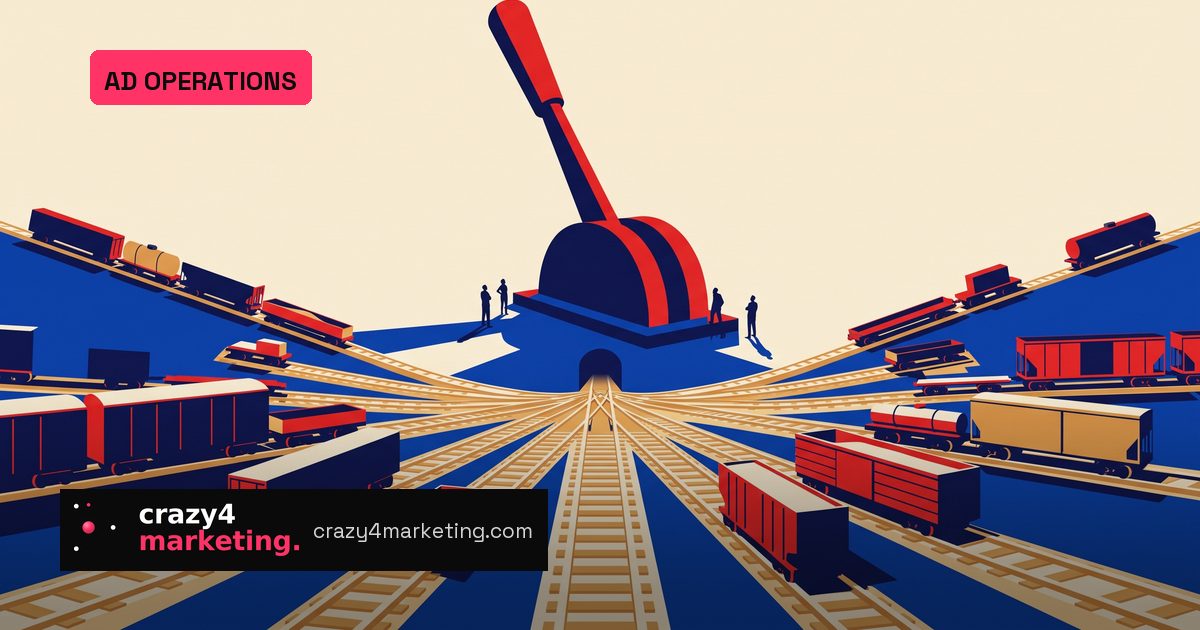
Most marketers see the ad server as plumbing. For publishers, it is the system that makes the final call: which creative wins each slot, how the impression is delivered, and what gets logged for billing. Every other layer in the chain can propose. The publisher ad server decides.
How the decision actually works
The process starts in the page. A tag library such as Google Publisher Tag sends the ad unit code, requested sizes, and key-values like section=sports or a subscriber flag. The server then matches those signals against line items, runs a selection, and returns the winning creative.
That selection is not just a highest-price test. In Google Ad Manager, line items carry a numeric priority, and the lower number wins. Sponsorship has priority 4, Standard uses 6, 8 and 10, Network, Bulk and Price Priority all sit at 12, and House is 16. Only Sponsorship and Standard are guaranteed, and only those two enter inventory forecasts.
Below the guaranteed layer, the server starts comparing money. Price Priority line items rank by CPM and compete in real time against exchange demand through dynamic allocation. That means an auction bid can displace a non-guaranteed booked campaign at the moment of the request.
Header bidding is an input, not the boss
Header bidding gets a lot of credit, but the wrapper still passes its best price into the ad server as targeting values, historically in one-cent or five-cent buckets. The server may accept that bid or choose something else based on publisher rules.
Scale helps explain the concentration. The source reports testimony from Google engineering director Glenn Berntson that Google Ad Manager reaches about 8.2 million ad requests and 60 million bid requests per second at peak. That translates to more than 600 billion ad requests a day.
Why this matters for your marketing stack
- Fees bite at scale. Ad serving costs typically run 1% to 2% of large publisher revenue, but Google’s server is free to more than 90% of its publisher customers.
- Measurement is shifting. Ad Manager and AdSense will count only rendered ads from February 17, 2027, moving billing to a begin-to-render basis.
- Dependency is real. During a two-day outage in January 2026, publishers reported effective CPMs down between 50% and 90%.
- Switching is hard. Years of configuration, forecasting history, and creative assets stay locked in the server.
From market leader to legal remedy
Google bought DoubleClick for $3.1 billion in 2008. The source cites internal estimates putting Google’s share of U.S. publisher ad serving at roughly 85% by 2012 and above 90% by 2015; a federal court fixed the figure at 91% in 2022.
Judge Leonie Brinkema ruled on April 17, 2025 that Google had monopolised the publisher ad server and ad exchange markets for open-web display and unlawfully tied the two together. On September 2, 2026, a remedies opinion imposed six years of conduct rules instead of a divestiture, including a requirement that Google let its exchange bid into rival ad servers on the same terms and build interfaces for Prebid demand. The European Commission also fined Google 2.95 billion euros on September 5, 2025.
What to do now
If you buy or sell open-web display, treat the ad server as a measurement boundary. For publishers, audit line item priorities and key-values: a poorly configured priority can quietly push guaranteed revenue aside. For advertisers, expect baseline discrepancies between your third-party ad server and the publisher’s count, especially as rendered-impression rules roll out in 2027.
An easy framework: proposal, decision, log. Every demand source makes a proposal; the ad server makes the decision; the log creates the invoice. Check each stage before you optimise campaign performance.
Source: PPC Land