The goodbye heard around marketing
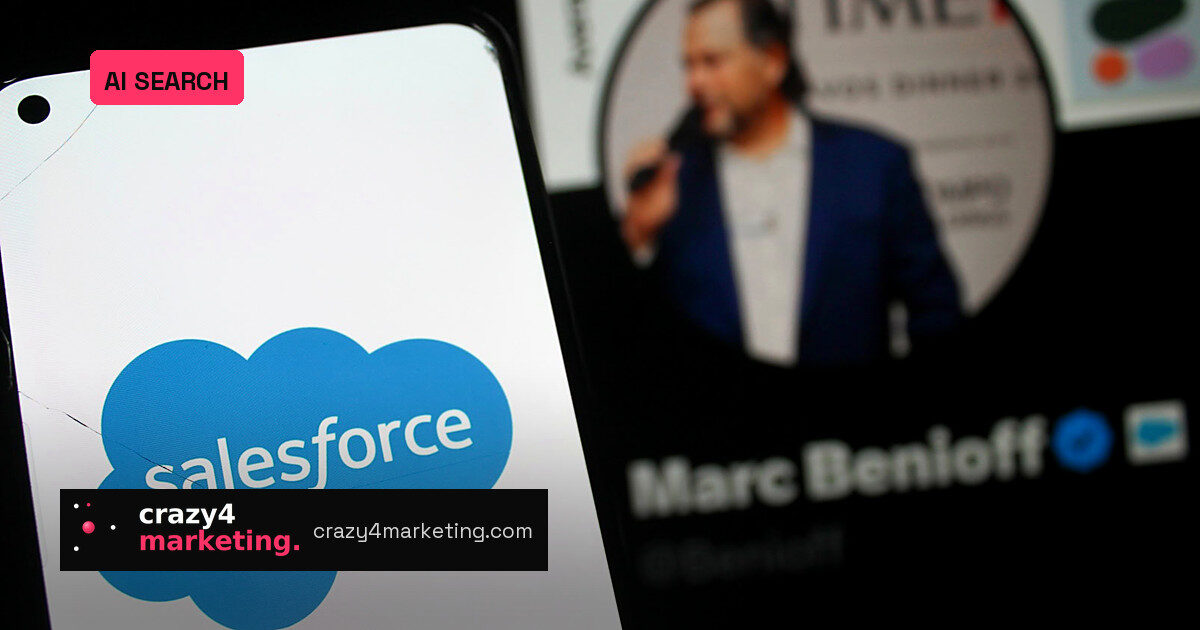
On Nov. 18, Salesforce CEO Marc Benioff posted that customers \u201caren\u2019t searching anymore.\u201d Instead, he said, people are asking Claude, ChatGPT, Gemini and other AI assistants which brand to pick. His punchline for marketers: \u201cNo click. No referral. Nothing in your analytics.\u201d
Benioff used the post to promote Palmata, an AI-based tool that tracks how visible a company is in AI answers. It recommends changes and simulates their effect before publication. The implicit argument: the next battle for visibility is inside AI interfaces, not search results pages.
Then Salesforce\u2019s own content complicated the story.
Salesforce\u2019s pages tell a different story
Salesforce\u2019s SEO and answer engine optimization guide, published Sept. 11 and written by SEO Senior Director Graham Hardt, states that SEO \u201cis still the foundation.\u201d The guide says SEO \u201cisn\u2019t going away\u201d and describes SEO and answer engine optimization as two visibility layers for the same audience.
Palmata\u2019s FAQ links to that guide, so the product\u2019s own page steers marketers back to fundamentals. The launch article from Jason McGhee, head of product and engineering for Palmata, added that SEO gave organizations a practical framework for visibility and that the work remains essential. Contentful introduced Palmata in June; Salesforce completed its acquisition of Contentful on Sept. 1.
SEO experts push back
Practitioners were quick to respond. Aleyda Solis, founder of Orainti, argued that AI search relies on many of the same fundamentals as SEO. AI search optimization goes beyond traditional SEO, she said, but it doesn\u2019t replace it. She also drew a sharp line: monitoring what AI platforms say about your brand is not the same as improving visibility or business outcomes.
Pedro Dias, a technical SEO product manager and former Googler, put it bluntly: \u201cSEO isn\u2019t traffic. It never has been.\u201d Lily Ray added that the AI visibility gold rush is already oversaturated.
What to actually do
For growth teams, the practical move is not to choose between SEO and AI visibility. It\u2019s to run them as connected measurement streams.
- Keep tracking organic rankings and traffic.
- Add a second signal: how often AI assistants cite or recommend your brand.
- Use AI visibility data to find gaps, then close them with the same technical, content and authority work that powers SEO.
Benioff\u2019s \u201cno click, no referral\u201d line is a useful warning that attribution is changing. But writing off search because AI answers are growing would be risky, especially when Salesforce\u2019s own guide says to track both sets of metrics.