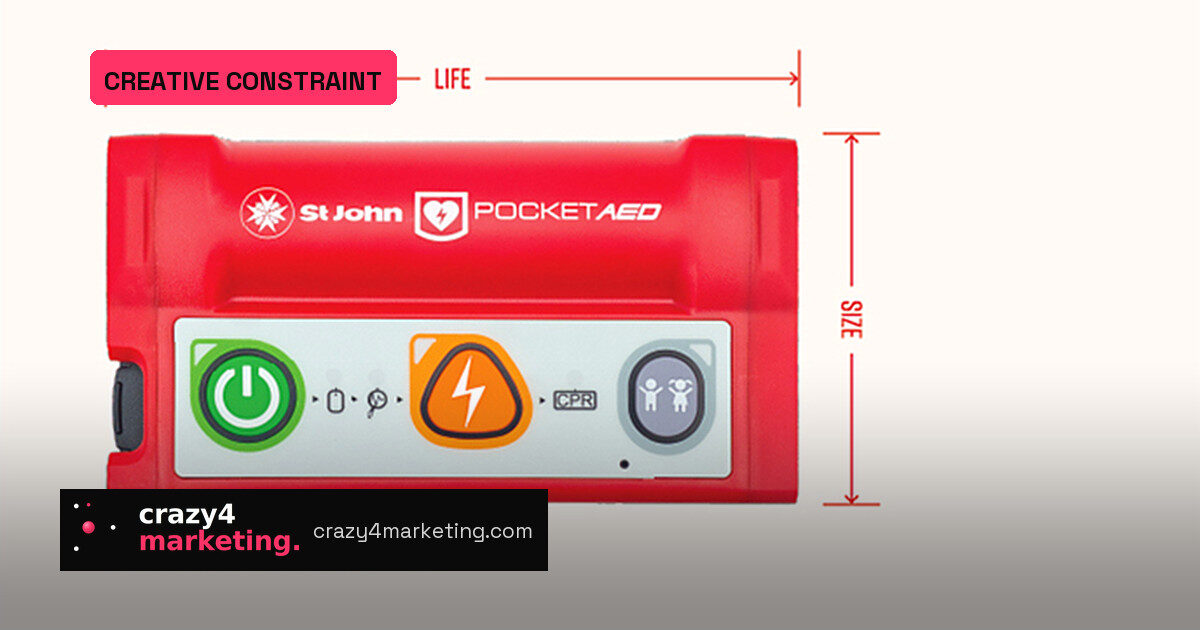
Most brands buy a national TV spot and fight for every pixel. St John Ambulance Australia just did the opposite: it ran a national ad that used only a 235×125 pixel box on screen, deliberately matching the size of its new Pocket AED.
The campaign, created by St John WA’s in-house agency Devil Jane with production by Sandbox, launched with a Channel 9 buy tied to the Paramedics TV show sponsorship. Print executions went further, with bespoke layouts that showed the product at actual size.
A national first, built around a constraint
St John is known for a network of fixed-location AEDs. The Pocket AED takes that life-saving capability and shrinks it into a device that can fit where it is needed. Instead of saying “small”, the campaign demonstrates it by limiting the media space itself.
Creative directors Tom Birts and Tim Newton said the team knew they wanted the ad to be the same size as the device, but getting from idea to air took significant technical work. Director Jack Connell and Sandbox handled the calculations, framing, lens choice and post-production needed to make a 235×125 pixel execution work on linear TV.
“I’m so glad I paid attention in maths class, because it well and truly came in handy here,” said Sandbox director Jack Connell.
St John Ambulance Australia CEO Brendan Maher called the work a step forward for collaboration across the national and state teams, and noted the TVC subverts the expected ad format to capture attention for a potentially life-saving device.
Why a mostly empty screen works
This is not minimalism for its own sake. The format is the message: the product’s competitive advantage is portability, and the ad proves it before a single word of voiceover lands.
The mechanics create attention in three ways:
- It breaks the pattern. A tiny box in a full-screen break forces viewers to notice the space around it.
- It proves, not claims. Actual size is a product demonstration, not a headline.
- It earns earned media. A national TV buy that uses 235×125 pixels is inherently shareable for trade press and marketers.
For performance marketers, the reminder is useful: the most efficient message is often the one that lets the platform format do the selling.
What to borrow
You don’t need a defibrillator to use the same thinking. If your product has a physical or functional truth – small, fast, quiet, long-lasting – ask whether the media placement can demonstrate it. Then bring production and media teams in early; this idea only worked because the technical math was treated as part of the creative product.
The campaign also shows the benefit of in-house creative and national-state alignment. First-time national work ran smoothly because the agency knew the brand and the broader network backed the idea.