
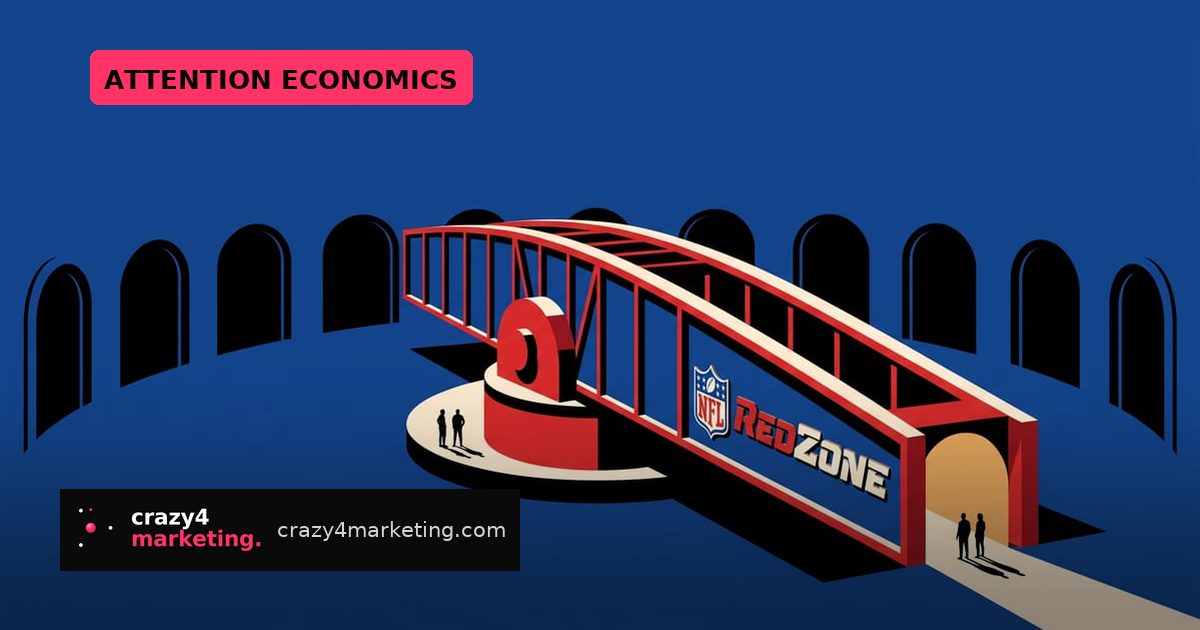
PPC Land has published a deep explainer on the whip-around — the live sports format that jumps between simultaneous games, arriving just before something decisive and leaving the second it resolves. No match is shown end to end. NFL RedZone is the famous example.
It reads like a broadcast trade piece. It is actually a masterclass in attention economics, and performance marketers should read it that way.
How the format actually works
A whip-around owns almost no cameras. It licenses clean feeds from the broadcasters holding the underlying rights and re-cuts them, which makes it a rights product before it is a production one. Simulcast permission is negotiated separately, and contracts typically cap how long any single game can be shown.
The control room inverts normal television. A conventional telecast follows a rundown; a whip-around follows the field. Spotters watch scoring probability — an offence entering the red zone, a pitcher one out from a no-hitter, a swimmer in the final fifty metres. Producers queue the next look-in while the current one is still live, and a short delay on incoming feeds gives the director margin to switch without missing the play.
Two visual grammars run in parallel: the single-feed cut, and the split screen or quad box holding two to four events at once. That quad box doubles as ad inventory — a commercial can sit in one quadrant while play continues elsewhere.
The lineage, briefly
German public radio has run a Bundesliga conference broadcast since 1963, with a televised version on pay TV from the 2000/01 season. DirecTV launched its Red Zone Channel in 2005 inside NFL Sunday Ticket, hosted by Andrew Siciliano. NFL Network launched the current NFL RedZone on 13 September 2009 with Scott Hanson.
Then the copies: ESPN Goal Line (4 September 2010, closed after 2019), MLB Network Strike Zone (10 April 2012), MLB Big Inning (April 2021), and Peacock’s Gold Zone for Paris 2024, extended to the Paralympics on 15 August 2024 and back for Milano Cortina in February 2026. When Google took Sunday Ticket for the 2023 season, the DirecTV original closed.
The scarcity-versus-inventory trade
Here is the part every growth team should sit with. For sixteen seasons, RedZone sold itself on seven hours without commercial breaks. It monetised through carriage fees, subscriptions and named sponsorships — Mercedes-Benz and Allstate attached to recurring segments — not spot inventory.
Then it tested split-screen ads late in the 2024 season and adopted advertising across 2025. Sports Business Journal put the load at four fifteen-second spots: one minute across seven hours. Boycott calls followed anyway. Speaking to Front Office Sports in early September 2026, Hanson said the count would fall again, and repeated the promise the whole format rests on — the show will “never miss a touchdown”.
That is the classic monetisation trap in miniature: the thing people paid to escape becomes the thing you sell them.
Why it matters for media buyers
- Live is where mass reach survives. DeepIntent cited that 96 of the 100 most-watched US telecasts in 2025 were live sports.
- The audience is commercially specific. Whip-arounds were built for fantasy players and later absorbed sports bettors — both heavy programmatic targets. Proximic by Comscore’s football guide covers 4.5 billion hours of NFL viewing with betting and fantasy segments.
- Session length is the real product. Remove every reason to change channel and you get long, unbroken viewing — which raises exposure frequency.
- Tolerance is measurable. Magnite’s 2026 study found US adults accepting 8.7 minutes of ads per hour in live environments; the company reported 5,800 new live sports advertisers with spend up 56%.
- Access is opening. Google opened NBCUniversal’s Winter Olympics inventory via Display & Video 360 on 12 January 2026. Peacock’s ad revenue per subscriber hit $6.53 a month in that quarter.
Three lessons that transfer
1. Curate, don’t aggregate. Gracenote found 26% of sports fans cannot find the games they want. Multiview hands the viewer a grid; a whip-around makes the decision for them. In marketing terms: fewer choices, better sequencing, higher completion.
2. Attribution breaks when you sit between channels. A viewer watching a game through a whip-around is on a different channel from the one carrying it — credit splits. Sound familiar? That is every mid-funnel channel you own.
3. Protect the promise. RedZone’s ad load is tiny, and it still triggered backlash, because the promise was the product. Price your differentiator before you sell against it.
Source: PPC Land