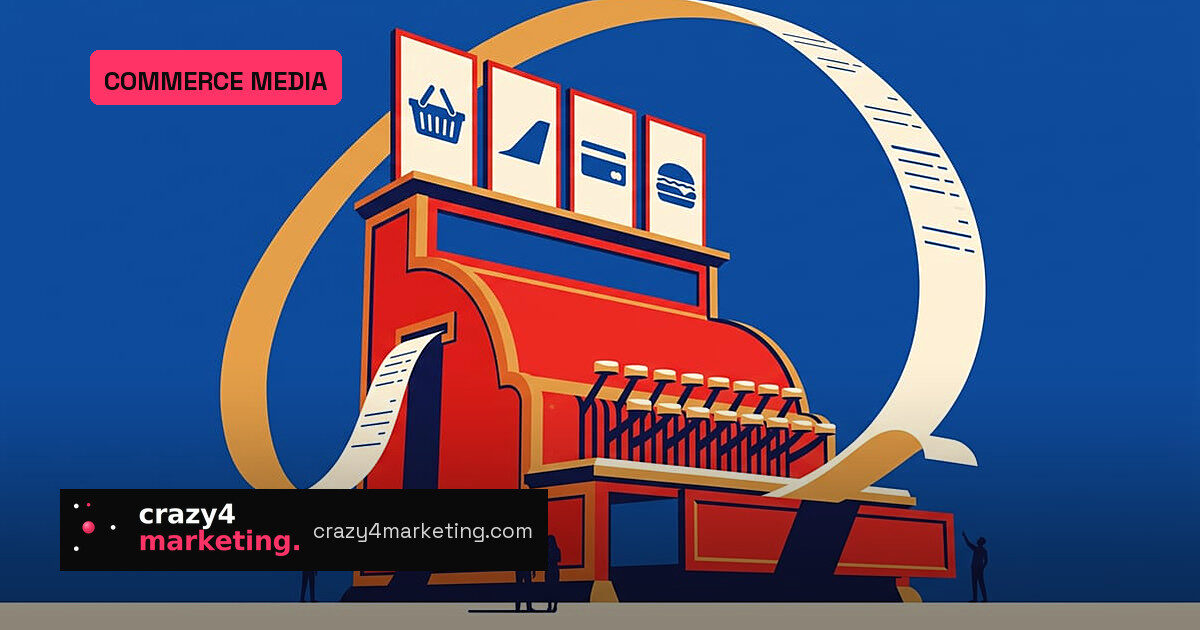
Commerce media is advertising sold by a business that can see what its customers actually buy, targeted on that purchase data and measured against the sales it records. The seller can be a retailer, a bank, an airline, a delivery app or, since August, a burger chain. What they share is proximity to the transaction at a moment when third-party tracking has weakened.
Retail media is the largest branch of commerce media, but it is not the whole category. IAB Europe’s March 2025 definitions put retail media networks inside the wider commerce category and named travel, payments, food delivery and classified platforms as non-retail sellers.
Three ingredients turn transactions into media
A commerce media network needs data, inventory and a way to close the loop. The data is usually loyalty, account or order history. A bank sees card spending across merchants; a grocer sees baskets down to the SKU; an airline sees routes, fare classes and frequent-flyer tiers.
Inventory runs in three environments:
- Onsite: sponsored listings on the operator’s own website and app, often sold in its own auction.
- Offsite: the operator’s audience applied to the open web, CTV and social platforms through DSPs.
- Physical: in-store screens, seatback video, airport lounges and drive-thru menu boards.
Measurement is where the value sits. A closed loop matches ad exposure to purchases in the seller’s records. IAB Europe’s Commerce Media Measurement Standards V2, released on January 22, 2026, set a default 30-day lookback after a view or click, cut to 7 days for quick commerce, and counts sales as gross unless a network says it reports net. The standards cite an anecdotal 20% gap between the two.
Scale has arrived
The US market alone reached $63.4 billion in 2025, up 18% and roughly a fifth of the $294.6 billion digital total, according to the IAB and PwC. In September the IAB lifted its 2026 growth forecast for commerce media to 13.6%, ahead of the 12.3% it expects for US advertising overall. Globally, WPP Media’s December 2025 forecast put commerce advertising at $178.2 billion, overtaking television for the first time.
Buyers are spreading budgets across more networks. A McKinsey survey of 150 US advertisers found 53% using five or more networks in 2025, up from 38% in 2023, with 44% of budgets going offsite. Aggregators and consoles are consolidating in response, from Criteo becoming Google’s first onsite retail media partner in Search Ads 360 to Koddi following in June 2026.
The trust gap is real
Commerce media still asks buyers to accept results marked by the party selling the inventory. Attributed sales are not the same as incremental sales, and a shopper who would have bought anyway still counts. The ANA, after consulting more than 40 brand heads of media, recommended in August 2026 a standardised 14-day lookback window, half IAB Europe’s default; Amazon did not take part.
Maturity also lags the ambition. A Forrester study for Koddi found only 13% of 788 organisations qualified as trailblazers, and 63% named measurement as their main barrier. Card and bank records add a privacy fault line that networks describe as permissioned, encrypted or de-identified, but these are company descriptions rather than audited findings.
What to do before you spend
Treat a network’s reported ROAS as a starting point, not a verdict. Three questions will keep you honest:
- Are sales reported net or gross, and what lookback window applies?
- Does the network offer clean rooms or raw data so you can test incrementality yourself?
- Which budget owns this spend: brand, trade or shopper marketing? The accounting treatment changes the reported number.
Commerce media is not going back to a niche. It is becoming a default channel for any marketer who needs proof of sale, provided they are willing to verify the proof.
Source: PPC Land