
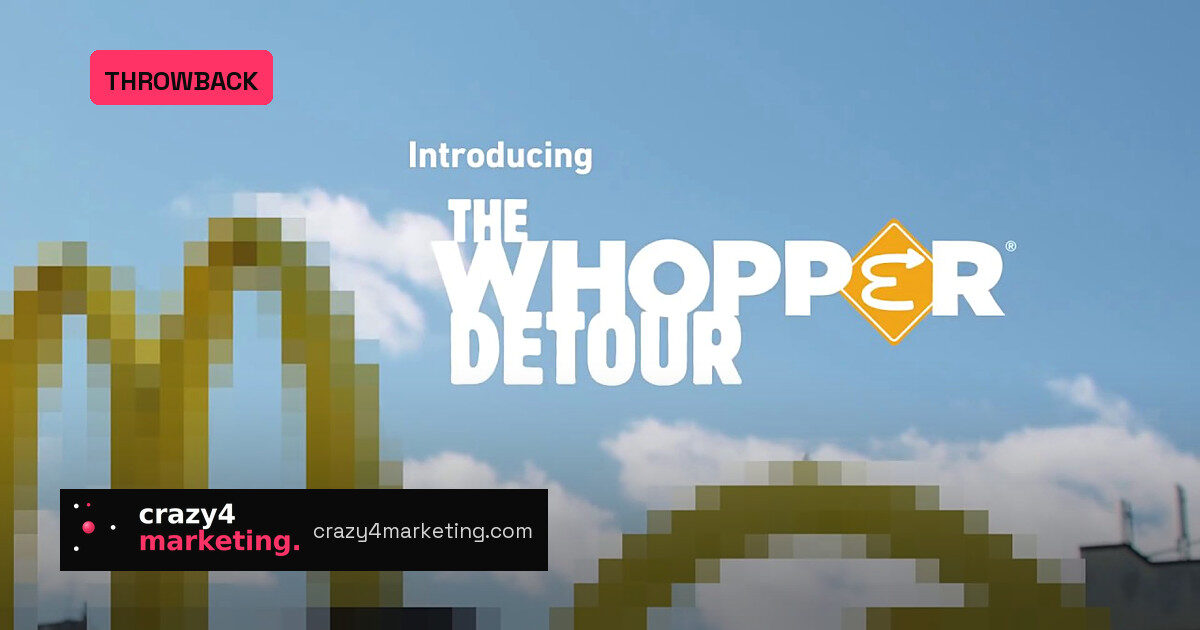
Some campaigns ask for attention. This one asked for a detour. In December 2018, Burger King and FCB New York turned McDonald’s locations across the United States into an unlock condition: get near a McDonald’s, and the Burger King app would sell you a Whopper for 1 cent.
The hook and when it ran
Whopper Detour ran for a limited stretch in December 2018. The promise was blunt: a Whopper for 1 cent, but only if you were close to a McDonald’s. That inversion made the competitor’s locations the trigger for Burger King’s offer.
The case film captures the idea with deadpan clarity. It does not explain a product. It shows a behavior: drive to the arches, open the BK app, unlock the deal, then navigate away to the nearest Burger King.
How the film was built
The campaign was built around a geofenced mobile mechanic, not a traditional TV spot. The app used location data to detect when a user was inside a tight radius around a McDonald’s. Once the condition was met, the 1-cent Whopper unlocked and the app directed the user to the closest Burger King for pickup.
The film worked as a case study and a piece of product storytelling. It leaned on the friction: the user had to go to the rival first. That friction was the joke, the mechanic and the proof all at once.
Why it spread in its day
The idea was inherently shareable because it sounded like a dare. It used McDonald’s as the punchline without being hostile. The promotion turned a routine discount into a location-based game, and the mobile-first design gave people an immediate reason to download the app.
- The offer was absurd enough to repeat: a 1-cent Whopper at McDonald’s.
- The mechanic was simple to explain but impossible to ignore.
- It flipped a weakness—lagging app adoption—into the main event.
What it did for the brand
Whopper Detour is credited with a surge in Burger King app downloads and a run at the top of the App Store charts during the promotion. More importantly, it reframed Burger King as a brand that understands mobile, mischief and speed.
The campaign became a benchmark for competitor targeting. It proved that a smart mechanic can outperform a bigger media budget when the behavior is the story, and it turned the app into a distribution channel rather than a loyalty card.
Steal this
Three moves from Whopper Detour still work today:
- Make the competitor the trigger. Use geofenced offers around rival locations to intercept demand at the moment of intent.
- Turn friction into the feature. A small, playful barrier can be more memorable than a frictionless discount.
- Close the loop to your own asset. The app was not just the coupon; it was the navigation system to a Burger King.
Whopper Detour endures because it understood that the best mobile ad doesn’t ask for a view—it asks for a move.
Watch the original: Burger King on YouTube