

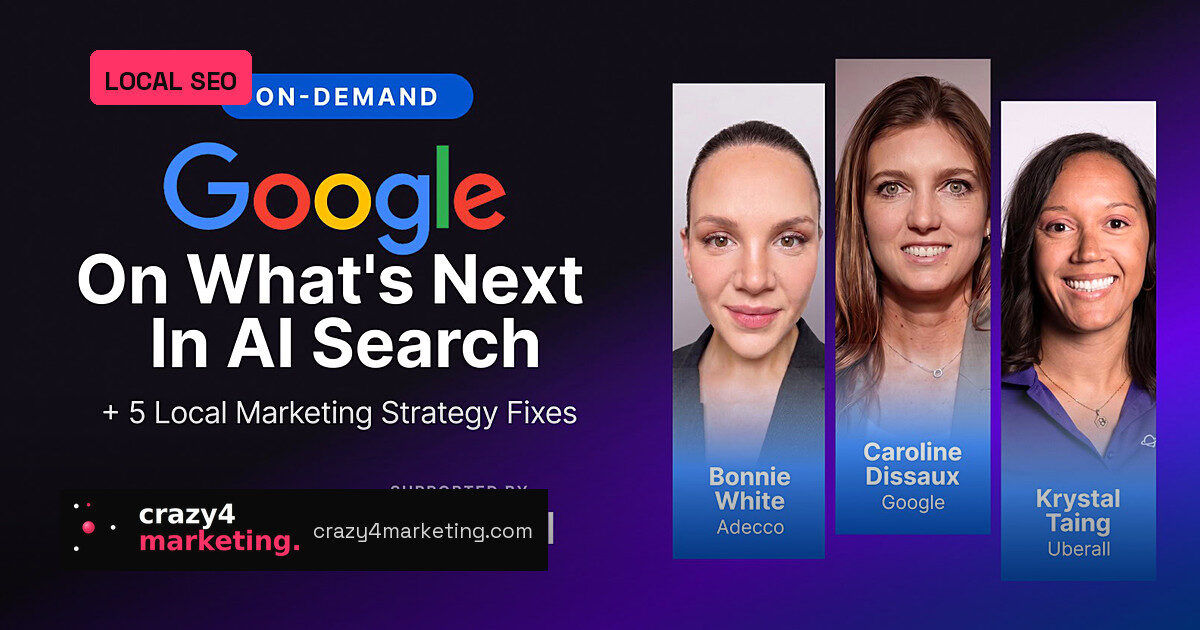
AI search is quietly shifting local discovery from “show me what’s nearby” to “show me a nearby place that can do this exact thing this weekend.” Google’s Caroline Dissaux, Adecco’s Bonnie White and Uberall’s Krystal Taing discussed the shift in Google’s September 24 webinar, Google On What’s Next In AI Search + 5 Local Marketing Strategy Fixes. The implication: a Business Profile with a name and opening hours may no longer be enough to earn an AI-generated answer.
The query got more specific
Google representatives described longer, more conversational searches and AI features that split a complex request into related questions. That means a customer can now ask whether a location offers a specific service, has an appointment slot, and is accessible, all in one go.
Krystal Taing of Uberall put the change in terms of scale. “What’s different is the scale, the complexity, and importance of getting these right across every location and what it means to LLMs and generative AI,” she said. A strong national brand profile does not prove each branch can satisfy a specific request.
What a stronger Business Profile looks like
The speakers recommended several priorities. Publish relevant updates, offers and events on Google Posts, but keep a realistic cadence rather than copying a social schedule. Link existing social profiles and refresh photos or videos when products, spaces or seasonal details change. Add structured menus or detailed service lists where relevant; food businesses can include items, ingredients and current prices, while service businesses should describe offers without inventing a menu. Respond to reviews and keep contact options current.
Five fixes for multi-location teams
The session’s most useful takeaway: don’t try to fill every field at once. Give each location an owner, a source of truth and a way to detect gaps.
- Establish one source of truth for each location, auditing hours, categories, attributes, services, menus, inventory and booking details before syndicating updates.
- Close the review gap with clear ownership and response standards.
- Localize approved offers with accurate neighborhood, service, image or location details.
- Automate routine checks, but keep human review for policy, brand-sensitive claims and exceptions.
- Measure at the location level, comparing visible AI answers with profile engagement and actual outcomes.
Taing also framed the division of labor. “It doesn’t mean that a human needs to manually review every single thing,” she said. Humans should set strategy, standards and guardrails while systems handle volume.
Don’t mistake post metrics for AI visibility
Google Business Profile post views and clicks can help assess individual posts, but the speakers said those figures do not prove a post caused visibility in AI Overviews or AI Mode. Compare post topics with the queries and AI answers you actually see. For variable pricing, describe the service clearly rather than publish an unreliable figure.
Source: Search Engine Journal


