
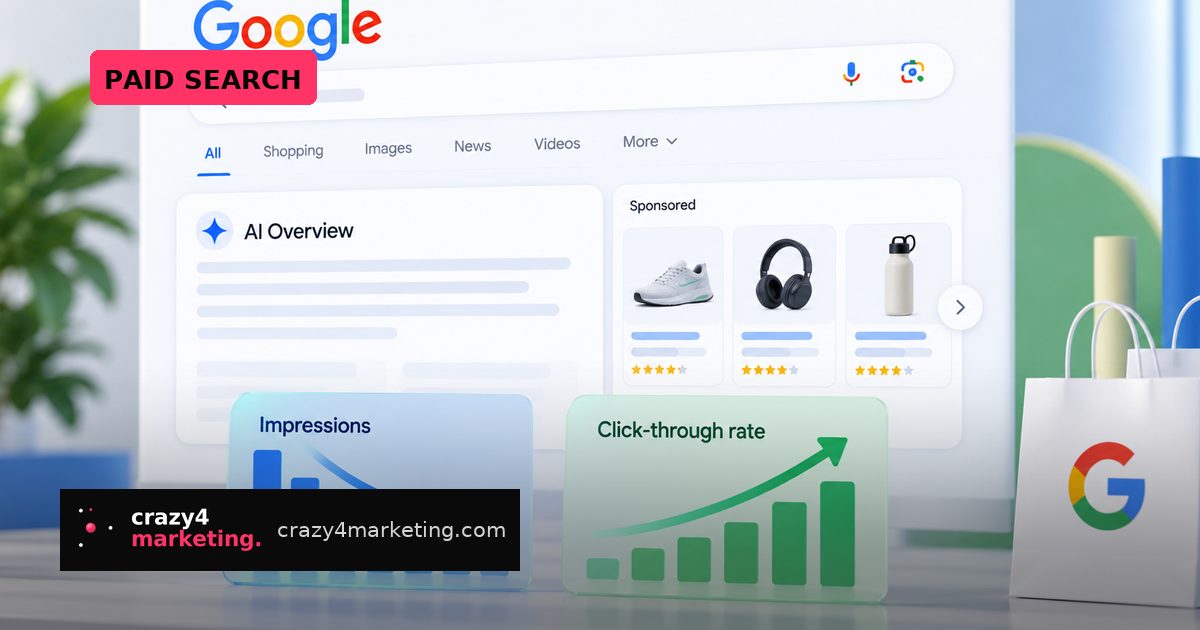
If your Shopping campaigns are quietly posting their best click-through rates in years, don’t pop the champagne yet. That number may be going up for a reason nobody wants: your ads are simply being shown less.
That’s the pattern Mike Ryan, head of ecommerce at Smarter Ecommerce, laid out in a new analysis reported by Search Engine Land. And his working theory points at AI Overviews.
What the data shows
Ryan had been watching Shopping CTRs climb in Smarter Ecommerce’s Market Observer benchmark data. When separate ecommerce data from Optmyzr showed CTR up 17% year over year — close to the roughly 20% lift he was tracking — he dug in.
Looking across thousands of Shopping and Performance Max campaigns spanning hundreds of advertiser accounts, he found the same shape again and again:
- Clicks were roughly flat or slightly down.
- Impressions had fallen noticeably.
- CTR, the ratio of the two, went up.
In other words, the numerator barely moved. The denominator shrank. That’s not performance improvement — that’s arithmetic.
The ‘reverse crocodile’ twist
Ryan has previously described the SEO “crocodile effect”: publishers racking up impressions in search while clicks flatline, the two lines opening like jaws. Shopping ads appear to be living the mirror image — fewer impressions, higher CTR.
His hypothesis is that Google may be more inclined to serve an AI Overview on queries with a lower predicted chance of producing an ad click, while holding Shopping placements for searches with stronger click propensity. He calls it “experience switching,” and notes that anecdotally he rarely sees Shopping ads and AI Overviews sharing the same SERP — it’s usually one or the other.
If that’s what’s happening, Google can cut total Shopping impressions without cutting clicks at the same rate. Two contradictory-sounding things become true at once: AI Overviews suppress some ad inventory, and the ads that remain monetize just fine.
Important caveat, and Ryan says it himself: the data doesn’t prove causation. The timing could be coincidental, AI Overviews could be contributing via some other mechanism, or the driver could be something else entirely. It’s a hypothesis, not a verdict.
Why this matters for your reporting
Because CTR has quietly become one of the least trustworthy numbers in your dashboard.
For years, a rising Shopping CTR was a clean signal: better creative, better feed, better bidding, better query mix. Now it can also mean Google is filtering out your low-intent impressions for you. Same metric, opposite story.
If you report CTR up 20% to a client or a board without checking impression volume, you’re selling a win that may actually be a shrinking addressable market.
What to do this week
A simple diagnostic framework for any ecommerce account:
- Chart the three lines separately. Impressions, clicks and CTR, year over year, at account and campaign level. If CTR is up while impressions are down more than clicks, you have the pattern Ryan describes.
- Shift your KPI hierarchy. Judge campaigns on clicks, revenue, conversion volume and blended efficiency — not rate metrics that can improve while the business shrinks.
- Audit query mix. Look at search terms and category-level data to see where impressions disappeared. Broad, informational, research-style queries are the likeliest casualties.
- Rebuild upper-funnel demand elsewhere. If the discovery-stage query no longer serves your ad, that demand has to be captured through content, creators, retail media, email and social.
- Reset benchmarks. Any internal CTR target set before AI Overviews scaled needs a new baseline.
The bigger picture
Ryan expects this to be a phase. His view is that Google will move from “either/or” search experiences toward “both/and” as it builds AI-native ad formats and places more Shopping ads directly inside AI Overviews.
That’s the real headline for growth teams. The current impression squeeze may reverse — but when it does, the inventory will look nothing like the Shopping grid you optimised for. Start treating AI surfaces as a placement you’ll need to win, not a threat you can wait out.
Source: Search Engine Land