

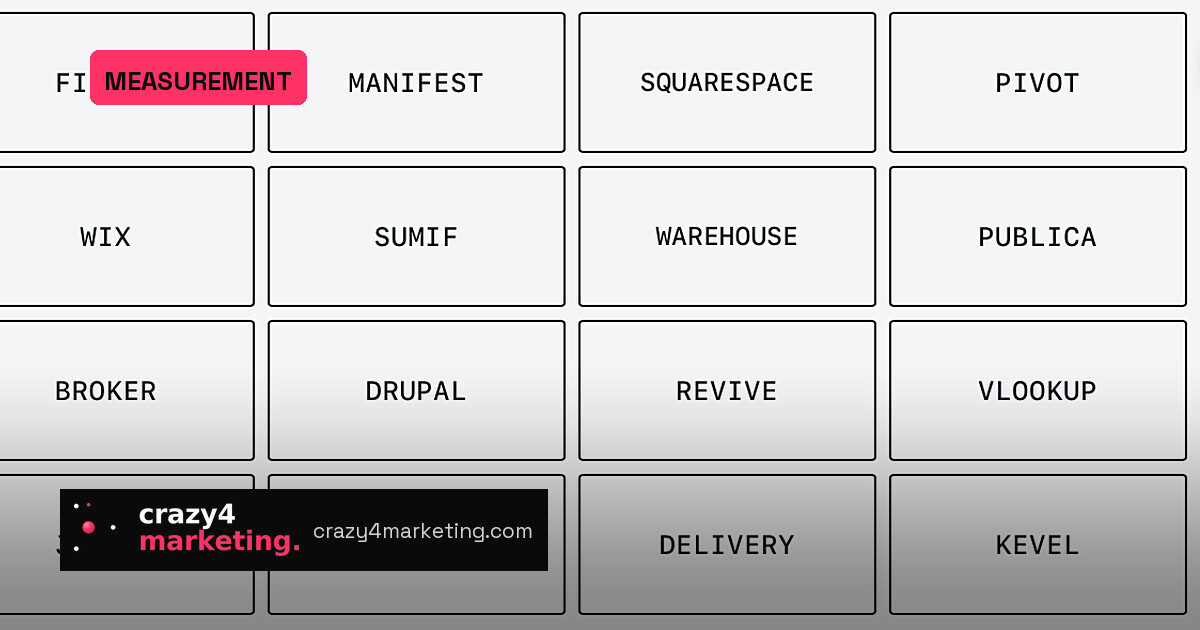
What PPC Land launched
PPC Land has turned a familiar performance marketing headache into a small puzzle. The reader-funded daily, written by Luís Rijo since 2016, has published more than 10,000 articles. Its latest piece is built around a claim every paid media team knows: “Definitions settle more measurement fights than maths.”
The game uses 16 terms split into four groups of four, drawn from four corners of the job. At least one category is far narrower than the tiles suggest, and the publication says it is not the obvious one. That is the setup: a vocabulary test disguised as a sorting puzzle.
Why this matters for performance marketers
Most PPC disputes start after the dashboard loads. One person calls a conversion a view-through conversion; another means a click-through purchase. Both numbers can be accurate. The comparison is still useless because the label is not shared.
Alignment on definitions is a strategy, not a nicety. If your team does not agree on qualified lead, ROAS or attribution window, you cannot trust an experiment result. The maths is rarely the broken part. The contract around the metric is.
Why definitions drift in the first place
Platforms do not help. Google, Meta, Shopify and analytics tools often use the same word with different counting logic. An attributed conversion in one interface is not the same event in another. Teams inherit this drift, and after a few quarters they stop noticing it.
The fix is not another dashboard. It is a shared vocabulary document, short enough to be read before a meeting and specific enough to settle a dispute.
Run the same exercise before your next review
Use the game’s logic in your own measurement audit.
- List the 10-16 metrics your team uses most in campaign reports.
- Ask each person to write a one-line definition without checking the docs.
- Group the answers and mark where definitions diverge.
- Rename the metric or add a prefix, such as click-through ROAS or blended ROAS, so the label matches the formula.
This turns vague arguments into a visible vocabulary gap. That gap is easier to fix than a modelling problem.
What to do about it
Do not wait for a cross-channel debate to discover that revenue means gross in one dashboard and net in another. A definitions audit can take under an hour and belongs next to any test plan or quarterly business review.
Low scores in the PPC Land puzzle are not a failure. They are a map of where your team has shaky shared language, precisely where future measurement fights will start.
Source: PPC Land


