

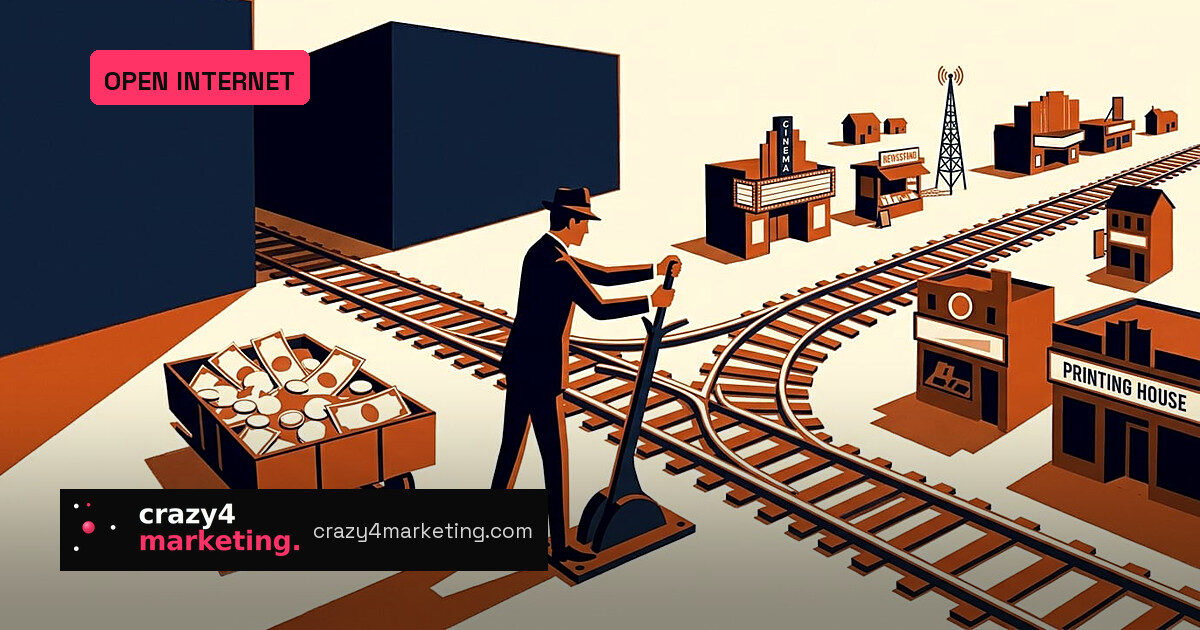
The open internet’s next vote is not in a courtroom. Jeff Green, founder and CEO of The Trade Desk, has published a long essay arguing that the biggest advertisers will decide whether the open internet survives an AI economy. The piece, “The case for the Open Internet,” relaunches The Current, a publication owned and operated by The Trade Desk.
The pitch: budgets, not browsers
Green’s essay tries to widen the definition beyond display ads in a browser. He frames the open internet as “a particular marketplace design” that keeps power distributed, and he puts premium media at the centre. Streaming platforms and publishers spend billions producing films, shows and journalism; in his telling, advertiser money pays for much of that.
Then he draws the line: Google and Amazon are named as walled gardens that are centralized, proprietary and opaque. Green warns that a handful of tech companies are positioned to charge everyone else rent for access to audiences and ideas.
What’s actually at stake for marketers
The essay contains no new time-spent or ad-spend data. But it frames the decision marketers already make every quarter: whether to keep following easy walled-garden reach or to test premium open-web inventory. The claim is not subtle. If the largest advertisers don’t move budgets, Green argues, media companies become “anemic” and pay rent to a few gatekeepers.
That matters because programmatic buying is consolidating fast. In Guideline data cited around the industry, DSPs outside the four largest fell to 5% of tracked spend in early 2026. Two of every three UK ad pounds already go to Google, Meta and Amazon, according to AA/WARC figures.
Why now
The essay arrives after a brutal stretch for The Trade Desk: agency disputes, an iOS Safari block on its ad domain, a weak Q3 guide and roughly 575 job cuts. So the open internet argument is also a commercial argument for the company’s independence. That does not make the question wrong; it does mean marketers should read it with the same scrutiny they’d apply to any vendor-owned publication.
The Current says it will now carry weekly op-eds from industry leaders, most outside the company. The real test is whether it runs pieces that challenge The Trade Desk’s own positions.
What to do before budgets lock
- Audit data ownership. Ask each platform who owns the data your campaigns generate and whether you can port it.
- Test premium media against UGC inventory. Run a small, measurable pilot rather than accepting reach and cost as the only signals.
- Treat measurement as a negotiation. Walled-garden metrics are convenient, but you should validate performance with your own holdout or incrementality test.
- Watch for concentration risk. If a platform stops carrying your audience tomorrow, how quickly can you shift spend?
The takeaway
Green’s essay is ultimately a request aimed at the people who control budgets. Whether the open internet survives may indeed be decided by Fortune 500 advertisers — and by the smaller teams that copy their allocation patterns. The useful response is not to pick a side, but to make the open web earn budget on performance and data portability.
Source: PPC Land


