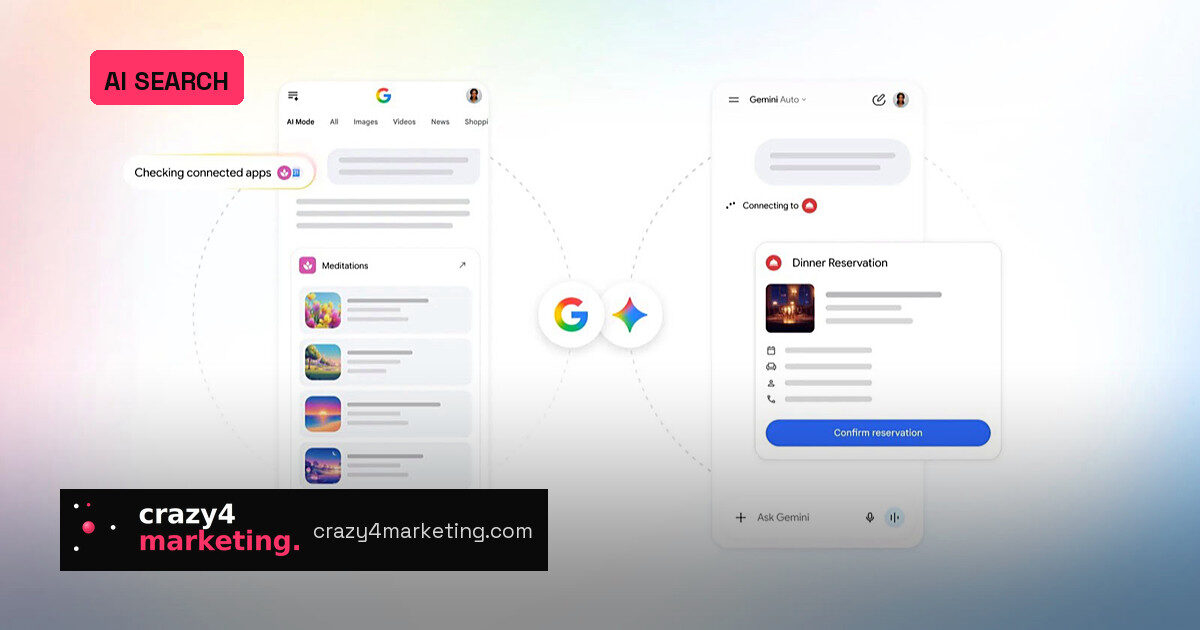
Google has moved its Connected Apps program from announcement to a public preview. The platform, first detailed on Oct. 28, now lets developers apply for access so their apps can run inside AI Mode in Search and the Gemini app. Robby Stein, Google’s VP of Product for Search, confirmed on X that Google “just opened the public preview.”
What the preview covers
The rollout is live in the United States, in English, for AI Mode. Google says additional developers, geographic markets, and Google products will be added in the next few months. The current connected apps in Search include Instacart, Canva, YouTube Music, Yahoo Fantasy Football and Sleeper Fantasy Football. Across Search and Gemini, Google has launched more than 50 connected apps.
How an app gets in
Developers connect through a remote Model Context Protocol server or through AppFunctions, which Google calls Android MCP. A remote MCP server reaches Search and Gemini users on web, Android, and iOS; the Android MCP route reaches Gemini users on Android.
Registration happens in Google Connected Console. Each app needs a category and at least three capabilities that users see when deciding whether to connect. The category sets minimum capabilities and cannot be changed after registration. Developers also choose availability by country, language, and Google product. Google reviews and tests every app before publishing, and sign-in apps must include test accounts with sample data. An app Google cannot fully test may be rejected.
The routing rules that matter
This is where growth teams should pay attention. Google’s policy says an app cannot reference other tools or create rules for when other tools should be used. It also bans “overly broad or deceptive capability descriptions” aimed at influencing the model to select one app over another.
In practice, the model reads your server instructions to decide when to delegate a task. Google’s MCP server guide recommends clear instructions so requests route accurately. Violations can lead to rejection, suspension, removal from the platform, or termination of the developer account.
- Pick the right category at registration; it cannot be changed later.
- Write capability descriptions that describe tasks clearly, not hype.
- Treat server instructions as the new routing copy for an AI model.
- Prepare test accounts and sample data if your app requires sign-in.
Why this is a new distribution surface
For digital marketers and D2C founders, AI Mode can now send a user’s task to an app instead of a content result. That makes capability descriptions the equivalent of landing-page copy, and honesty the equivalent of quality score. On the user side, AI Mode may default to the last app used for a task; users can also specify a different app or pick from a list after a general query.
Google Search Advocate John Mueller called connected apps “still extremely early” in a LinkedIn comment, while noting he does not work on the product. Partner apps including Adobe, Experian, Localiza and Peloton are expected to move from Gemini to Search, and Calm is set to arrive on both. Once an app is live, developers can view traffic, latency and error rates in the console.
Source: Search Engine Journal