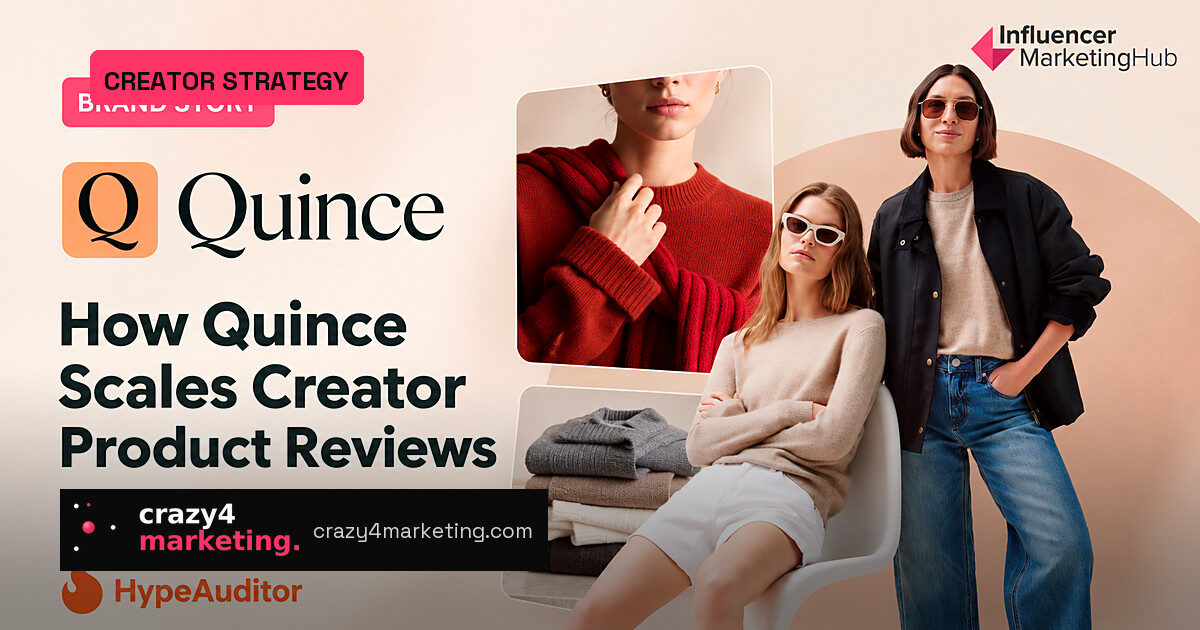
The $50 cashmere sweater made Quince easy to notice and just as easy to question. The brand’s manufacturer-to-consumer model removes retail middlemen, but a radically low price always forces the same question: did quality get cut along with the margin?
Product proof beats price claims
Quince began leaning harder into quality-led messaging in the second half of 2023. Head of Brand Antonieta Moreland told Marketing Brew that small Meta tests showed stronger conversion and incrementality among audiences that responded to quality claims. Once shoppers accepted that the product was credible, price could push them toward purchase.
A creator can answer what a price tag cannot:
- Does the cashmere feel soft or itchy?
- Do the jeans hold their shape?
- Does bedding still feel good after repeated washing?
- Would the creator actually keep it?
A gifting engine, not a sponsor farm
By 2024, Quince was working with roughly 300 creators a month, Modern Retail reported, with relatively few paid flat sponsorship fees. Most creators received product so they could test fit, sizing, washing, packing and everyday wear before speaking about it.
The scale shows on Instagram. HypeAuditor tracked 4,099 Quince mentions from 2,416 influencer accounts over six months. Nano and micro creators made up 66.6% of that network; only 1.2% were mega influencers. Reels accounted for 78.3% of content, a format built for showing texture, movement and daily use instead of repeating a claim.
The system works because gifting distributes the proof across categories. Fashion creators test cashmere, home creators test bedding, family creators test kidswear, and travel creators test luggage. Quince supplies the product, the creator supplies the use case, and the content supplies the evidence.
The real test is brand trust
Quince is no longer just the sweater company. In March 2026 it raised a $500 million Series E at a $10.1 billion valuation, per TechCrunch. The catalog now spans more than 100 categories. That makes individual product reviews necessary but not enough.
Quince hired Dakota Kate Isaacs as its first Head of Brand Strategy and Narrative in 2026. She told Fast Company the job is to “humanize Quince” as it builds an identity beyond lower-priced alternatives. For marketers, the lesson is clear: creator reviews can validate one product, but a catalog-wide review engine only compounds if every product can carry the quality argument. A gifted item that disappoints on camera travels through the same network that creates the hype.
Source: Influencer Marketing Hub