
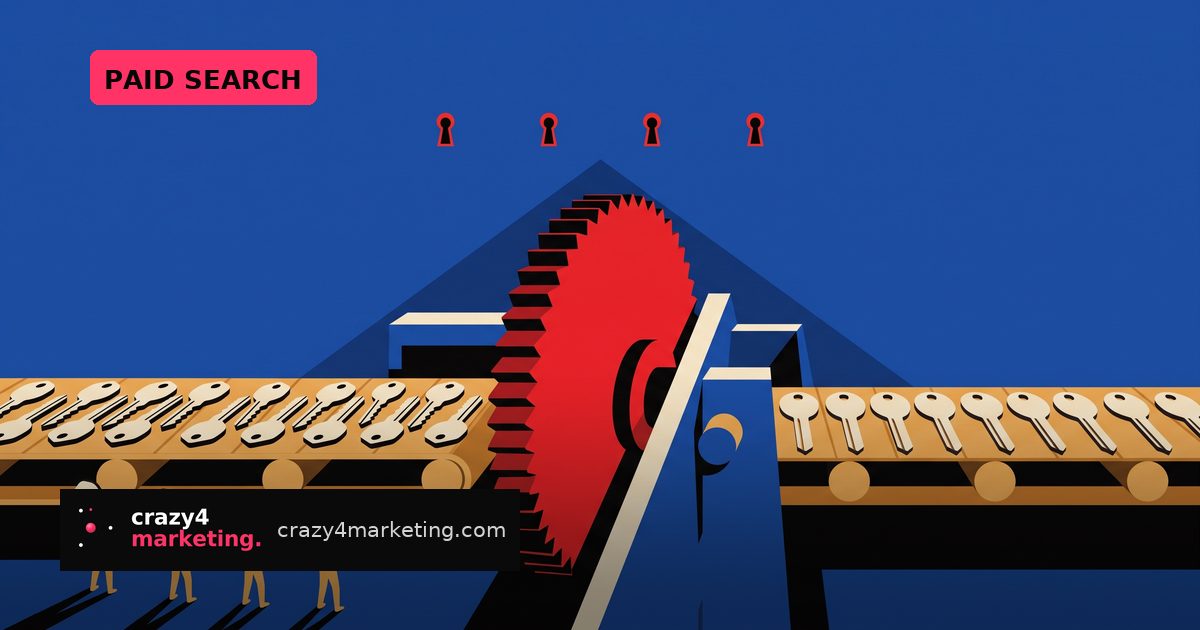
PPC Land has published a deep explainer on search engine marketing, and it lands at an awkward moment for anyone still buying keywords the way they did in 2019. The mechanics are intact – keyword, auction, cost per click – but the buyer’s ability to say which query triggered the ad is quietly disappearing.
The auction, restated
Nothing is bought in advance. Every query fires a fresh contest, and the advertiser sets a ceiling, not a price. Google’s Ad Rank is calculated twice per auction – once for eligibility, once for ordering – and draws on six inputs: bid, auction-time ad quality, Ad Rank thresholds, auction competitiveness, search context, and expected impact of assets and formats.
Two things worth tattooing on your media planner’s forehead:
- The 1-10 Quality Score in the interface is a diagnostic summary, not the number that enters the auction.
- Thresholds are dynamic and rise for lower-quality ads. Below the line, no bid buys a placement. In thin auctions, thresholds – not a rival’s bid – set what you actually pay.
Prices have moved. WordStream benchmarks across 13,474 campaigns put the 2026 average Google Ads CPC at $5.42, versus $2.32 in 2016. Dispersion is brutal though: smec put European Shopping CPCs at €0.36 in April 2026. Averages are for headlines, not budgets.
Match types are becoming a suggestion
The keyword hierarchy still exists on paper. Exact match keywords identical to the search term rank first, phrase and broad match keywords or Performance Max search themes identical to the term rank second, and AI-based relevance ranking comes third.
But AI Max for Search, announced 6 May 2025 and out of beta on 15 April 2026, expands keywords into keywordless matching and rewrites creative from landing pages. Independent testing has been rough. Smarter Ecommerce, looking at more than 250 retail campaigns in November 2025, measured ROAS roughly 35% below other match types in the same campaigns; one four-month test recorded a $100.37 cost per conversion against $43.97 for phrase match. One paid search director reported 99% of impressions producing zero conversions across around 30,000 search terms.
Reporting is the second problem. Because AI Max treats every keyword as broad match, traffic gets attributed back to narrower match types – so a single exact match row can blend three delivery mechanisms. Independent measurement puts literal delivery at about 71% of exact match impressions.
Why the money still flows here
Search remains the biggest single line in digital advertising. Alphabet reported $63.3bn in Search and other advertising revenue for the quarter ended 30 June 2026, up 17%, while Google Network slipped 1% to $7.3bn. Full-year 2025 search revenue ran to roughly $224bn. Microsoft, the distant second, posted $13.9bn in search and news advertising in fiscal 2025, with growth slowing to 10% in the June 2026 quarter.
And spend is climbing, not draining. Funnel, analysing more than 5,000 companies, found US monthly paid search spend across its client base rose 122% – from $45m in January 2024 to $100m by April 2026. So much for the answer-engine apocalypse.
What growth teams should actually do
Treat the next 12 months as a control audit, not a channel review:
- Segment before you migrate. The campaign-level broad match setting began auto-upgrading to AI Max in September 2026; Dynamic Search Ads migration moved to February 2027. Ring-fence a control campaign on phrase or exact so you have a clean baseline.
- Stop trusting match type rows. Build incrementality tests and use conversion-lag-adjusted holdouts rather than platform-reported ROAS.
- Use the new transparency levers. Site-level Search Partner reporting arrived in August 2025 and network opt-outs reached some PMax advertisers in July 2026 – research puts partner network ROAS 37% below Google Search proper.
- Don’t stuff every RSA slot. Former Google staff have argued excess assets simply prolong the learning period.
The bigger shift
In September 2026 Google began testing eligibility for exact and phrase match keywords to serve text ads inside AI Mode – a surface reported at over a billion monthly users, where reporting cannot separate that traffic from ordinary search. Meanwhile OpenAI has opened a conversational auction outside the search engines entirely.
The transaction shape hasn’t changed: intent is expressed, an auction resolves in milliseconds, a click is billed. What’s dissolving is your right to specify the query. Plan measurement accordingly.
Source: PPC Land