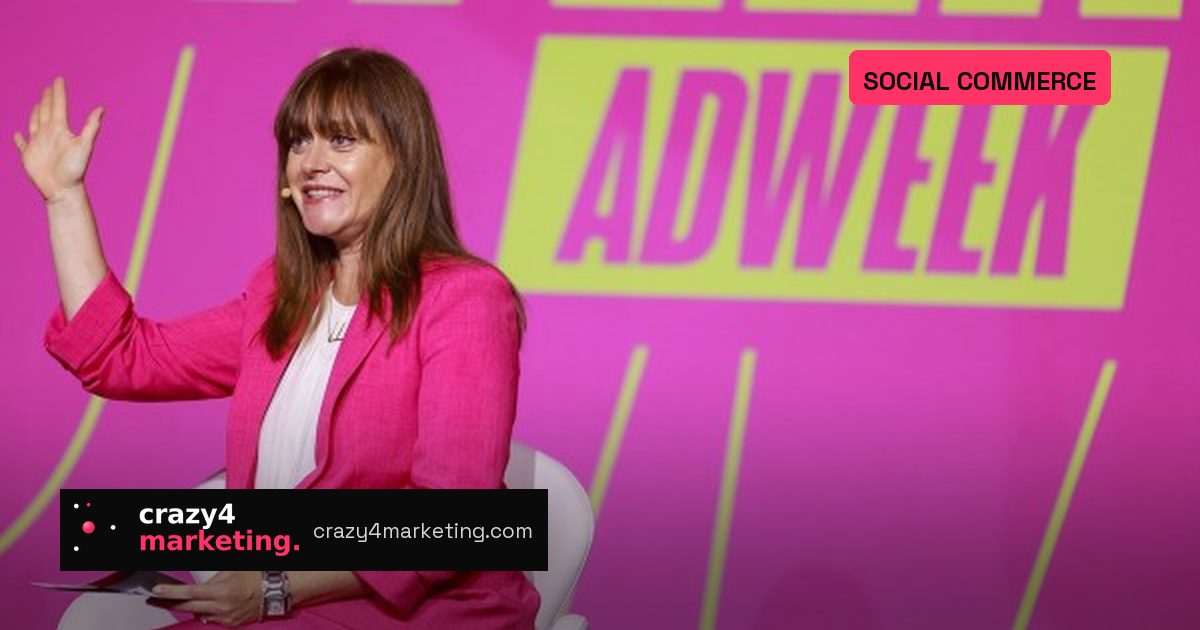
Social commerce is not dead, but it is being rewired. At Brandweek 2026, TikTok’s three-day ‘Agencies Doing Cool Sh*t’ series made one point clear: the brands winning now treat TikTok as a demand engine inside a bigger system, not as a channel.
A beauty brand’s connected-system test
Iced Media founder and CEO Leslie Ann Hall described the launch strategy for Rael, a Korean holistic cycle care brand that was introducing a microneedling serum. Two problems stood out: beauty on TikTok is intensely competitive, and a scientific product is hard to simplify for social feeds.
The agency’s move was to partner with mega creator Mikayla Nogueira. Her credibility sparked other creators to talk about Rael, turning TikTok into what Hall called a “demand engine.” The sharper shift was strategic: the team used social awareness to fuel results across retail and other channels.
Hall said the winning approach combines performance media, social commerce and generative engine optimization. “The best thing that we did was look at TikTok as a way to drive awareness to fuel omnichannel growth instead of as a single channel.”
The purchase journey is now a loop
Hall returned with a Moroccanoil example to explain why the purchase journey is no longer linear. A shopper may discover a product on TikTok, then query an AI platform for more information. Or they may start with an AI recommendation and use social content to validate it before buying.
The practical implication is simple: content has to exist at every step. Hall’s advice was to make sure brands have enough content to reach consumers at all stages of those journeys. TikTok’s Emily Freed, general manager of U.S. agency, added that TikTok and TikTok Shop are becoming top sources for large language models.
Freed’s takeaway is that AI recommendations gain traction only when they are “validated by real people.” That means brands need two things working at once: data that machines can discover and creator content that humans can trust.
Here’s the framework this points to:
- Discovery: Creator content and paid social put the product in front of a new audience.
- Validation: Shoppers search AI tools, reviews and further creator posts before they decide.
- Conversion: A buy may happen on TikTok Shop, a retailer site or another channel, so measurement has to be omnichannel.
Scale creators like an affiliate system
On the final day, Boost Engine co-founder and president Alex Yang shared how Bissell encouraged creators to move beyond tired before-and-after cleaning content. Instead of forcing one format, the brand let creators explore different creative angles until a repeatable winner emerged for the audience profile.
Yang said the goal is not one viral post but an “army of your affiliates.” In his telling, that can mean working with thousands of creators. Repeatability comes from respect and good briefs: tell creators about the paid media strategy behind a product, the assortment strategy and the winning content format, then give them room to execute.
“For creators, if you really want to activate them and drive growth, having this mindset of exploring content in different formats and finding the winning format for your brand, for your audience profile will be crucial to success,” Yang said.
What this means for growth teams
The Brandweek conversations offer a clear checklist. Build social proof through credible creators. Structure product data so AI platforms can find it. Treat creator partnerships as an operational system rather than a campaign. And measure the full journey, because the last click will keep lying to you.
Source: Adweek