

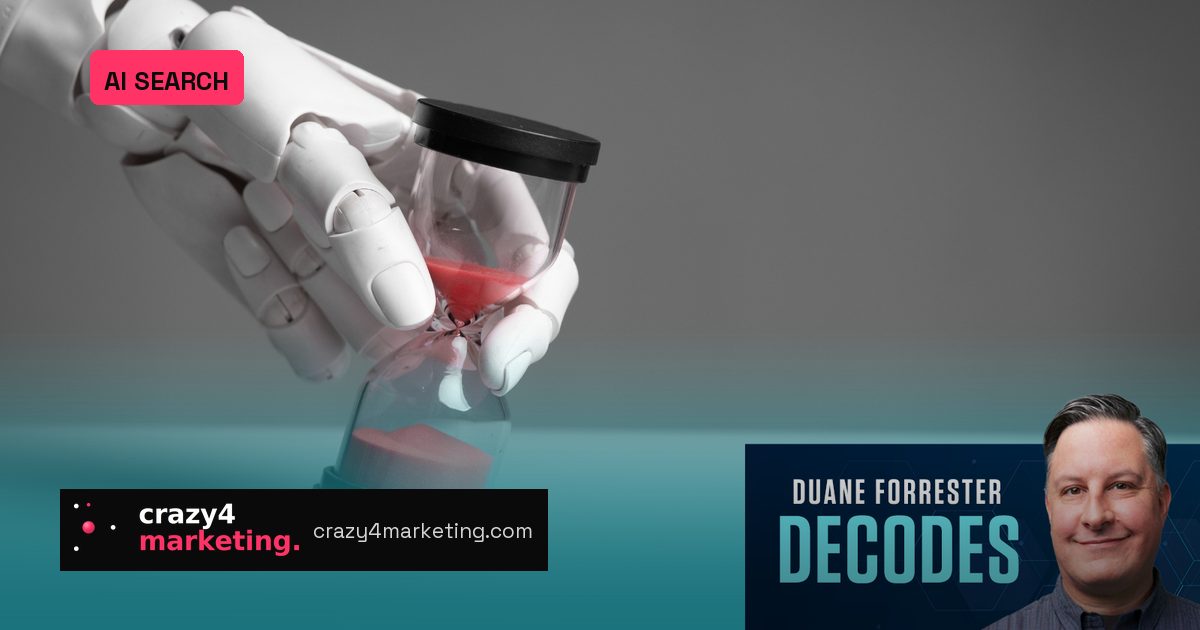
Ask an LLM a question and it compresses a trip that once took days into seconds. Same starting point, same decision, almost no travel. Duane Forrester’s recent piece calls the model a time machine—and warns that the missing journey was doing quiet work marketers never had to build on purpose.
The journey used to carry the data
Research was never only about the answer. Thin sources, contradictions, dead ends and the time a search took all signaled how much confidence the answer deserved. The source article calls this “path metadata”: a byproduct of the journey, not a feature. Search engines compressed the trip but kept much of that metadata visible. AI answers strip it out.
An answer arrives in confident prose whether the evidence behind it is deep or nearly absent. That is not a new uncertainty—it is the old uncertainty with the evaluation signals removed.
The research caught up
Several studies now point the same direction:
- Wharton, October 2025: Seven experiments with 10,462 people found AI summaries left users knowing less than Google links, even with identical facts, and their advice was sparser and less likely to be adopted.
- Pew Research Center, March 2025: Across 68,879 Google searches, people clicked a normal result on 8% of visits when an AI summary appeared versus 15% without one, and clicked cited sources roughly 1% of the time.
- Yale, 2015: Searching the internet inflated how much people believed they knew, even after empty searches.
- Microsoft Research and Carnegie Mellon, 2025: Knowledge workers with higher confidence in AI showed less critical thinking, though the survey was self-reported.
Not all studies are causal. Pew calls its finding an association. But the Wharton controlled experiments and real-world tracking converge in the same place: AI answers change what people learn and what they do next.
Why this hits marketers
Under the old model, someone who read a bad summary could click through, land on your page and swap the wrong version for yours. That correction was free and automatic. At roughly 1% source-click rates, it no longer fires.
That changes what an AI citation is worth. As Forrester puts it, “Citation is presence, not traffic.” If one visit in a hundred produces a click, measuring AI referrals as a traffic channel is wrong. The value is being inside the answer a person acts on.
Your inbound lead is not uninformed—they are confidently underinformed. They arrive with the confidence of someone who finished the research and the depth of someone who read one paragraph. A decade of content strategy assumed a staircase: beginner explainers first, comparisons in the middle, proprietary depth last. AI now runs the top of that staircase before anyone reaches your site.
What to change
Do not delete the 101 material. Models still read it, and being absent from what they read is worse than being absorbed. Change the placement. The content only you can produce—customer evidence, unique frameworks, operational detail—has to work as the front door now, not the bottom layer.
Measure the AI answer itself, not just the referral trickle. Track whether your brand appears in the synthesis a buyer acts on, then build the assets most likely to be absorbed and cited.
The mirror
Marketers are also users. If your competitive analysis or strategy deck came from a model synthesis, it may be the sparser, less original output described in the research—and you may be more certain than the process earned. The time machine works. What it does not tell you is how far you traveled or what you skipped.
Source: Search Engine Journal


