
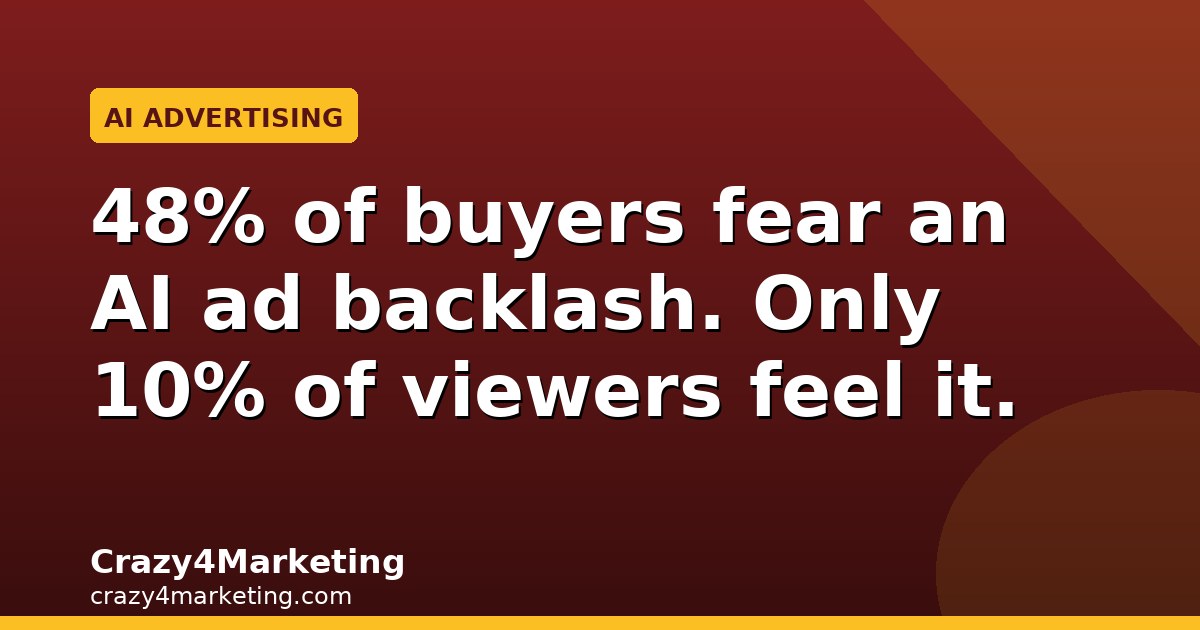
Here’s a stat worth pinning above your desk: 48% of TV media buyers think viewers find AI-generated creative off-putting. When researchers asked actual viewers, just 10% said they disliked the AI ads they had seen.
That’s a 38-point gap between industry fear and audience reality — and it’s coming from FreeWheel, the Comcast-owned ad tech unit, in a new report titled “AI in TV Advertising: The Buyer, Seller, and Viewer Perspectives,” published 5 September 2026.
What the research actually measured
FreeWheel stitched together three surveys. AdExchanger fielded a study of 226 media buyers and 50 media sellers in April 2026. Dynata surveyed 2,496 US adults the same month. An earlier AdExchanger survey of 216 marketers and agencies ran in November 2025.
Sellers were slightly less pessimistic than buyers — 39% assumed viewers were put off by AI creative — but still overshot viewer sentiment by 29 points. Notably, neither side underestimated viewer tolerance. The error runs in one direction only.
Why the gap matters to your media plan
If your team is slowing down AI-assisted creative production because you’re worried about backlash, you may be optimising against a phantom. That caution has a real cost: fewer variants shipped, slower testing cycles, higher production spend per asset.
The evidence isn’t one-sided, though, and it’s worth being honest about that. NielsenIQ research presented at CES 2025 found consumers process AI-made ads differently at a neurological level, describing them as annoying and confusing. A Raptive survey of 3,000 US adults found suspected AI content cut reader trust by nearly half and knocked 14% off purchase consideration. IAB data shows a generational split: 39% negative sentiment among Gen Z versus 20% for Millennials.
The reconciling insight comes from a Taboola field study with researchers from Columbia, Harvard, TU Munich and Carnegie Mellon across 500 million impressions: AI creative matched human creative performance when audiences couldn’t tell it was machine-made. Perceived artificiality is the problem. Origin isn’t.
What viewers actually want AI to do
The viewer data is the most actionable part of the report. Openness was overwhelming when AI improves the ad experience:
- 89% open to AI reducing ad repetition within an episode
- 89% open to AI timing ads to minimise disruption
- 76% open to AI-created personalised advertising
Translation: audiences aren’t anti-AI. They’re anti-annoying. Use automation to fix frequency and placement first, and you’re pushing on an open door.
Buyers want an assistant, not an autopilot
On the agentic side, buyers drew a hard line. 68% rated monitoring campaign performance a high priority for AI tools — the top use case. Then 53% wanted AI matching deals to relevant inventory, 48% tracking top-performing SSPs and publishers, 47% drafting RFPs, 47% setting up campaigns, 46% monitoring spend against commitments.
Negotiating directly with publishers came last at 19%. Only 22% were strongly open to AI running campaigns without human oversight, and just 13% saw AI as a near-term job threat.
Sellers had different priorities: 60% named inventory allocation, 55% automated inventory classification, 53% AI-assisted pricing. Only 26% saw agentic selling as the biggest near-term impact area. Buyers and sellers are automating opposite ends of the same transaction.
Attribution is the shared bottleneck
Both sides landed on the same unresolved problem. 47% of buyers said proving ROI is the biggest barrier to more CTV spend. 69% of sellers said advanced attribution and incrementality measurement is the AI capability they most need to compete.
That tracks with the wider record: IAB’s State of Data 2026 found up to 75% of buy-side decision-makers rate attribution, incrementality tests and MMMs as underperforming. AppsFlyer found 58.6% of marketers think their organisation underinvests in channels it can’t measure, with CTV among the worst blind spots at 47.1%.
Three moves for this quarter
One: stop treating AI creative as a brand risk by default — test it, measure it, and let the numbers rule, especially with older cohorts where sentiment resistance is lower.
Two: prioritise polish. If the tell is visible, performance suffers. Invest in finishing, not in hiding the tech.
Three: point your automation budget at monitoring and measurement before negotiation. That’s where buyers, sellers and the data all agree the value sits.
Source: PPC Land