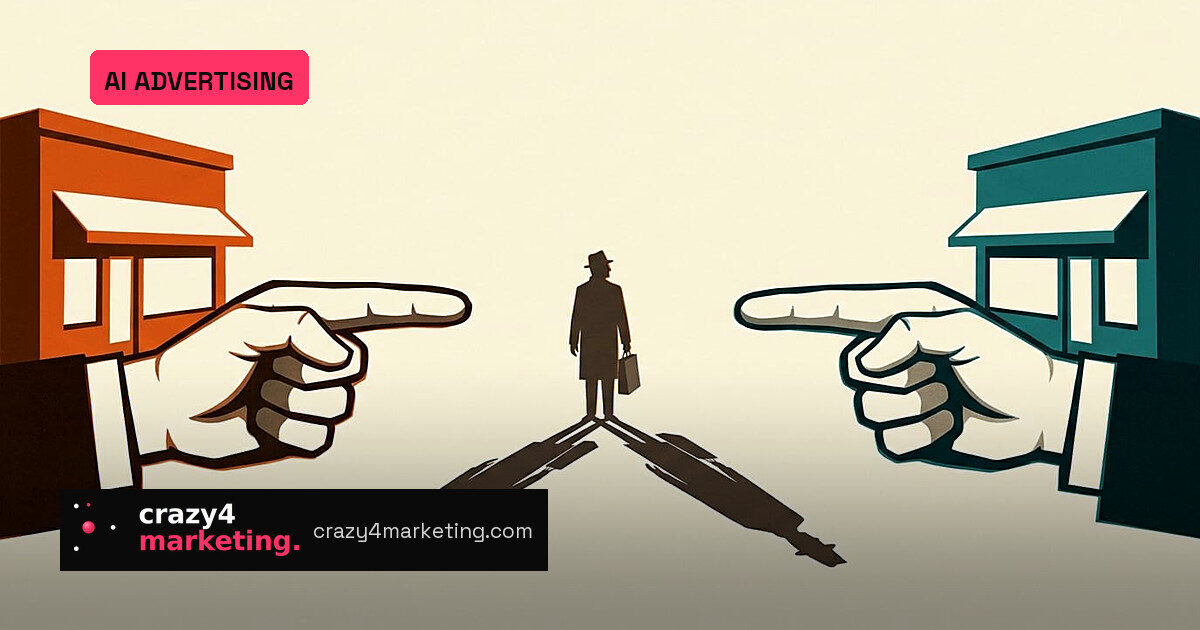
Bluefish says Google and ChatGPT put a different brand first in 35% of 5,810 buying topics. On October 27, the New York company moved that insight from organic AI monitoring into paid advertising with a new product: Paid Media Briefs.
What Bluefish launched
Bluefish calls its platform the Agentic Marketing Platform, or AMP, and sells it to very large companies. Until now the suite focused on Answer Engine Optimization: tracking how often, and in what terms, brands appear in unpaid AI answers. The expansion carries its four pillars—AI Monitoring, AI Optimization, AI Orchestration and AI Measurement—into paid media.
Paid Media Briefs, sold as an extension of the Bluefish Optimization Suite, is the first piece. It gives media teams ready-made recommendations on ad targeting, creative and landing pages for Google and ChatGPT. The company’s argument is that an ad’s effect changes with the recommendations already inside the generative answer.
Bluefish CEO Alex Sherman said, “The agentic funnel doesn’t distinguish between organic and paid marketing, and neither should the platforms marketers use to manage it.”
What is actually in a brief
Each brief covers one ad group on one AI channel. It explains why a visibility gap exists, compares how AI responses describe the brand and its competitors, and supplies search themes, keywords, headlines, descriptions, contextual guidance and landing page suggestions.
For Google, briefs cover AI Overviews and AI Mode through Search with AI Max and Performance Max. They offer up to 50 search themes, up to 15 short headlines under 30 characters and up to four descriptions under 90 characters. For ChatGPT, a brief provides up to 50 context hints, ad titles of up to 50 characters, descriptions and landing page ideas.
Why the 35% figure matters
The headline number means roughly one in three shopping questions gets a different leading brand depending on whether the answer comes from Google or ChatGPT. By PPC Land’s calculation, that is about 2,030 of the 5,810 topics; in roughly 3,780 topics the platforms agree on the leader.
That is a practical problem for paid search teams. An ad placed next to an AI answer sits inside a generated editorial context. If ChatGPT recommends a competitor while Google recommends you, the same creative may be poorly aligned on one surface.
- Bluefish has not named the three categories in the study.
- It has not said which Google product was queried or when.
- There is no definition of what it means for a brand to “lead” an answer.
- No pricing, performance data or client results have been published.
That missing detail does not make the launch irrelevant, but buyers should treat the 35% figure as directional rather than a benchmark.
Control still sits with Google and OpenAI
Bluefish produces recommendations; it does not buy media. Google’s AI Max and Performance Max automation decides how much of the keywords and themes survive. OpenAI’s creative enhancements, switched on by default at the end of October, can rewrite headlines, descriptions and destination URLs unless advertisers opt out.
Independent tests have also questioned AI Max performance. Smarter Ecommerce found roughly 35% lower return on ad spend than traditional targeting across more than 250 retail campaigns, and a separate four-month test put AI Max at $100.37 per conversion against $43.97 for phrase match.
What marketers should do about it
Treat AI ad placements as context-dependent rather than one uniform search auction. Before uploading paid briefs or context hints, check what Google and ChatGPT already say about your brand and your closest competitor for the same buying topic. When the platforms disagree, split your creative by platform instead of running one generic message.
Also audit the default settings. OpenAI’s creative enhancements are opt-out, and Google’s automated campaign types apply their own matching. A carefully written brief can be rewritten before it ever runs.
Bluefish says Google and ChatGPT are only the starting point; it plans to extend into sponsored publisher content, creator partnerships, user-generated content and retail media, though no dates are given.
Source: PPC Land