
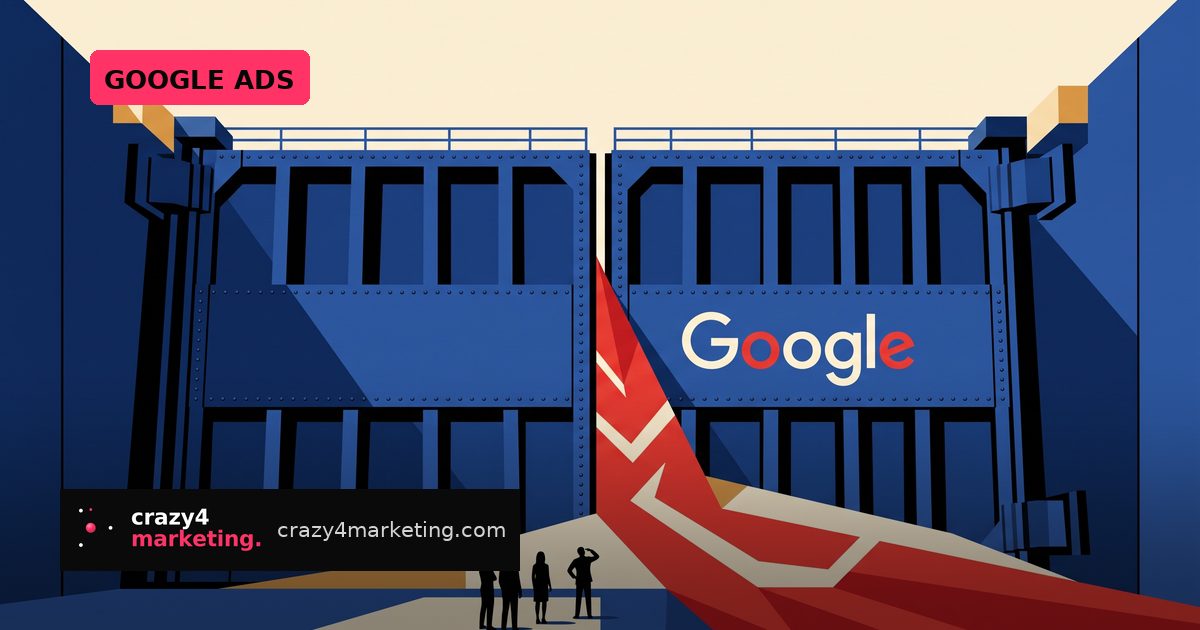
The last fence advertisers had around Google’s AI surfaces just got a gate in it.
Google has started serving text ads from standard Search campaigns built on exact and phrase match keywords inside AI Mode, according to reporting from PPC Land. Ads Liaison Ginny Marvin confirmed the behaviour on September 4, 2026, calling it “a small experiment that recently kicked off” and limiting it to queries with what she described as explicit and direct user intent.
Until now, showing up in Google’s AI answer surfaces meant opting into automation: broad match with smart bidding, AI Max for Search, Performance Max, Shopping or Dynamic Search Ads. That rule no longer holds without exception.
How it surfaced
There was no product announcement. Anthony Higman, founder and CEO of ADSQUIRE, posted on LinkedIn on September 3 that regular Search campaigns with restrictive match types were serving in AI Mode, saying he had verified it across multiple campaigns. Barry Schwartz of Search Engine Roundtable published Google’s confirmation the next afternoon.
Marvin added the mechanics in a LinkedIn comment: exact and phrase match keywords are eligible for text ads in AI Mode, but only where intent is explicit and direct. AI Max and PMax for Search keep exclusive access to the newer conversational formats, including Highlighted Answers.
So eligibility expands. The format set does not.
Why exact match matters here
Square brackets have been the industry’s main spend-control mechanism for twenty years. That control has been thinning for a while, and it is measurable.
Smarter Ecommerce analyst Mike Ryan published an analysis of 383 million impressions across EMEA ecommerce Search campaigns in late July 2026 showing that only around 71 percent of exact match impressions were genuinely exact, down from at or near 100 percent through the first half of 2025. Documentation from November 2025 had already shown a single exact match keyword triggering ads on thirteen queries that never contained its defining term.
Add AI Mode delivery on top, and one exact match keyword row in your account may now be blending three different things:
- Literal matches to the keyword
- Close variants Google inferred
- AI Mode impressions on the same row
Nothing in Google Ads reporting currently separates them. Similarweb made the same point in August: a buyer running Search, Shopping or PMax can serve inside an AI answer with no line in any report telling them so. The May 17, 2026 shift to showing AI-interpreted intent in the search terms report instead of typed strings made the picture blurrier still.
The scale you are opting into by default
AI Mode is not a side experiment. Google brought shopping ads to it on February 11, 2026 at more than 75 million daily active users, and said at Google I/O 2026 that monthly users had passed 1 billion, with queries roughly doubling every quarter and searches averaging three times the length of traditional ones.
Similarweb data from August 2026 put nearly 30 percent of ad-eligible AI Mode queries as already carrying ads, alongside 26 percent of ChatGPT responses. Adthena, using a different basis, reported US AI Mode ad frequency at 5.8 percent. Methodologies differ. Direction does not.
The timing is the story
The test landed three days after Google began converting campaigns using automatically created assets or campaign-level broad match into AI Max for Search on September 1, 2026. So two things are happening at once: legacy automation settings are being folded into AI Max, while the surface AI Max was sold to unlock is opening to campaigns that never adopted it.
That matters because independent measurement of AI Max has been rough. Smarter Ecommerce found roughly 35 percent lower ROAS across 250-plus retail campaigns in November 2025. Lunio reported 72 percent more invalid traffic in retail search in August 2026. Google itself revised its headline claim from 14 percent more conversions at beta to an average of 7 percent at general availability in April 2026.
What to do this week
Three practical moves while the test runs:
- Baseline now. Snapshot CTR, CPC and CVR by match type before any AI Mode volume muddies the trend line.
- Watch for anomalies. Sudden impression lifts on tightly controlled exact match rows with softer conversion rates are your only available signal.
- Tighten negatives, but expect leakage. As SearchSavior’s Michael Hulsmann has noted, matching keeps loosening while negative keyword rules stay literal.
Microsoft, worth noting, went the other way: on December 18, 2025 it confirmed exact match keywords hold absolute auction priority over other campaign types, a guarantee Google has no equivalent for.
Google named no geography, vertical, account share or duration for the test, and the intent condition lives in a LinkedIn comment rather than help docs. Plan for it to stick anyway.
Source: PPC Land